
8 field cases · 2012–2026
Extrusion case studies: what actually went wrong, and what fixed it
Eight lines in eight countries, written from the commissioning record rather than the sales file: a filler masterbatch extruder chasing output with screw speed in Dubai, a two stage single screw extruder that never ran in Japan, PET flake held at 0.6–0.79 dL/g in Cambodia, and a first-build TPE underwater pelletizing line in Korea. Each page carries the readings, the changes and the settings that a reader running the same material can use. A reference extrusion case studies page from Kerke.
These extrusion case studies are not testimonials. Every one of them starts with a line that was making bad product, and the useful part of the page is the middle: the reading that sat outside its window, the setting that had been copied from another material, the assumption that cost a week. Read the one closest to your own material, then compare the numbers with your panel before you change anything.
Filler masterbatch — Dubai
A PE filler masterbatch producer in Dubai ran a KTE-75B at 560 rpm to chase output and got yellowed, porous pellets instead. The filler masterbatch ex…
Waste material recycling — Japan
The customer had run similar equipment for years, so they declined installation on their new SE-140 / SE-140 two stage single screw extruder. It never…
PET bottle flake — Cambodia
A bottle-flake recycler in Cambodia bought a KTE-75B after running their own flake on it in Nanjing. The PET flake pelletizing line now returns pellet…
Graphite, ABS/HIPS, pencil — Germany
A German compounder bought five machines at once — KTE-20, KTE-36B, KTE-50B, KTE-65B and an SE-30 — for graphite compounds, ABS and HIPS granules and …
PE film recycling — Kuwait
A Kuwaiti recycler bought one KTE-75B for PE film, then reported the cooling pipe as a quality defect — twice, with a free replacement sent the first …
PE filler masterbatch — Pakistan
The customer ordered a KTE-52B for PE filler masterbatch without ever visiting Nanjing. What made that safe was not trust — it was weekly progress pho…
PA + short glass fibre — Mexico
A compounder in Mexico bought a KTE-75D for PA with short glass fibre. The container arrived with damage; photographs went over the same day and the r…
TPE elastomer — Korea
Underwater pelletizing lines are expensive, and this one was our first build of its size. It ran on the first production campaign, paid for itself in …
All eight extrusion case studies at a glance
| Country | Material | Line | Figure | What it measures |
|---|---|---|---|---|
| Dubai, UAE | Filler masterbatch | KTE-75B | 3 days | engineer on site |
| Japan | Waste material recycling | SE-140 / SE-140 | 1 week | on site |
| Cambodia | PET bottle flake | KTE-75B | 0.6–0.79 | dL/g pellet IV |
| Germany | Graphite, ABS/HIPS, pencil | KTE-65B | 5 | lines commissioned |
| Kuwait | PE film recycling | KTE-75B | 3 | lines now running |
| Pakistan | PE filler masterbatch | KTE-52B | 1 year | no breakdown |
| Mexico | PA + short glass fibre | KTE-75D | 2 days | damage to dispatch |
| Korea | TPE elastomer | KTE-85B | 3 months | payback reported |
How to read an extrusion case studies page
Each page follows the same four sections, so they can be compared with each other and with your own record. Situation sets out the line, the material and the symptom in the customer's words. Readings is the panel and hand data taken on site — this is the part worth copying into your own log. Changes lists what was altered and in what order, because the order matters when two settings interact. Result gives the outcome and the customer's own assessment, including the cases where the fault was on the customer's side of the battery limits.
Three things every one of these cases has in common
The machine was rarely the defect. In seven of the eight, the fix was settings, water, feeding or training. The first diagnosis was wrong. Every customer arrived with a theory — undersized machine, bad part, bad supplier — and every theory was testable with a gauge. The fix was cheap once it was found. No case on this page ends with a new extruder.
FAQ
How are the outputs in the cases measured?
Each case states the material and the sampling method - typically weighed 60-second samples at stable settings, so the kg/h figures are reproducible, not peak readings.
Can I contact the reference customer directly?
Case by case, yes. The faster route is a video call with the running line first; ask and we arrange it with the plant.
My material is not in the case list - what now?
Send 25-50 kg for a trial. The case library covers the common families; the trial answers for yours in 3-7 days with pellets and a measured output report.
Send 25–50 kg and we run it on our lab extruder: pellets, running video and a capacity report back in 3–7 days.
Extrusion case studies — the short version
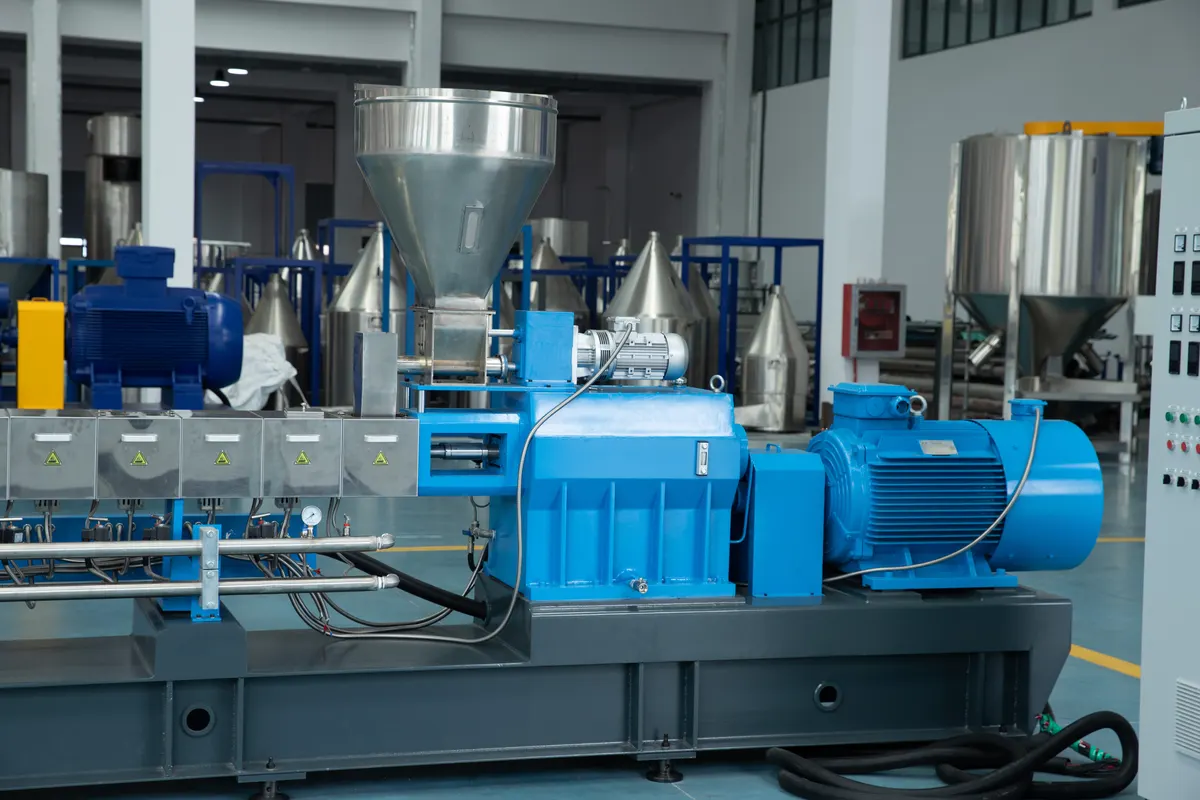
Note on extrusion case studies: each record below is written the same way — what the line was doing, what the readings showed, what was changed, and what a reader running the same material should check before ordering. Start with the material closest to yours.
Related on this site: Machine range: KTE-50B to 135D · Pelletizing methods compared · quotation and free trial · Wikipedia: Masterbatch