
Machine · Kneader compounding extruder
Kneader Compounding Extruder (KNE-400 / 800 / 1200)
A kneader compounding extruder does in one unit what a twin screw needs two stages for: the kneading section wets out and disperses the filler, and the single screw on its discharge only builds pressure. The line for CaCO3 above 85%, carbon black above 40% and heat-sensitive carriers.
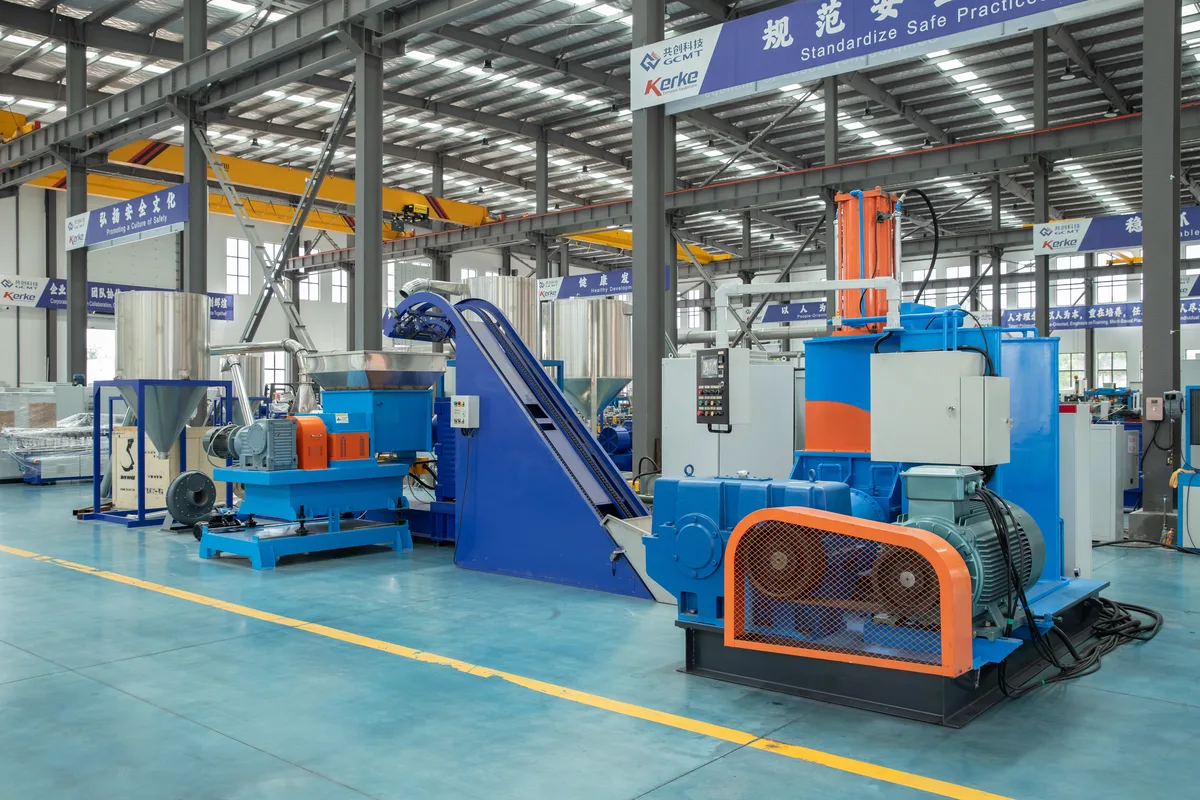 Kneader compounding extruder — workshop photo 1, Kerke workshop, Nanjing
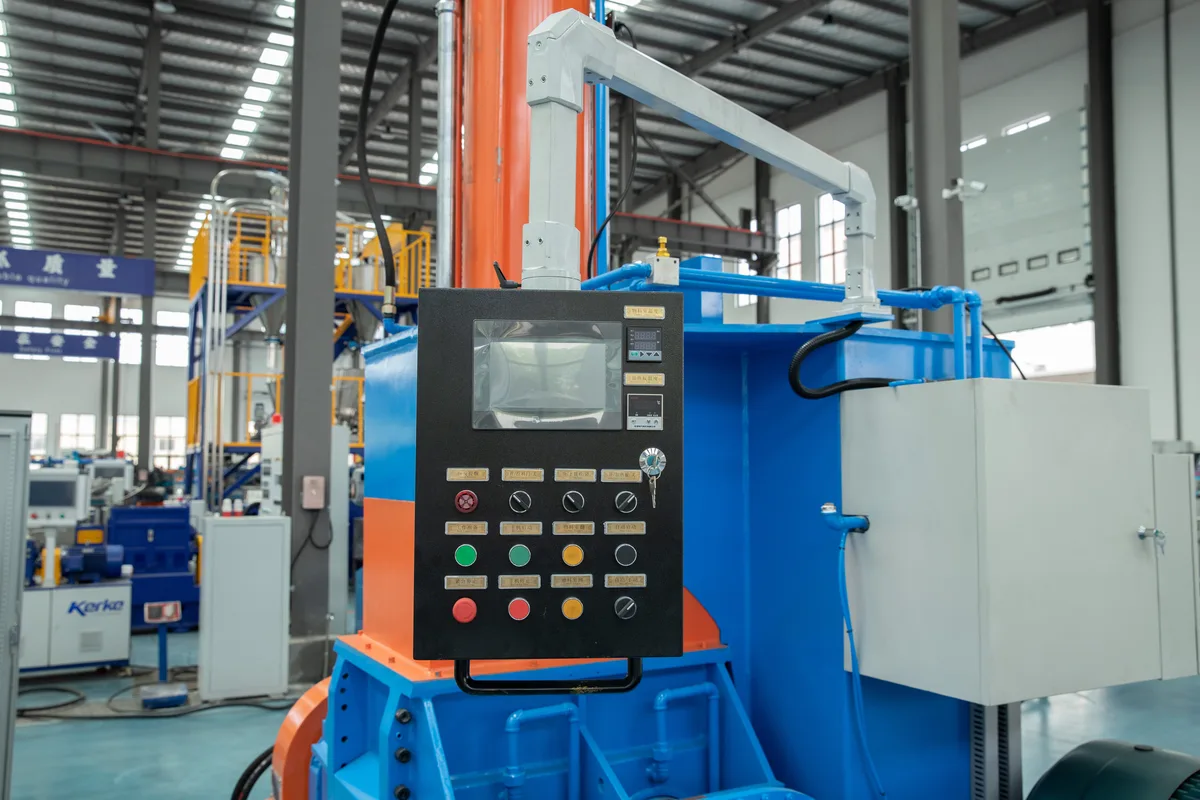 Kneader compounding extruder — workshop photo 2, Kerke workshop, Nanjing
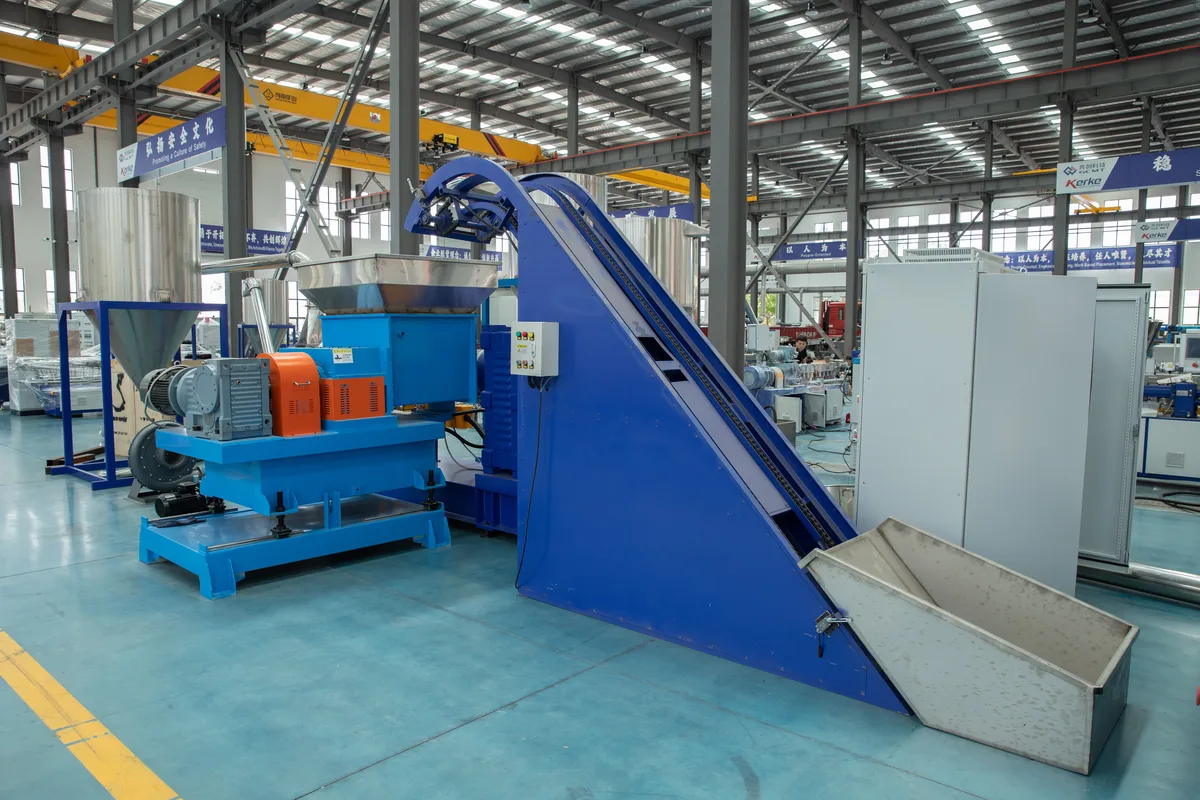 Kneader compounding extruder — workshop photo 3, Kerke workshop, Nanjing
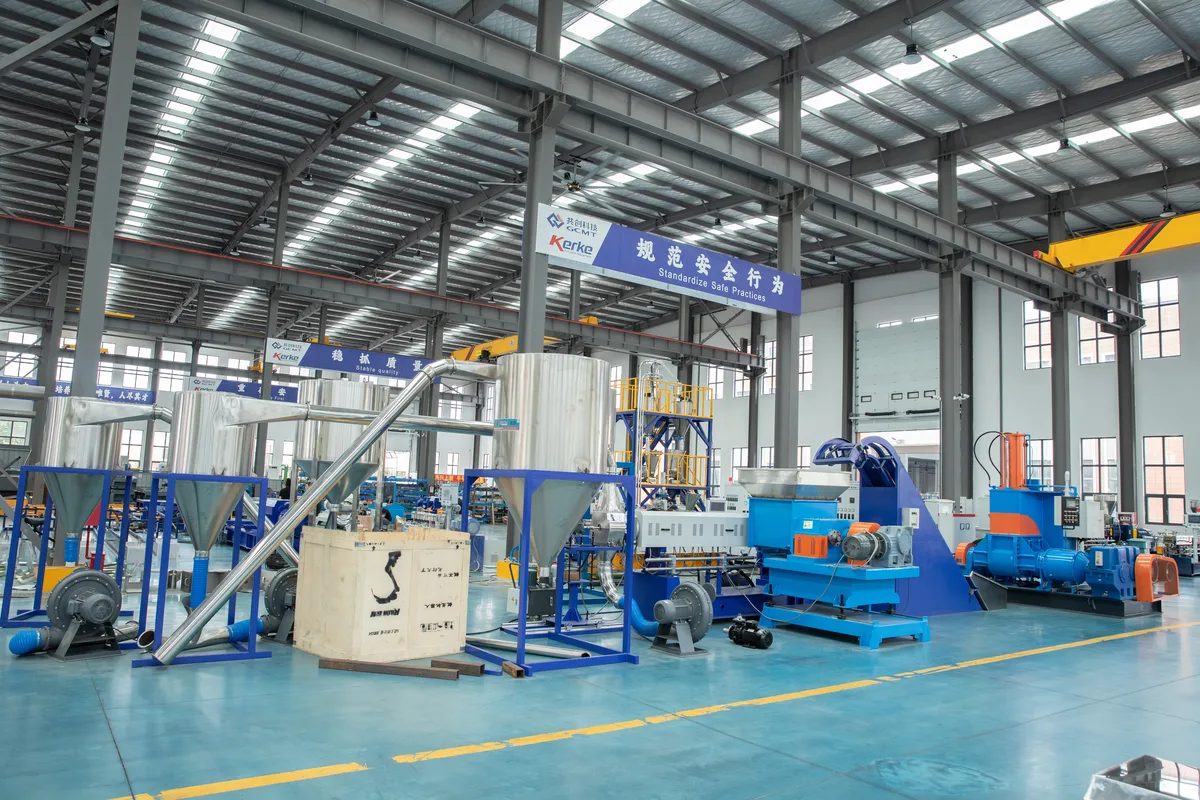 Kneader compounding extruder — workshop photo 4, Kerke workshop, Nanjing
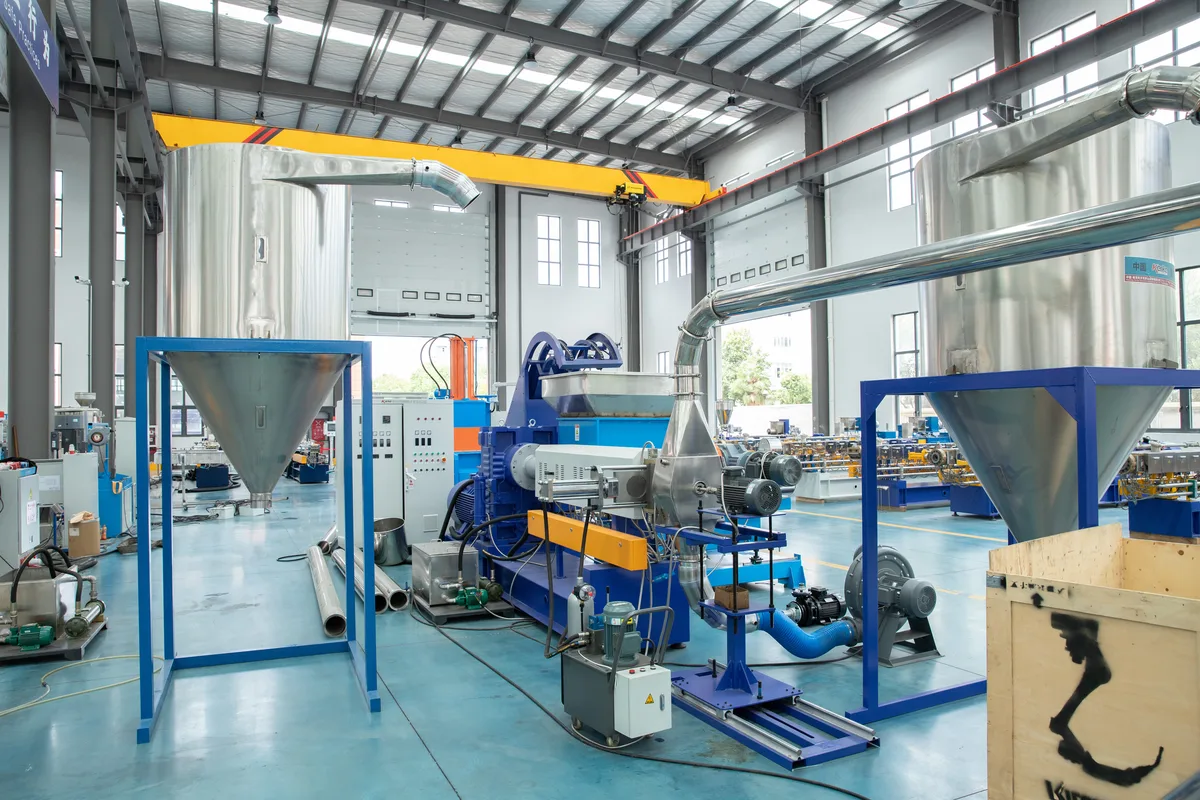 Kneader compounding extruder — workshop photo 5, Kerke workshop, Nanjing
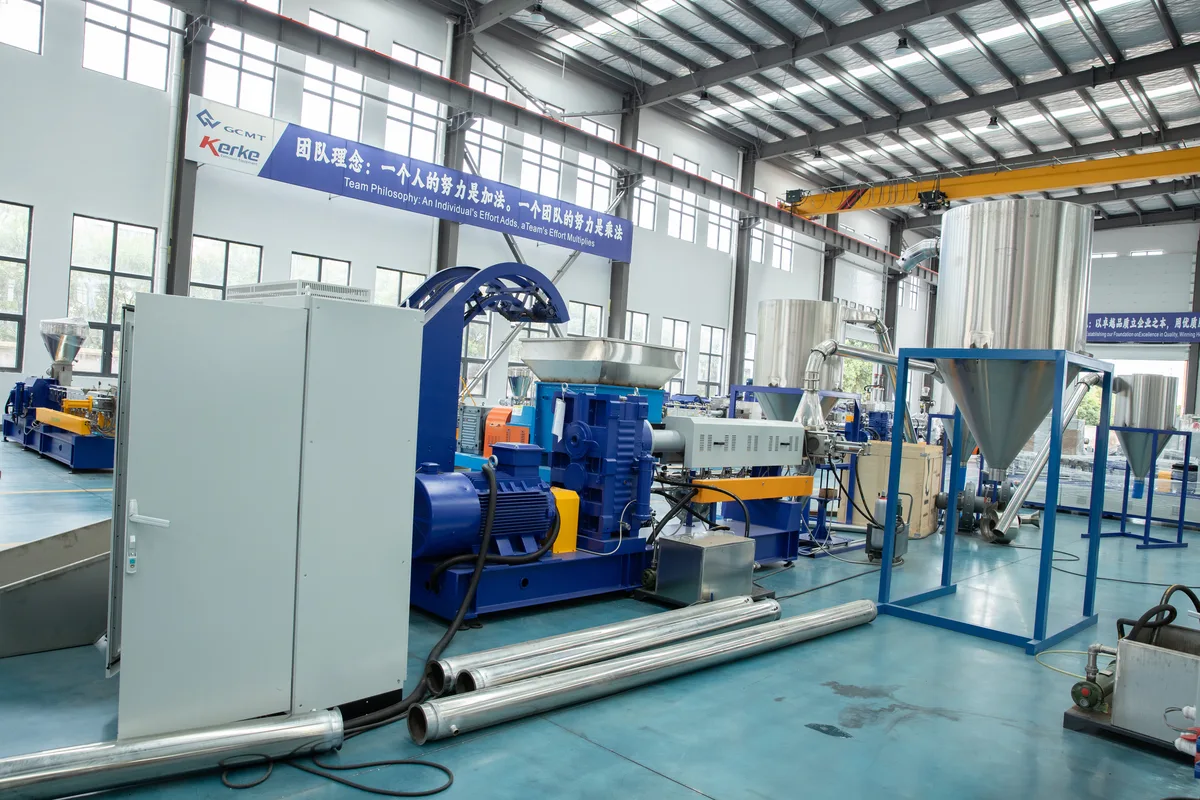 Kneader compounding extruder — workshop photo 6, Kerke workshop, Nanjing
Quick answer
A kneader compounding extruder is one continuous line in two duties: a self-cleaning kneader reactor wets out and disperses the filler, and the single screw bolted to its discharge does nothing but build die pressure. Built for CaCO3 filler masterbatch above 85%, carbon black above 40%, high-density colour masterbatch and TPU/TPE/TPO/TPR — 100–1,200 kg/h.
Workshop photos and a running video — shot on our own lines, not stock images.
Parameter table
| Line | Output (kg/h) | Discharge screw | Pelletizing | Typical product |
|---|---|---|---|---|
| KNE-400 | 100–400 | SE-120 / SE-150 | Water ring hot-face | High filler masterbatch, CaCO3 > 85% |
| KNE-800 | 400–800 | SE-180 | Water ring or strand | TPU · TPE · TPO · TPR, high-density colour masterbatch |
| KNE-1200 | 800–1,200 | SE-200 | Underwater or air-cooling die face | Carbon black masterbatch > 40%, tonnage |
Reference output measured on the stated material family; subject to a material trial. Motor and torque values are per machine, not per screw shaft.
One machine, two duties, and neither is a twin screw. The kneading section is a self-cleaning kneader reactor: it wets out and disperses the filler at very high loading, in plug flow, with a heat-exchange surface large enough to take heat out as fast as the rotors put it in. The second duty — building die pressure — is done by a single screw bolted to the discharge, at low speed, adding no mixing at all. Line sizes are quoted by output band (KNE-400, KNE-800, KNE-1200) because the kneader is configured to your material rather than picked from a fixed catalogue.
Why this line holds 85–90% filler
Filler masterbatch fails in two directions at once. Shear dispersion of 1,250-mesh CaCO3 or talc generates heat, and the carrier degrades; the more filler the melt carries, the harder it is to push through a die. A kneader resolves the first by mixing without intense shear, and the discharge screw resolves the second by pressurising without mixing. That division is what makes 88–90% repeatable rather than a trial result.
Residence time, not screw speed
Material moves through the kneading section in a narrow residence-time band — close to plug flow — so every particle sees a similar heat and shear history. Output therefore follows how much filler the kneading section can wet out per hour, and the discharge screw is sized from that figure. Two lines with the same installed power can differ by 40% in output for this reason alone, which is why we ask for the formulation before quoting a motor size.
When a kneader line beats a two-stage twin screw
- CaCO3, talc or mixed mineral filler above 85%, where a twin screw's dispersive shear heat turns the carrier yellow.
- Carbon black masterbatch above 40% — the other classic kneader duty, on the same line with a different rotor and die set.
- High-density colour masterbatch and TPU/TPE/TPO/TPR where a visible wet-out stage decides dispersion quality.
Cutting, chosen by filler level
Water-ring hot-face is the default from about 80% upward: short water contact, no separate drying step. Air-cooling die face takes over where the compound cannot meet water at all — water-sensitive carriers and PVC-type formulations. Underwater cutting is kept for TPU, EVA and elastomer grades where pellet shape is sold, and strand cutting for products where the customer checks pellet geometry rather than bulk density.
What this machine is normally bought for
High Filler Masterbatch Line
Above 85% the melt stops behaving like a polymer: it will not take shear heat, and one machine cannot both wet out the…
Black Masterbatch Extruder Line
Carbon black at 40% costs 20–25% of the output of a general colour masterbatch on the same machine — dispersion eats t…
Color Masterbatch Extruder Line
Colour masterbatch is a dispersion business with a cleaning problem attached: the same line has to make 20% pigment di…
TPE / TPU / TPR Elastomer Line
Elastomer compounding is dominated by oil: SEBS takes 100–300 phr, and injecting it all at once makes the screw slip i…
FAQ
Kneader compounding extruder or two-stage twin screw?
Up to about 85% filler the two-stage twin screw is cheaper per kg/h and simpler to run. Above it, or when the carrier cannot take dispersive shear heat, the kneader wins — it wets out the mineral without the heat that yellows masterbatch.
Why is there a single screw on the kneader discharge?
Because building die pressure inside the kneading section would add exactly the shear the kneader was chosen to avoid. The screw pressurises at low speed and adds no mixing, so the heat history stays short.
Which cutting system for 88% filler?
Water-ring hot-face to about 85%: short water contact and no separate drying step. Above that, air-cooling die face, because the strand embrittles and snaps in a water bath.
Where these numbers come from
Screw diameters, speeds, motor ratings, torque and reference output come from the Kerke parameter table and the product master data sheet, and are cross-checked against commissioning records. Where a catalogue value and a trial value disagree, the trial value is the one we quote.
Reviewed by the Kerke process team, Nanjing. Page updated 6 November 2026.
Send 25–50 kg — we return pellets, a video and a report with the parameters we used, in 3–7 days.
Kneader compounding extruder — the short version
Note on kneader compounding extruder: what separates one machine from another is torque class, L/D and the wear package matched to your material, not the build standard. Shortlist from the tables, then confirm the choice on a trial with your own powder.
Related on this site: Extrusion lines by application · Extruder selection guide · free extrusion line quotation · Wikipedia: Twin-screw extruder