
Process · 8 min read
Seven Pelletizing Methods Compared: Strand, Water Ring, Underwater, Hot Face
The pelletizer is chosen by the polymer, not by the budget. This table compares all seven methods we build on the criteria that actually decide the purchase: filler ceiling, water contact, pellet shape and fines. A reference pelletizing methods compared page from Kerke.
A pelletizing mistake shows up months later as dust in the customer's bag, moisture in their dryer or tails in their mould. Choose by polymer first, filler level second, pellet shape third.
The comparison
| Method | Filler ceiling | Water contact | Pellet shape | Best for |
|---|---|---|---|---|
| Water-cooled strand | ≤ 50% | Full immersion | Uniform cylinder | PET, PA, engineering plastics, low-filled masterbatch |
| Air-cooled strand | ≤ 60% | None | Uniform cylinder | PVC, biodegradable, materials that must stay dry |
| Water strand (special for PET) | — | Full immersion | Cylinder, low dust | PET bottle flake and sheet grade, IV-critical |
| Water ring hot face | 70–85% | Spray + ring | Lens / half-round | Filler masterbatch, carbon black |
| Air-cooled hot face | 85–90% | None | Irregular, low bulk density | PVC, HFFR, WPC, high filler |
| Underwater | ≤ 70% | Full chamber | Round, dense | TPE/TPU, EPP beads, hot melt |
| Spray / mist | ≤ 60% | Light | Round | Sticky or low-melting products |
Why water contact is the deciding column
Water is a cooling medium and a contaminant at the same time. For PET, moisture hydrolyses the chain and destroys IV. For PVC, water plus residual heat means hydrolysis of the stabiliser system and corrosion in the bag. For PLA, water at 60 °C starts the same hydrolysis the product is designed for in a compost heap.
So the sequence of questions is: does the polymer tolerate water (PET tolerates it if dried afterwards; PVC does not) → does the filler level allow a strand (above 50% the strand embrittles) → does the application need a specific pellet shape (bead products need round, dense pellets).
What each option costs you downstream
- Strand lines are the cheapest to buy and the most labour-intensive to run: a broken strand stops the line and the operator rethreads it.
- Water ring removes the strand handling problem but adds 8–12% surface moisture, so a centrifuge and a fluid-bed dryer are part of the price.
- Air-cooled hot face needs no dryer at all, which is why PVC lines use it even though the pellet shape is irregular.
- Underwater gives the best pellet quality and the highest cost per kg/h; the water circuit must be temperature-controlled to ±2 °C.
How we choose for a customer
We run the material on the lab line with the pelletizer we think is right, then send pellets plus a note on fines percentage, bulk density and moisture. If the pellet does not feed in your downstream machine, the trial has failed early and cheaply — which is the point of doing it before the order.
FAQ
Water ring or underwater for TPE?
Underwater. TPE and TPU need round, dense pellets and the water chamber holds temperature more evenly than a ring. Water ring gives lens-shaped pellets that bridge in some feeders.
Why does my strand break at 60% filler?
There is not enough polymer left to hold the strand together through the bath. Above roughly 50% move to water ring, above 82% to air-cooled hot face.
Can one line run two pelletizing methods?
Yes, if the die and discharge are designed for it. The pelletizer is a module; the die plate and the water circuit are what need to be swapped.
Where these numbers come from
Values are drawn from the Kerke parameter table, commissioning records and service reports from lines in the field. Temperature windows and consumption figures are typical ranges — confirm on your own material before they become a production setpoint.
Send 25–50 kg and we run it on our lab extruder: pellets, running video and a capacity report back in 3–7 days.
Pelletizing methods compared — the short version
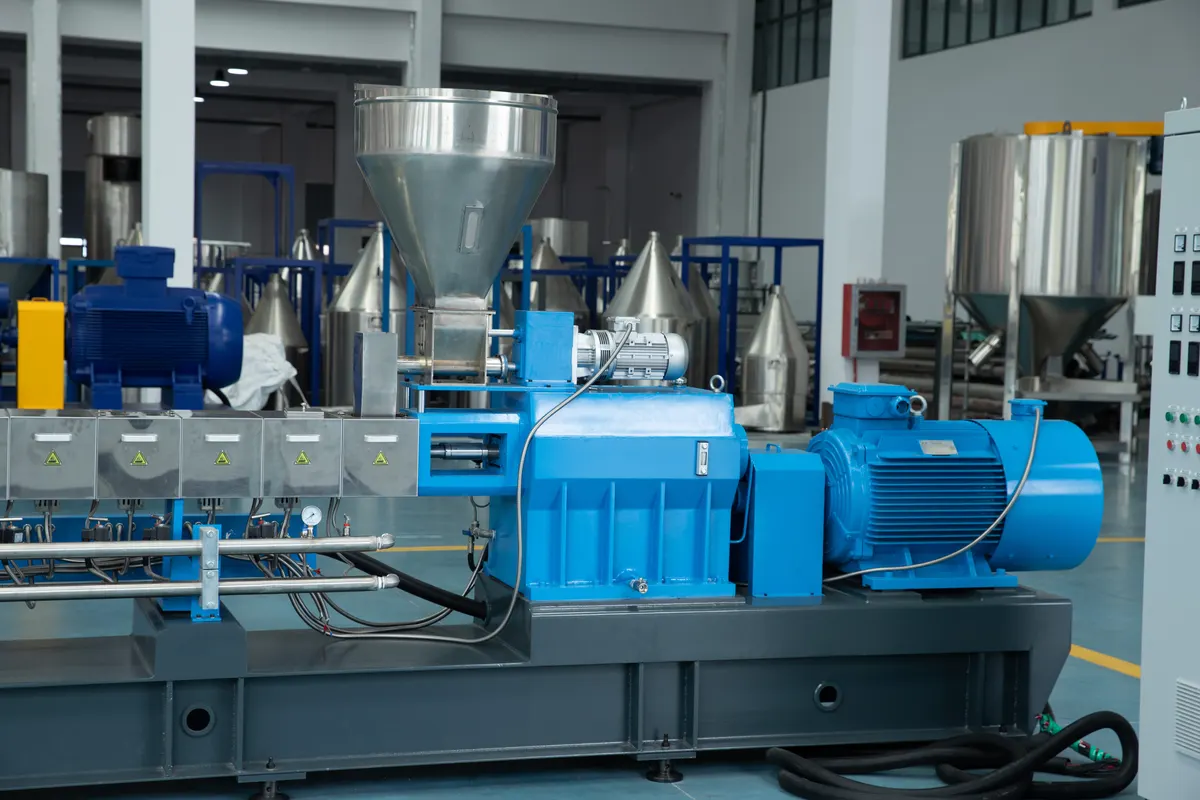
Note on Pelletizing methods compared: every figure on this page is a reference range measured on Kerke's own test line in Nanjing, not a catalogue maximum. If your material differs from the one in the table, send 25–50 kg and we will replace the range with a measured number.
Related on this site: Twin screw extruder range · Extrusion lines by application · free extrusion line quotation · Wikipedia: Pelletizing