Case study 8 · Pakistan · PE filler masterbatch
Small twin screw extruder bought without a factory visit: KTE-52B in Pakistan
The customer ordered a KTE-52B for PE filler masterbatch without ever visiting Nanjing. What made that safe was not trust — it was weekly progress photographs, a factory acceptance video with their own material, and a local agent who did the installation in Urdu. A year later the line had not missed a shift. A reference small twin screw extruder page from Kerke.
Quick answer
A small twin screw extruder is the hardest machine to buy remotely, because the buyer cannot see the workshop that machines the screws. This one was de-risked in three steps: weekly production photographs from order to crating, a factory acceptance run on the customer's own CaCO3 with the video and the parameter sheet sent over, and installation by our agent in Pakistan in the customer's language. Twelve months later the line had run without an unplanned stop.
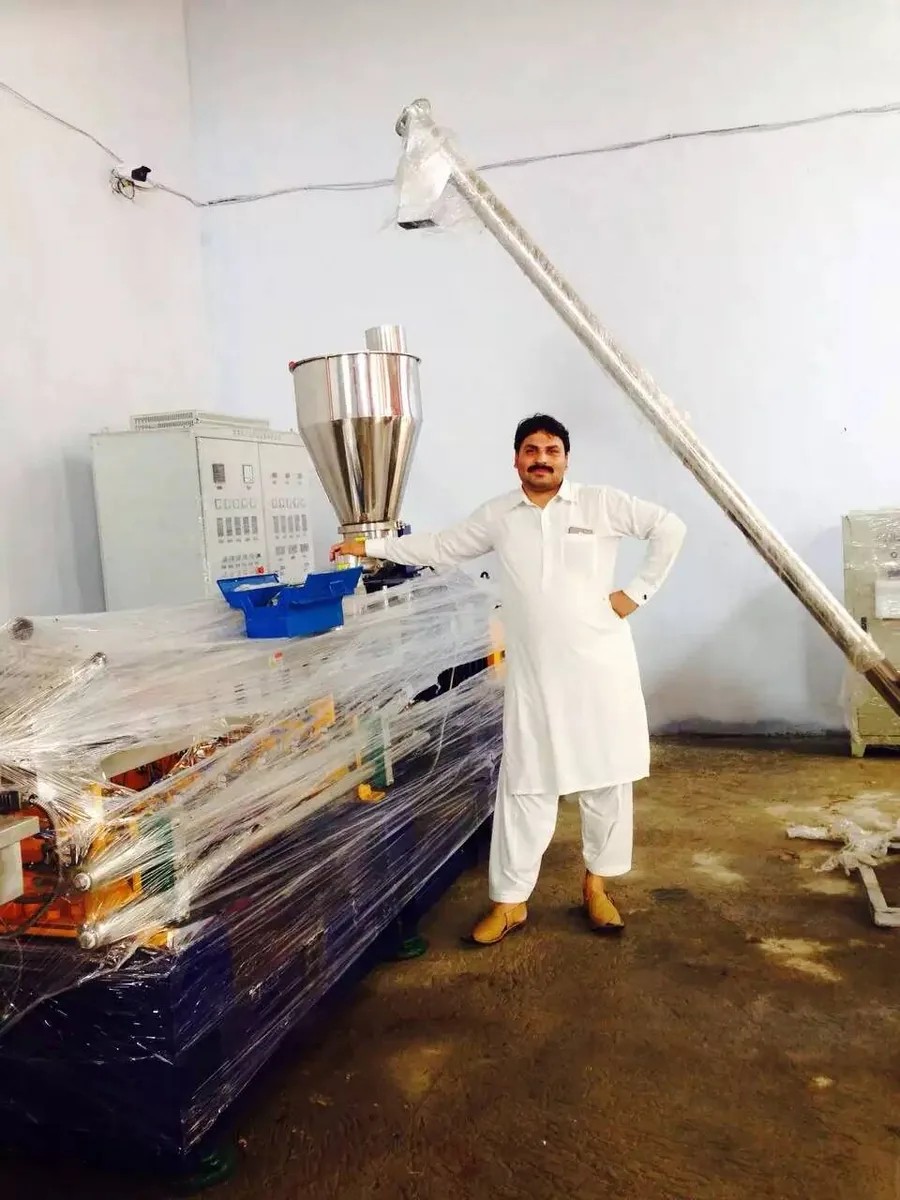
Photograph from the commissioning file for this project; customer names are withheld where requested.
The situation: a first machine, bought at a distance
The customer runs a PE filler masterbatch business in Punjab and needed a second line sized to the local film and injection market: 75–80% CaCO3 in an LLDPE carrier, 100–150 kg/h, water-ring hot-face cutting. A KTE-52B — 51.4 mm screws, 2×720 N·m, 55–75 kW, 80–200 kg/h — sits exactly in that band, and it is the size most first-time buyers should be looking at rather than the 75 mm machine they ask for.
He bought a small twin screw extruder without coming to China first. That is not unusual, and it is not reckless if the order is structured properly. What made this one work was that every stage had a piece of evidence attached to it.
What a remote buyer of a small twin screw extruder actually needs
Four things, in order of how much they reduce the risk of a small twin screw extruder bought unseen:
| Evidence | When | What it proves |
|---|---|---|
| Weekly production photos | From order to crating | The machine exists, is being built in sequence, and the barrel, screw elements and frame are the ones specified. |
| Factory acceptance run on customer material | Before shipment | Output, melt temperature, pellet shape and amp draw on the actual formulation — with the parameter sheet, not just a video. |
| Dimensional and material report | With the FAT | Screw element material, liner type, gearbox ratio, motor nameplate — the items a buyer cannot check on arrival. |
| Local agent for installation | On arrival | Commissioning in the customer's language, without a visa delay or an interpreter. |
The agent is the part that is specific to this market. Pakistan has a long extrusion service tradition, and an agent who installs in Urdu saves the customer both the travel cost of our engineer and, more importantly, the week of miscommunication that turns a commissioning into an argument.
How the order was run
- Drawing approval before steel. Screw configuration, barrel length and die drawing signed off with the customer's formulation in the header.
- Weekly photographs, every Friday. Machining, assembly, wiring, test run, crating. The customer has 26 photographs of his own machine being built.
- FAT on his CaCO3. 75% loading, water-ring cutting, output recorded against the parameter sheet and sent with the video.
- Shipment with a spare set. Screw elements for the wear zone, heater, temperature sensor and a die plate, in the same container.
- Agent installation and training. Two weeks including start-up, shutdown and the first wear check.
Result
Twelve months of production with no unplanned stop and no spare-part shipment. The customer's own assessment, given a year later, was that the machine had not given him a single problem — and he has since recommended two other buyers in the same industrial estate.
Line configuration
| Item | Specification |
|---|---|
| Model | KTE-52B, 51.4 mm, 2×720 N·m, 55–75 kW |
| Output band | 80–200 kg/h (75–80% CaCO3 in LLDPE) |
| Screw | Building-block elements, W6Mo5Cr4V2, bimetallic liner |
| Feeding | Loss-in-weight on the mineral, volumetric on the carrier |
| Venting | Vacuum vent, −0.06 to −0.09 MPa |
| Pelletizing | Water-ring hot-face, centrifugal dryer |
| Voltage | 380 V / 50 Hz, built for the destination |
What transfers to your line
Ask for these four things before you pay a deposit
A FAT on your material, with the parameter sheet — not a stock video of a similar machine. The dimensional and material report, so you know what the screw and liner are made of. Weekly photographs from order to crating. The name of the person who will commission it, and the language they will commission in.
If the target is filler masterbatch at 75–80%, the small machine is usually the right one: the filler masterbatch line page sets out where 52 mm stops being enough, and the size chart maps output against diameter across the whole range.
FAQ
Is a 52 mm machine enough for filler masterbatch?
For 75–80% CaCO3 in PE this small twin screw extruder covers roughly 80–200 kg/h, which is the right size for a regional film and injection market. It stops being enough when you want to hold 85% and above, where the architecture changes rather than the diameter.
Can I buy without visiting the factory?
Yes — a small twin screw extruder can be bought safely if the order is structured with evidence: weekly build photographs, a factory acceptance run on your own material with the parameter sheet, and a material and dimensional report. Those three replace most of what a visit gives you.
Who installs the machine in my country?
Where we have an agent, the agent installs and commissions in the local language; where we do not, an engineer travels. The agent route is faster and cheaper, and on this order it saved the customer both the visa time and the interpreter.
What spare parts should ship with a small line?
A wear set of screw elements, one heater, a temperature sensor and a die plate. That covers everything that normally stops a filler masterbatch line inside the first year, and it costs a fraction of an air-freight shipment later.
Where this record comes from
Commissioning reports, service logs and the parameter sheet issued with the line. Machine figures are the quoted bands for the model; process windows follow the Kerke parameter table and are confirmed on a material trial before they become a production setpoint. Where the customer asked not to be named, the country and the application are kept and the company name is not.
Reviewed by the Kerke process team, Nanjing. Case published 9 November 2026.
Send 25–50 kg and we run it on our lab extruder: pellets, running video and a capacity report back in 3–7 days.
Small twin screw extruder — the short version
Note on small twin screw extruder: the readings in this record come from the commissioning log of the line described, and the settings are the ones that were left with the customer. Treat them as a starting point for your own material, not as a guarantee — the same correction on a different filler grade or carrier ends in a different number.
Related on this site: Extrusion lines by application · Twin screw extruder types · free extrusion line quotation · Wikipedia: Extrusion