
Case study 3 · Japan · Waste material recycling
Two stage single screw extruder that never ran: one week in Japan
The customer had run similar equipment for years, so they declined installation on their new SE-140 / SE-140 two stage single screw extruder. It never produced saleable pellets. We flew in, took the risk onto ourselves, and spent a week on the line — most of it on the vent, the screen and the operators.
Quick answer
A two stage single screw extruder is not a bigger single screw — the first stage plasticises and vents, the second builds pressure, and the line only runs when those two duties are balanced. Here the first-stage vent was left closed, the screen changer carried a mesh two sizes too fine, and the forced feeder was set by ear. Opening the vent, dropping to 60 mesh, matching feeder speed to screw speed and re-teaching the start-up sequence took a week and made the line saleable.
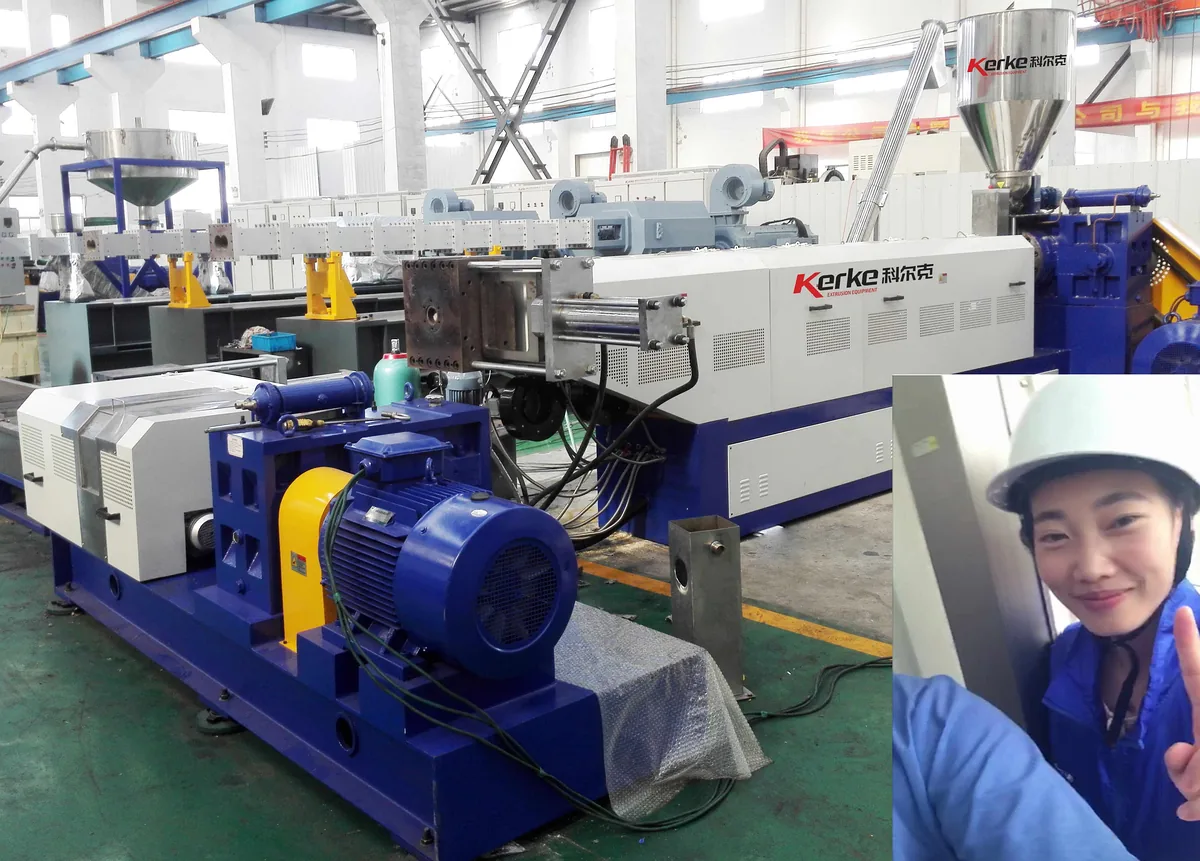
Photograph from the commissioning file for this project; customer names are withheld where requested.
The situation: a line that had never made a saleable pellet
The customer recycles post-industrial waste plastics in Japan and already owned similar equipment, so when the SE-140 / SE-140 line arrived they installed it themselves and declined commissioning support. Within two weeks the machine was producing pellets with bubbles, a burnt smell and unstable strand, and the customer's own buyers had rejected two lots. By the time we were called, the relationship on site was not good.
We offered one thing before discussing the machine: if the line could not make product the customer accepted, we would carry the risk. An engineer was on site inside a week and stayed for seven days.
What was wrong with the two stage single screw extruder
Nothing was broken on the two stage single screw extruder. It was being run as if the second stage were a metering section of a single screw, which is the standard mistake with this architecture: the two stages have to be balanced by pressure and by venting, not by one speed dial.
| Item | On arrival | Correct for this feed | Effect |
|---|---|---|---|
| Stage-1 vent | Closed, plugged with a blind flange | Open to atmosphere, then −0.05 MPa on the second vent | Moisture and volatiles had nowhere to go; that is the bubble and the smell. |
| Screen changer | 120 mesh | 60 mesh, 40 µm only for clean rigid scrap | Fine mesh on contaminated film raises head pressure until the safety valve lifts and output collapses. |
| Forced feeder | Set by ear, no catch sample | Matched to stage-1 amps, verified by 10-minute catch | Starving then flooding: the stage-1 screw never ran full, so it never vented properly. |
| Stage-1 profile | 230 °C flat | 180–200 °C, rising only at the last zone | Film scrap needs gentle melting; 230 °C degraded the polymer before the vent. |
| Stage-2 profile | Same as stage 1 | 190–205 °C with the die 10 °C above stage 2 | Pressure build-up without re-melting what stage 1 had already controlled. |
| Strand cooling | Bath 1.2 m from the die | 0.3–0.5 m, water 30–40 °C | Long air gap let the strand sag and stick before it hit water. |
Two of these are worth dwelling on. The closed vent is the one that reads as "cheap machine" to a buyer: pellets with bubbles look like a dispersion failure, but on a recycling line they are almost always a venting failure. And the 120 mesh screen is the classic self-inflicted wound — a finer screen feels like better filtration until the pressure spike costs you a shift.
The week, day by day
- Day 1 — read, don't touch. Panel log, ampere readings on both stages, catch samples of feed and product. The line was cycling: 12 minutes full, 4 minutes starved.
- Day 2 — venting. Blind flange off, stage-1 vent opened, second vent pulled to −0.05 MPa. Bubbles gone by the afternoon; smell reduced but still present, which pointed at temperature.
- Day 3 — screening and pressure. 120 → 60 mesh; head pressure dropped from 21 MPa to 14 MPa and the safety valve stopped lifting.
- Day 4 — feeder and stage balance. Forced feeder matched to stage-1 amps; stage-2 speed set from the pressure the die needs, not from the output the customer wanted.
- Day 5–6 — profile and strand. Both stages re-profiled for film scrap; bath moved to 0.4 m from the die, water to 35 °C.
- Day 7 — training. The 9-step start-up sequence written on the wall in Japanese and English, with the three readings the operator is allowed to change and the three they are not.
Result
Pellets came out clear of bubbles and odour, strand ran without breaks for a full shift, and the customer's buyer accepted the third lot. Output settled at the low end of the SE-140 / SE-140 band — the line is sized by the feed's bulk density, and this feed is light.
Line configuration
| Configuration | Stage 1 | Stage 2 | Output (kg/h) | Feed |
|---|---|---|---|---|
| SE-120 / SE-120 | 120 mm | 120 mm | 200–400 | Film, bag, rigid regrind |
| SE-140 / SE-140 (this line) | 140 mm | 140 mm | between the 120 and 150 builds | Post-industrial film and mixed scrap |
| SE-150 / SE-150 | 150 mm | 150 mm | 400–800 | Film, woven bag |
| SE-180 / SE-180 | 180 mm | 180 mm | 800–2,000 | Woven bag, heavy film |
What transfers to your line
If you are installing a two stage single screw extruder without support because you have run single screws before, check these three before you call anyone — they are what a commissioning week actually buys:
Vent, screen, feed — in that order
Vent open and pulling. A closed first-stage vent turns moisture into bubbles and bubbles into a quality complaint. Mesh matched to contamination, not to ambition: 60 mesh on film, finer only on clean rigid scrap. Feeder matched to stage-1 amps — a starved first stage cannot vent, and a flooded one cannot melt.
Every two stage single screw extruder leaves with that sequence; the version on the wall is the same one in our 9-step start-up article; the venting and screening logic applies to twin screws as well.
FAQ
Why would a two stage single screw extruder be chosen over a twin screw for recycling?
Cost per kg/h on light, contaminated feed, and the fact that a two stage single screw extruder separates venting from pressure build-up. A single screw with forced feeding handles film and woven bag at a lower capital cost, and the second stage gives you a dedicated pressure-building section that does not compete with mixing. A twin screw wins when the scrap needs compounding or heavy filling.
Can the customer's own team install the line?
Mechanically yes — this two stage single screw extruder was installed correctly. The failure was in commissioning: venting, screening, feeder balance and the start-up sequence. Those are the four things a commissioning visit actually delivers, and they are the reason the machine is sold with one.
What mesh should a recycling line run?
60 mesh as a default for film and mixed scrap, 40 µm only where the feed is clean rigid regrind and the product needs it. Finer mesh raises head pressure, and on a two-stage line that pressure has to be carried by the second stage — which then has nothing left for the die.
How much output is lost by running the vent closed?
Not output directly — quality first. The line keeps running and keeps making pellets nobody will buy. In this case the visible symptom was bubbles, and the invisible one was a burnt smell that came from the 230 °C profile, not from the vent.
Where this record comes from
Commissioning reports, service logs and the parameter sheet issued with the line. Machine figures are the quoted bands for the model; process windows follow the Kerke parameter table and are confirmed on a material trial before they become a production setpoint. Where the customer asked not to be named, the country and the application are kept and the company name is not.
Reviewed by the Kerke process team, Nanjing. Case published 9 November 2026.
Send 25–50 kg and we run it on our lab extruder: pellets, running video and a capacity report back in 3–7 days.
Two stage single screw extruder — the short version
Note on two stage single screw extruder: the readings in this record come from the commissioning log of the line described, and the settings are the ones that were left with the customer. Treat them as a starting point for your own material, not as a guarantee — the same correction on a different filler grade or carrier ends in a different number.
Related on this site: Extrusion lines by application · Twin screw extruder types · free extrusion line quotation · Wikipedia: Extrusion