
Selection · 6 min read
Twin Screw Extruder Size Chart: 16 mm to 135 mm, 1 to 4,000 kg/h
The complete model table with screw diameter, speed, motor, torque and reference output — plus how to read it without over-committing on capacity. A reference twin screw extruder size chart page from Kerke.
Sizing starts from the material and the required output, then moves to torque class, then to L/D. Diameter is the last choice, not the first — two machines of the same diameter can differ by 80% in torque.
Model table
| Model | Dia. (mm) | Speed (rpm) | Motor (kW) | Torque (N·m) | Output (kg/h) |
|---|---|---|---|---|---|
| KTE-16 | 15.6 | 500 | 2.2 | 2×18 | 1–5 |
| KTE-20B | 21.7 | 500 | 4 | 2×30 | 2–15 |
| KTE-36B | 35.6 | 500–600 | 18.5–22 | 2×210 | 20–100 |
| KTE-50B | 50.5 | 500–600 | 55–75 | 2×525 | 80–200 |
| KTE-65B | 62.4 | 500–600 | 90–110 | 2×860 | 200–450 |
| KTE-65D | 62.4 | 300–800 | 132–160 | 2×1,530 | 350–600 |
| KTE-75B | 71 | 500–600 | 132–160 | 2×1,530 | 300–800 |
| KTE-95B | 93 | 500–600 | 250–315 | 2×3,000 | 800–1,500 |
| KTE-135D | 135 | 500–800 | 500–1,000 | 2×7,800 | 1,500–4,000 |
Torque per unit volume: the number that decides
Specific torque is torque divided by the centreline distance cubed (T/A³). B-class machines run at 6–8 and cover most masterbatch and compounding work; D-class at 8–12 for high filler, glass fibre and high output. A KTE-65B and a KTE-65D share the same screw diameter; the D carries 78% more torque and costs roughly 35% more.
How to read the output column honestly
- The lower number is a demanding formulation — high filler, high pigment, high fibre.
- The upper number is a favourable one — unfilled PE or PP at moderate rpm.
- For loose film and flake, halve it: bulk density, not the machine, is the limit.
- Quote the range to your customer, never the top number. The top number belongs to a trial report, not to a contract.
Then choose L/D
32–36 for simple filling; 40–44 for masterbatch with dispersion; 44–48 for reinforcement with side feed and one vacuum; 52–60 for reactive extrusion with two vents and liquid injection. Every extra 4D adds residence time and mixing, and costs output.
FAQ
What size machine do I need for 500 kg/h of filler masterbatch?
KTE-75B on a single stage at 80–82% filling, or KTE/SE-65/150 two-stage above 85%. Both are quoted in the 400–700 kg/h band depending on filler grade.
Is a bigger machine always more productive per kW?
Yes, up to a point: specific energy falls as diameter grows, but so does the minimum stable output. A 135 mm machine cannot run economically at 300 kg/h.
Why do two catalogues quote different output for the same model?
Different reference materials. We quote by material family and always state the assumption; a number without a material attached is marketing, not engineering.
Where these numbers come from
Values are drawn from the Kerke parameter table, commissioning records and service reports from lines in the field. Temperature windows and consumption figures are typical ranges — confirm on your own material before they become a production setpoint.
Send 25–50 kg and we run it on our lab extruder: pellets, running video and a capacity report back in 3–7 days.
Twin screw extruder size chart — the short version
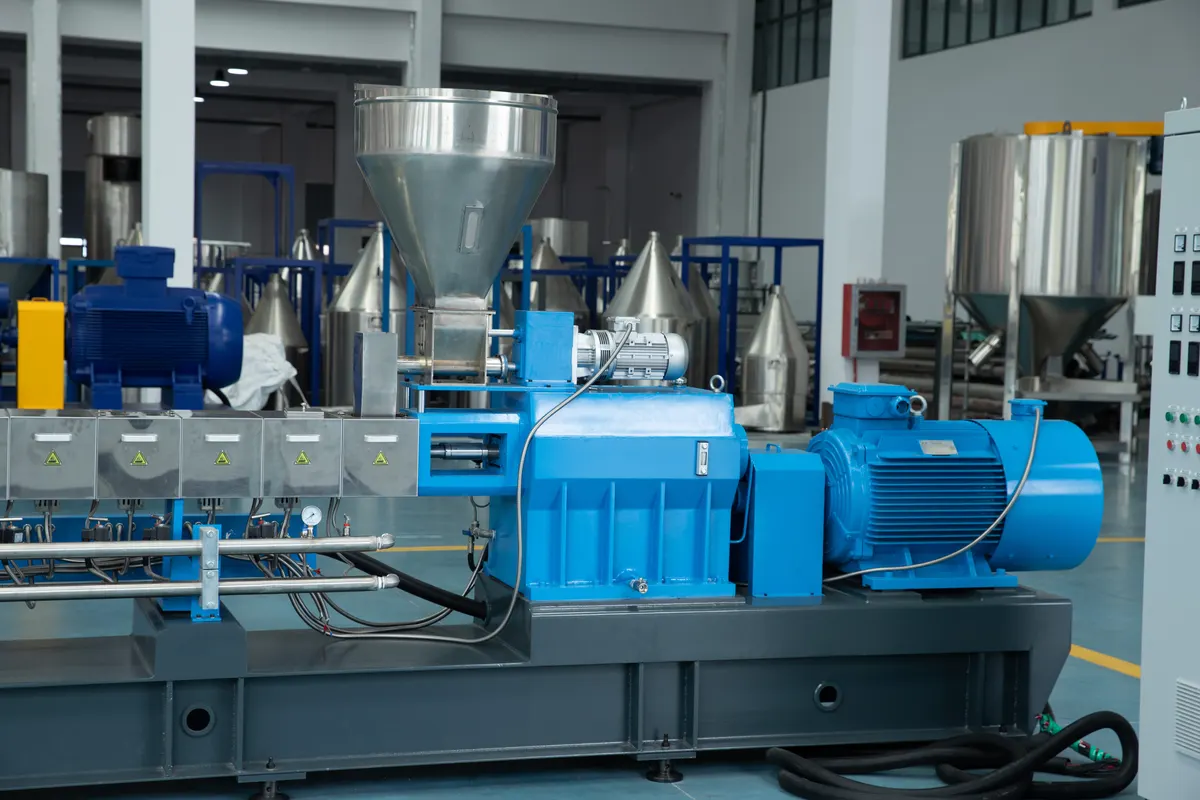
Note on Twin screw extruder size chart: every figure on this page is a reference range measured on Kerke's own test line in Nanjing, not a catalogue maximum. If your material differs from the one in the table, send 25–50 kg and we will replace the range with a measured number.
Related on this site: Twin screw extruder range · Extrusion lines by application · free extrusion line quotation · Wikipedia: Pelletizing