
Case study 4 · Cambodia · PET bottle flake
PET flake pelletizing line holding IV 0.6–0.79: a KTE-75B in Cambodia
A bottle-flake recycler in Cambodia bought a KTE-75B after running their own flake on it in Nanjing. The PET flake pelletizing line now returns pellets in the 0.6–0.79 dL/g range from flake that varies lot to lot — because drying, shear and vacuum were designed around IV, not around tonnage.
Quick answer
PET recycling is decided by one number: intrinsic viscosity. On this PET flake pelletizing line the flake is crystallised and dried at 160 °C for 4–6 hours to below 50 ppm moisture, melted on a low-shear L/D 44–48 screw, devolatilised in two stages and water-ring strand cut. Measured loss is 0.02–0.05 dL/g per pass, which is what keeps output in the 0.6–0.79 range from mixed bottle flake.
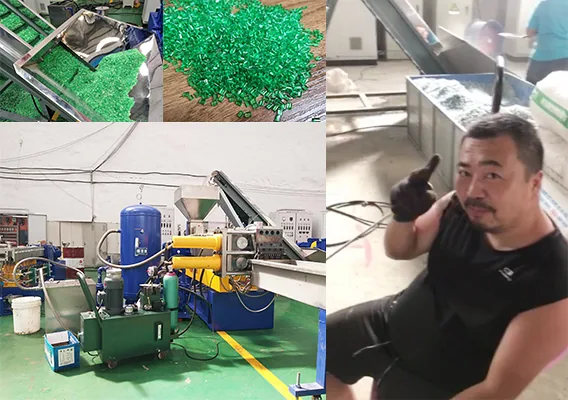
Photograph from the commissioning file for this project; customer names are withheld where requested.
The situation: flake in, price out
Cambodia collects and washes bottle flake and sells it on. The step that decides the price is pelletising, and the step that decides pelletising is IV retention: bottle-grade flake at 0.78–0.80 dL/g becomes fibre-grade at 0.65, and fibre-grade becomes a different, cheaper product. Every degree of shear and every ppm of moisture costs money.
The customer's flake is not one grade. It arrives as mixed clear and light-blue bottle, washed, with moisture that varies by lot, and IV that ranges from about 0.60 to 0.79 dL/g. They tested their own material on our KTE-75B before ordering — the trial is free, they covered the freight — and bought the line on the strength of the pellet sample, not the brochure.
What a PET flake pelletizing line has to control
Three variables decide whether IV survives, and only one of them is inside the extruder.
| Lever | Setting on this line | What it does to IV |
|---|---|---|
| Drying | 160 °C × 4–6 h, dew point −40 °C, moisture <50 ppm | Hydrolysis is the largest single loss. Wet flake loses 0.1 dL/g or more and the loss is not recoverable. |
| Screw shear | L/D 44–48, conveying and light kneading, no 90° blocks | Each pass costs 0.02–0.05 dL/g when the flake is dry; aggressive geometry doubles it. |
| Vacuum | Two-stage vent, −0.06 to −0.09 MPa | Removes the water that drying did not reach and the volatiles from printed or glued flake. |
Two more decisions sit downstream of the PET flake pelletizing line. The melt filter runs 60–80 µm because finer mesh on flake with residual contamination raises pressure and temperature, and temperature is an IV cost. Cutting is water-ring strand, not die-face: PET needs to be cooled fast and evenly, and a strand line lets you see the surface quality before it reaches the pelletizer.
How the line is set for flake that varies
- Drying is logged per lot, not per shift. Dew point and residence time are recorded; a lot that arrives at 0.9% moisture gets longer residence, not a faster line.
- Screw speed is fixed by melt temperature, not output. 260–280 °C barrel, die slightly below the maximum melt temperature; if the melt climbs, speed comes down before anything else is touched.
- Vacuum is checked at the flange. A gauge at the pump is not a gauge at the vent; the line carries a gauge at the vent for exactly this reason.
- Chain extender stays off the line by default. Epoxy ADR at 0.2–0.5% is available for low-IV lots, but it is added after melting and before the vacuum, and it is a cost per tonne — it is used when the lot needs it, not as a habit.
- Every lot gets an IV sample. Incoming flake and outgoing pellet, same lab, same method. That record is what lets the customer quote a specification instead of a hope.
Result
Pellets leave the PET flake pelletizing line inside 0.6–0.79 dL/g across the flake range the customer buys, with a measured loss of 0.02–0.05 dL/g per pass. The pellets found buyers in the local fibre and sheet market, and the machine was paid back inside the first year of running — which is the only result that matters on a recycling line.
Line configuration
| Stage | Equipment | Why |
|---|---|---|
| Crystallising and drying | 160 °C × 4–6 h, dew point −40 °C | The single largest IV protection on the line. |
| Extruder | KTE-75B, 71 mm, 2×1,530 N·m, L/D 44–48 | Low-shear geometry; 300–800 kg/h band. |
| Filtration | Hydraulic screen changer, 60–80 µm | Removes residual label and cap contamination without over-pressuring the melt. |
| Devolatilization | Two-stage vacuum, −0.06 to −0.09 MPa | Water and volatiles before the die. |
| Pelletizing | Water-ring strand, water 30–40 °C, centrifugal dryer | Fast uniform cooling; surface visible before cutting. |
What transfers to your line
Before you quote a PET flake pelletizing line, answer three questions
Where does the flake come from — bottle bale or already-washed flake, because the washing line decides the moisture you inherit. What IV do you need to sell — fibre, sheet or bottle, because that sets the drying and vacuum budget. Pellets or sheet — because a sheet line needs a melt pump and a die, and that is a different quotation.
The full parameter set is on the PET bottle flake recycling page; the drying and vacuum numbers are the same ones we run on the trial line in Nanjing.
FAQ
How much IV is lost in one pass on a PET flake pelletizing line?
0.02–0.05 dL/g when the flake is dried to below 50 ppm. Wet flake can lose 0.1 dL/g or more in a single pass, and that loss cannot be recovered by re-pelletising.
Can you run bottle flake without a crystalliser and dryer?
The line will run on undried flake. You cannot sell the pellets at bottle or fibre prices. Hydrolysis starts the moment wet flake meets hot metal, and it is the cheapest problem on the line to prevent and the most expensive one to fix afterwards.
Why water-ring strand and not underwater cutting for PET?
PET needs fast, even cooling and the strand gives you a visible surface before the pelletizer. Underwater cutting is used where round pellet shape is the selling point — TPE, TPU — not where IV and dust are the specification.
What does the free material trial include?
25–50 kg of your flake, run on our lab or production line, returned as pellets plus a report with drying time, temperatures, screw speed, vacuum and measured IV before and after. You cover the freight; the trial itself is free.
Where this record comes from
Commissioning reports, service logs and the parameter sheet issued with the line. Machine figures are the quoted bands for the model; process windows follow the Kerke parameter table and are confirmed on a material trial before they become a production setpoint. Where the customer asked not to be named, the country and the application are kept and the company name is not.
Reviewed by the Kerke process team, Nanjing. Case published 9 November 2026.
Send 25–50 kg and we run it on our lab extruder: pellets, running video and a capacity report back in 3–7 days.
PET flake pelletizing line — the short version
Note on pet flake pelletizing line: the readings in this record come from the commissioning log of the line described, and the settings are the ones that were left with the customer. Treat them as a starting point for your own material, not as a guarantee — the same correction on a different filler grade or carrier ends in a different number.
Related on this site: Extrusion lines by application · Twin screw extruder types · free extrusion line quotation · Wikipedia: Extrusion