
Case study 10 · Korea · TPE elastomer
TPE underwater pelletizing on a first-build line: KTE-85B in Korea
Underwater pelletizing lines are expensive, and this one was our first build of its size. It ran on the first production campaign, paid for itself in three months, and the customer ordered a second machine six months later. TPE underwater pelletizing is decided by water temperature, die freeze-off and oil absorption — not by the pelletizer's price tag.
Quick answer
TPE is pelletised underwater because the pellet shape is what the customer sells: round, free-flowing, no blocking in the bag. On this KTE-85B line (85 mm, 2×2,100 N·m, 550–1,000 kg/h) the die face runs in water at 40–55 °C with flow high enough to carry pellets away before they touch each other, and the die is heated to prevent freeze-off at start-up. On a TPE underwater pelletizing line the compounding side is oil absorption — SEBS takes 2–5 times its own weight, injected in stages, not all at once.
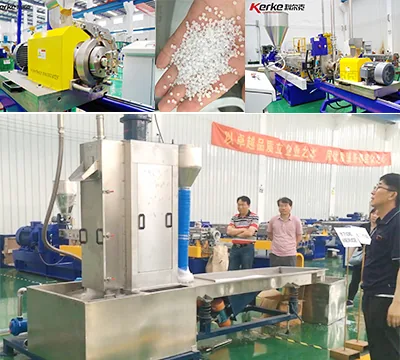
Photograph from the commissioning file for this project; customer names are withheld where requested.
The situation: a first build, bought on specification
The customer makes TPE compounds in Korea for consumer and automotive parts, Shore 30A to 90A, mostly SEBS-based with oil, PP and filler. The line is a KTE-85B — 85 mm, 2×2,100 N·m, 220–315 kW, 550–1,000 kg/h — with an underwater die-face pelletizing system built in our own workshop.
A TPE underwater pelletizing line is the most expensive pelletizing option, and buyers rightly ask why. The answer is pellet geometry: TPE sold into injection moulding has to be round, free-flowing and non-blocking, and a strand line gives neither the shape nor the consistency. This was our first build of the system at this size, which is exactly the kind of order where the risk sits with the supplier — so it was tested before it shipped, and it ran on the first campaign.
What decides TPE underwater pelletizing
Two separate problems that meet at the die: what the compound is, and what the water does to it.
| Variable | Setting on this line | Failure mode if wrong |
|---|---|---|
| Oil absorption | SEBS oil at 2–5× rubber weight, injected in two stages | One-shot injection makes the melt slip; the compound never homogenises and the pellet surface is oily. |
| L/D and mixing | 44–52, toothed and narrow kneading elements | All-90° geometry degrades SEBS; too short a screw leaves oil pockets. |
| Die temperature | Heated die, held above the melt freeze point | Freeze-off at start-up: holes block before the cutter reaches speed. |
| Water temperature | 40–55 °C | Cold water quenches the skin and gives tails and angel hair; hot water gives flat, deformed pellets. |
| Water flow | High enough to carry pellets clear of the die face | Pellets recirculate, stick together, and block the cutting chamber. |
| Cutting speed | Matched to throughput per hole | Slow cutter gives long pellets; fast cutter gives fines and heat at the die. |
The oil side is where most TPE lines are lost. SEBS absorbs oil slowly, and a single injection point at full rate produces a melt that slips in the feed zone and a pellet that sweats oil in the bag three days later. Two injection points, spaced along a dedicated absorption zone, are the difference between a compound and a mixture.
How the line was proven before shipment
- Die and cutter tested as a subassembly. Freeze-off behaviour checked at start-up, which is the failure that ruins the first hour of every underwater line.
- Compound run at three hardnesses. Shore 40A, 60A and 85A, with water temperature and cutter speed recorded for each — the settings shipped with the machine are the ones that produced acceptable pellets.
- Oil injection split into two points and the absorption zone length confirmed on the trial, not on the drawing.
- Installation and start-up support at the customer's plant, including the shutdown and restart sequence, because an underwater line that is restarted cold will block.
Result
The first production campaign on this TPE underwater pelletizing line produced pellets inside the customer's specification, and the customer reported recovering the machine cost within three months of running. Six months later they ordered a second machine, and during that installation the first line was running without attention — which is the most useful thing a supplier can see on a repeat visit.
Line configuration
| Item | Specification |
|---|---|
| Model | KTE-85B, 85 mm, 2×2,100 N·m, 220–315 kW |
| Output band | 550–1,000 kg/h (application dependent) |
| L/D | 44–52 |
| Oil injection | Two points in a dedicated absorption zone, up to 3× rubber weight |
| Pelletizing | Underwater die-face, water 40–55 °C, heated die |
| Downstream | Centrifugal dryer, vibrating screen, bagging |
What transfers to your line
Ask these three questions about any underwater line
Is the die heated and how is freeze-off handled at start-up? What water temperature and flow are specified for my hardness? Was the die and cutter run as a subassembly before shipment? A supplier who answers all three has built one before; a supplier who answers none is learning on your order.
The compounding side is on the TPE / TPU / TPR page; the seven cutting methods, including where underwater wins and where it does not, are compared in this article.
FAQ
Why does TPE need underwater pelletizing instead of strand cutting?
Because on a TPE underwater pelletizing line the pellet shape is the product. TPE for injection moulding has to be round and free-flowing; strand cutting gives a cylindrical pellet that blocks in the bag at higher hardness and deforms at lower hardness. Underwater die-face cutting gives round pellets with a controlled size.
What water temperature does TPE underwater pelletizing need?
40–55 °C on this line, set by hardness and by the die. Too cold and the skin quenches into tails and angel hair; too hot and the pellets flatten and stick in the dryer.
How is oil loaded into a TPE compound?
At two injection points along a dedicated absorption zone, up to 3× the rubber weight for SEBS. One-shot injection makes the melt slip in the feed zone and leaves oil pockets that sweat out of the pellet days later.
Can a first-build underwater line be trusted?
Only if the die and cutter were run as a subassembly before shipment, with water temperature and cutter speed recorded. That test is what turns a first build into a specification — and it is a fair thing to ask any supplier for.
Where this record comes from
Commissioning reports, service logs and the parameter sheet issued with the line. Machine figures are the quoted bands for the model; process windows follow the Kerke parameter table and are confirmed on a material trial before they become a production setpoint. Where the customer asked not to be named, the country and the application are kept and the company name is not.
Reviewed by the Kerke process team, Nanjing. Case published 9 November 2026.
Send 25–50 kg and we run it on our lab extruder: pellets, running video and a capacity report back in 3–7 days.
TPE underwater pelletizing — the short version
Note on tpe underwater pelletizing: the readings in this record come from the commissioning log of the line described, and the settings are the ones that were left with the customer. Treat them as a starting point for your own material, not as a guarantee — the same correction on a different filler grade or carrier ends in a different number.
Related on this site: Extrusion lines by application · Twin screw extruder types · free extrusion line quotation · Wikipedia: Extrusion