
Case study 6 · Kuwait · PE film recycling
PE film recycling line: three KTE-75B and one blocked copper pipe
A Kuwaiti recycler bought one KTE-75B for PE film, then reported the cooling pipe as a quality defect — twice, with a free replacement sent the first time. The photographs showed scale, not a bad pipe. Fixing the water fixed the machine, and two more lines followed. A reference pe film recycling line page from Kerke.
Quick answer
The copper pipe was not the defect. Photographs of the failed pipe showed it blocked solid with scale, and scale comes from hard water, not from copper. The customer moved the circuit to soft water, we replaced the pipe once more at no charge, and the line has run without a repeat since — followed by two more machines. On any water-cooled line, water quality is part of the machine specification.
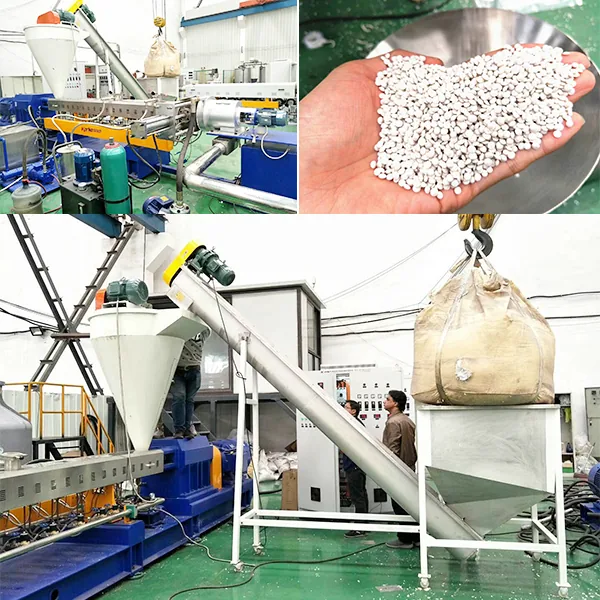
Photograph from the commissioning file for this project; customer names are withheld where requested.
The situation: a pipe that kept failing
A recycler in Kuwait washes and pelletises PE film. They started with one KTE-75B — 71 mm, 2×1,530 N·m — with forced feeding for the film, a vacuum vent and a water-ring hot-face pelletizer. The line ran well for a few months and then the cooling pipe on the barrel failed. We shipped a replacement free of charge. It failed again.
At that point the customer's conclusion was reasonable and wrong: the machine is poor quality, and the pipe should be made of a different material. Our conclusion, once we had photographs, was that the pipe was doing exactly what a pipe does when it is fed hard water in a hot climate.
What the photographs showed about this PE film recycling line
The customer sent pictures of the failed pipe cut open. The bore was not corroded or split — it was packed with a pale, hard deposit, and the cross-section was reduced to a fraction of its area. That is scale, and scale is a water problem with three inputs: hardness, temperature and flow.
| Item | What was happening | Why it matters on a PE film recycling line |
|---|---|---|
| Water hardness | Raw mains water, high Ca/Mg in the local supply | Above roughly 200 mg/L as CaCO3, scale deposits at the barrel jacket temperatures this line runs. |
| Water temperature | Cooling circuit returning hot; no chiller | Scale comes out of solution faster as temperature rises — a closed loop without a chiller accelerates it. |
| Flow | Single pass, no strainer, no flow switch | Once the bore narrows, flow falls, temperature rises, and the deposit grows faster. A flow switch would have alarmed long before the pipe blocked. |
| Maintenance | No flush schedule | Scale is manageable if it is removed early; it is a replacement if it is left for months. |
This is the part of a recycling line that nobody puts in the quotation. The extruder is specified by torque and L/D; the water circuit is specified by the site. On a PE film recycling line in the Gulf, the water circuit is the second most common cause of downtime after the feeder — and the cheapest to specify correctly.
What changed
- The circuit moved to soft water. A softener on the make-up line, and the loop converted from single-pass to closed with a chiller.
- A strainer and a flow switch were fitted. Both are cheap; the flow switch turns a blocked pipe from a failure into an alarm.
- The pipe was replaced once more at no charge, which settled the argument about whether the part or the water was at fault.
- A monthly flush went into the maintenance schedule, with the water hardness tested at the same interval.
Result
No repeat failure. It has since run continuously on the softened, chilled loop, and the customer ordered two more KTE-75B lines — three in total, all on the same water treatment. That is the cleanest possible answer to "was it the machine": a customer who blamed the pipe twice bought the same machine twice more once the water was right.
Line configuration
| Item | Specification | Note |
|---|---|---|
| Extruder | KTE-75B, 71 mm, 2×1,530 N·m, 132–160 kW | 300–800 kg/h band, feed-dependent |
| Feeding | Forced feeder / compactor for film | Bulk density 0.05–0.2 g/cm³ will not feed by gravity |
| Venting | Vacuum vent, −0.06 to −0.09 MPa | Wash-line moisture has to leave somewhere |
| Pelletizing | Water-ring hot-face, centrifugal dryer | Film recyclate cuts cleanly at the die face |
| Cooling water | <200 mg/L as CaCO3, 25–35 °C, closed loop, strainer + flow switch | Added to the commissioning pack after this case |
What transfers to your line
Check the water before you blame the machine
Hardness above 200 mg/L as CaCO3 will scale a jacket at 60–90 °C. Open loop without a chiller means the return temperature climbs and scaling accelerates. No flow switch means you learn about a blocked bore from a failed heating zone, not from an alarm. All three are site-side, and all three are cheaper than a spare barrel.
Film lines also live or die on the feeder: the waste plastic recycling page sets out which feed needs a compactor and which needs a two-stage line, and the maintenance schedule covers the flush interval.
FAQ
Was the copper pipe actually defective?
No. The failed pipe was cut open and photographed: the bore was blocked with scale, with no corrosion or split. Scale comes from hard water at temperature, and the second failure followed the same pattern because the water had not changed.
What water specification does a water-cooled extruder need?
Under about 200 mg/L hardness as CaCO3, 25–35 °C supply, a closed loop with a chiller, a strainer and a flow switch. Above that, softener on the make-up line. It is a site specification, but it belongs in the machine's commissioning pack.
Why did the customer buy two more machines after complaining?
Because once the water was corrected the line ran without a repeat failure. A customer who has blamed a part and been shown the cause will buy again if the machine then performs — which is exactly what happened here.
Can a PE film recycling line run on raw mains water in a hot climate?
A PE film recycling line can run on raw mains water, and it will scale. In the Gulf the combination of hard water and high ambient temperature makes a chiller and a softener close to mandatory rather than optional.
Where this record comes from
Commissioning reports, service logs and the parameter sheet issued with the line. Machine figures are the quoted bands for the model; process windows follow the Kerke parameter table and are confirmed on a material trial before they become a production setpoint. Where the customer asked not to be named, the country and the application are kept and the company name is not.
Reviewed by the Kerke process team, Nanjing. Case published 9 November 2026.
Send 25–50 kg and we run it on our lab extruder: pellets, running video and a capacity report back in 3–7 days.
Pe film recycling line — the short version
Note on pe film recycling line: the readings in this record come from the commissioning log of the line described, and the settings are the ones that were left with the customer. Treat them as a starting point for your own material, not as a guarantee — the same correction on a different filler grade or carrier ends in a different number.
Related on this site: Extrusion lines by application · Twin screw extruder types · free extrusion line quotation · Wikipedia: Extrusion