
Process guide · 5 min read
Flame Retardant Masterbatch: Formulation & Temperature Red Lines
Halogen-free flame-retardant masterbatch concentrates 70–80% phosphorus-nitrogen FR package into a carrier — and the entire process exists to keep barrel temperatures below the FR decomposition point: bromine systems <220°C, phosphorus-nitrogen typically ≤240°C at the melt, silver-free. 385 readable patents (2019–2020 concentration) show phosphorus-nitrogen is now the mainstream; brominated systems dominate only pre-2007 records.
Short answer: Halogen-free flame-retardant masterbatch concentrates 70–80% phosphorus-nitrogen FR package into a carrier — and the entire process exists to keep barrel temperatures below the FR decomposition point: bromine systems <220°C, phosphorus-nitrogen typically ≤240°C at the melt, silver-free. 385 readable patents (2019–2020 concentration) show phosphorus-nitrogen is now the mainstream; brominated systems dominate only pre-2007 records.
Reference formulations (patent-based)
| Grade | Composition (wt%) | Note |
|---|---|---|
| UV-stable halogen-free FR MB | P-N FR package 70–80 + PE 6–16 + POE 3–6 + compatibilizer 3–6 + light stabilizer 2–4 + lube 0.5–1 + AO 0.2–0.4 | The modern concentrated format |
| Weatherable FR ABS MB | ABS 70–90 + epoxy 8–14 + PC 6–11 + filler 7–14 + crosslinker 5–9 + FR 8–12 | MB form for ABS |
| Multifunction PC/ABS | PC 40–80 + block copolymer 10–30 + phosphate 10–30 + CNT 0.1–0.6 + Ag antibacterial 0.1–0.6 | FR + antistatic + antibacterial in one |
| PA-carrier MCA MB | PA6 powder 9.4–49.6% + MCA 50–90% + AO 0.4–0.6 | Nylon-carrier route |
Temperature discipline
| System | Window | Red line |
|---|---|---|
| Brominated (DecaBDE-ethane + Sb₂O₃ 3:1) | ≤220°C barrel | Bromine release above — odor + corrosion + FR loss |
| Phosphorus-nitrogen (APP, MCA, Al hypophosphite) | 180–240°C melt | APP is hygroscopic — vacuum venting mandatory |
| PC/ABS FR profiles (patent) | 180→240→210°C gradient | Rise to melt, fall to protect FR at the die |
A documented PC/ABS six-zone profile: 180–200 / 200–210 / 210–230 / 230–240 / 220–230 / 210–220°C — the die runs cooler than the melt peak, the inverse of the usual rule. When the additive decomposes before the polymer melts, the profile is written backwards on purpose.
Process requirements
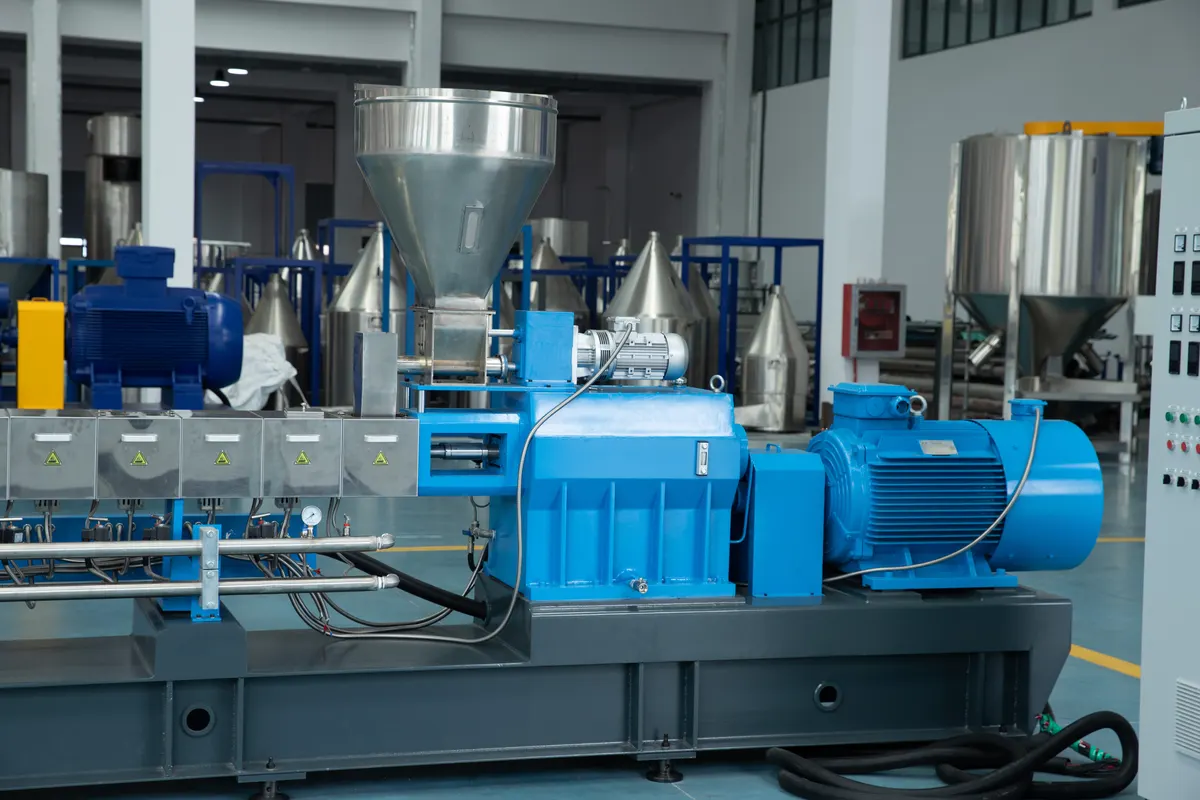
- FR masterbatch is the most capacity-constrained masterbatch family: KTE-65 delivers 160–260 kg/h (vs 200–400 for filler grades)
- High concentrated loading + strong dispersion = D-class gearbox + bimetallic liners
- Pelletizing: water-ring standard; APP systems need reliable vacuum to avoid voids
- Speed: 250 rpm median (patent band 200–300)
Compliance note
FR formulations carry UL94 / GB certification obligations — the machine guarantees process reproducibility, the formulator owns the rating. Patent records from 2010–2020 need re-checking against current RoHS/REACH status before referencing specific chemistries commercially.
Typical published practice — run trials on your own material before production.
Line setup that delivers this formulation
| System | Melt ceiling | Frame | Key configuration |
|---|---|---|---|
| Brominated | <220°C | KTE-65B 40:1 | Short residence, die-end cooling |
| Phosphorus-nitrogen | ≤240°C | KTE-65B 40:1 | Two vents, side feed at 20 D |
| ATH/MH filled | ≤200°C at melt | KTE-65B + SE-150 | Two-stage mandatory above 55% |
The 385 patents in the sample agree on one thing: the temperature ceiling is set by the FR, not by the polymer. Running 10°C below the decomposition point costs 5–8% of output and prevents the batch-level failures that show up as inconsistent flame ratings.
What this line costs
An FR masterbatch line at 65 mm with side feeding and water-ring pelletizing runs USD 72,000–88,000 in 2024 terms. Per kg/h at 350–450 kg/h that is USD 180–240. The FR package itself dominates cost of goods at 55–70%; the machine choice is therefore about protecting the FR, not about output per dollar.
Trials before production
- Determine the FR's decomposition onset by TGA before the first run; do not rely on the datasheet's generic number.
- Run the profile 10°C below onset and check flame rating on 3 mm and 1.6 mm bars — thin sections fail first.
- Log melt temperature at the die, not in the metering zone; the die is where overheating happens.
- Check for FR plate-out on the screw after 4 hours; plate-out predicts long-term drift.
- Test 5 batches for rating consistency, not one — FR failures are statistical.
The failure this recipe is known for
FR masterbatch fails by plate-out. After a few hours the FR migrates to the screw and barrel surface, output drops 5%, and the next batch is under-dosed because the FR is sitting on the metal. The causes are over-lubrication and excessive melt temperature — in that order. Reduce wax first, then drop the last zone 5°C.
FAQ
Can I run brominated FR on a standard barrel?
Yes, but corrosion protection matters: brominated systems release HBr traces at temperature, so specify a bimetallic barrel and check the vent line monthly.
Why does my flame rating drift between batches?
Dispersion, not dosage. Agglomerated FR behaves as if under-dosed in the thin section, even when the assay is correct.
Is a falling temperature profile necessary?
For phosphorus-nitrogen systems, yes at the die. A 10–20°C drop protects the FR without affecting pellet quality.
What output penalty should I budget?
20–30% versus an unfilled compound of the same frame, mostly from lower screw speed and shorter residence requirements.
Can I use the same line for brominated and halogen-free FR?
Not without a full purge and a vent inspection. Bromine residue in a halogen-free product fails the customer's RoHS screen at ppm levels. ## What these numbers do not settle
The 220/240°C ceilings are system averages. A specific brominated grade can tolerate 235°C; a specific phosphorus package can start decomposing at 225°C. Nor do the tables address the interaction with the polymer's own degradation — PVC and PBT both release volatiles that attack the FR. Read the ceiling as a starting point for a TGA, not as a specification.
Bottom line: every FR decision is a temperature decision. Set the profile 10°C below the FR's decomposition onset, accept the 5–8% output loss it costs, and test the rating on the thinnest section your customer moulds.
Where these numbers come from
Figures in this page are drawn from patent-set process statistics, commissioning records, cross-checked against delivered-line commissioning records. They are typical published practice — run trials on your own material before fixing production settings.
Flame Retardant Masterbatch — the short version
Related on this site: HFFR two-stage · ABS FR compound · Functional masterbatch
Bottom line. Halogen-free flame-retardant masterbatch concentrates 70–80% phosphorus-nitrogen FR package into a carrier — and the entire process exists to keep barrel temperatures below the FR decomposition point: bromine systems <220°C, phosphorus-nitrogen typically ≤240°C at the melt, silver-free. Use the references above to shortlist, then let the material decide: a 25–50 kg lab trial settles filler ceiling, pellet shape and output before you commit to a line.