
Process guide · 5 min read
ABS Flame-Retardant Compound: Formulation & the Two-Dryer Rule
ABS flame-retardant compounding is a twin-screw blending job with one non-obvious infrastructure demand: PC/ABS alloys need two independent dryers — PC at 80–100°C for 10–20 hours, ABS at 4–6 hours.
This page collects our floor notes on Flame Retardant Compound Formulation: how the line is laid out, the numbers we reference most, and the checks that prevent the usual startup problems.
Short answer: ABS flame-retardant compounding is a twin-screw blending job with one non-obvious infrastructure demand: PC/ABS alloys need two independent dryers — PC at 80–100°C for 10–20 hours, ABS at 4–6 hours. Skip one and hydrolysis shows up as batch-to-batch property drift that no screw configuration can fix. 1,030 patents in the ABS collection (405 readable) anchor the formulation windows below.
Reference formulations (patent-confirmed)
| System | Composition (wt%) | Process |
|---|---|---|
| Low-smoke FR PVC/ABS | PVC 46–53 + ABS 23–30 + nitrile rubber 3–6 + impact modifier 2–4 + plasticizer 20–25 + stabilizer 3.2–4.0 + Sb₂O₃ 1.6–2.4 + Mg(OH)₂ 8–12 + zinc borate 1.6–2.4 | Mixer → mill → calender; smoke density <60% |
| Halogen-free FR PC/ABS | PC (dry 80–100°C × 10–20 h) + ABS (4–6 h) + compatibilizer + FR toughener | Six zones 180→240→210°C gradient |
| Recycled halogen-free PC/ABS | Waste PC density-separated (NaCl solution: 24–26% float / 14–16% sink) → wash → dry → blend with ABS at 220–235°C | Sorting written into the patent |
| FR ABS masterbatch route | ABS 70–90 + epoxy 8–14 + PC 6–11 + filler 7–14 + FR 8–12 | MB form |
The statistics floor
Across 212 machine-parseable ABS patents: antioxidant 0.1–0.9 phr (n=23), toughener 3–10 (n=17), FR package 9–20 (n=17), compatibilizer 3–5.5 (n=13), lubricant 0.2–1 (n=14), PC 41–60 phr in alloys (n=10). These are the dosage bands any real ABS FR recipe must intersect.
Process window
| Parameter | Setting |
|---|---|
| Temperature profile | 180–200 rising, peak 210–240, falling to 190–210 at the die — the inverse gradient protects FR at the die |
| L/D | 35–45 (patent median 40; 25 appears in short-machine variants) |
| Speed | 300–600 rpm band |
| Feeding | Resin main-feed; FR/auxiliaries side-fed |
| Venting | Standard vacuum; FR systems gas if overheated |
Machine-package implications
- Two desiccant dryers (or a two-chamber unit) are part of the quote for PC/ABS — not an option
- Die-end cooling (falling profile) is a screw/barrel configuration feature worth specifying
- Recycled-PC routes connect to washing/separation equipment: "recycling + modification" combo lines are a KTE-65/75 dual-use sales case
Typical published practice — run trials on your own material before production.
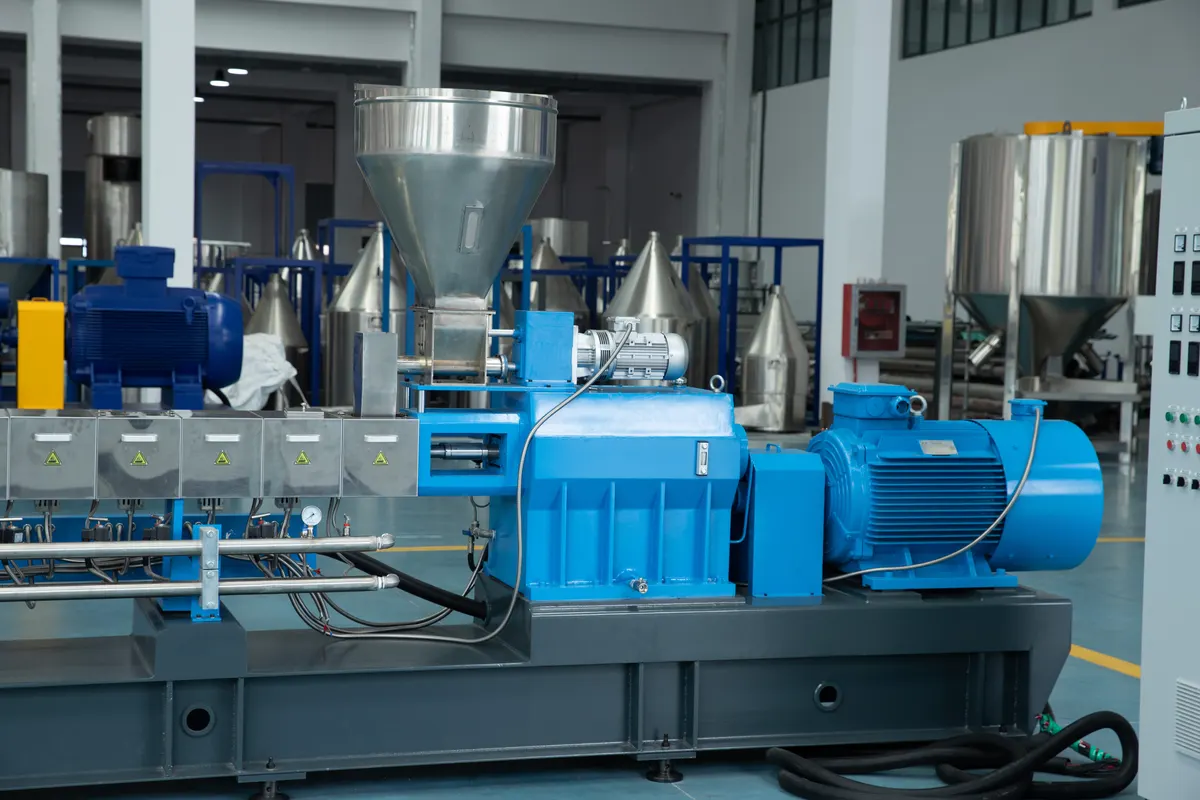
Line setup that delivers this formulation
| Element | Specification | Reason |
|---|---|---|
| Frame | KTE-65B, 40:1 | Throughput 250–450 kg/h with torque to spare at 60% FR loading |
| Gearbox | B-class (2×860 N·m) | FR packages are not abrasive; D-class is wasted money |
| Side feed | At 20 D, after melting | FR powder and Sb₂O₃ go in downstream of the melt |
| Venting | Two ports, −0.06 MPa | FR systems release volatiles when overheated |
| Pelletizing | Water-ring | Strand breaks on brittle FR compounds |
Run at 300–450 rpm rather than maximum. The FR package is the heat-sensitive component, and 50 rpm less costs about 6% of output while removing most of the discoloration risk.
What this line costs
A 65 mm line configured for FR compounding — gravimetric feeding, one side feeder, water-ring pelletizing — lands in the USD 75,000–90,000 band on 2024 quotation data, before the drying infrastructure. Add two desiccant dryers for PC/ABS work (USD 8,000–15,000 depending on throughput) because that part is not optional. Per kg/h of installed output the line runs USD 190–260 at 350–450 kg/h, and the dryers push it to USD 230–300 — the highest per-kilo figure in the masterbatch family, driven entirely by the moisture requirement.
Trials before production
- Dry both resins to the specified ppm and measure moisture before each run; a 0.05% difference changes impact strength by 5–10%.
- Run three FR loadings (low, mid, high) and record torque, melt temperature and die pressure at each — the usable window is where all three stay flat.
- Check die-end temperature against the FR's decomposition point; a falling profile near the die is the cheapest protection.
- Pull 5 kg at each condition and test impact and flammability after 24 hours, not immediately.
- Inspect the screw for FR build-up behind kneading blocks after the run; deposit there predicts long-term degradation.
The failure this recipe is known for
The signature failure of FR ABS is a batch that passes the lab test and fails in the customer's part. The cause is almost always thin-section behaviour: a 3 mm bar rates V-0 while a 1.6 mm wall drips, because FR agglomerates do not form a coherent char at the thinner section. Run the rating on the thinnest section your customer moulds, and check char morphology at 50×. It is cheaper to fail in your own lab than in a UL re-test.
FAQ
Why does my FR compound smell of ammonia?
Overheating at the die. Phosphorus-nitrogen systems release ammonia above roughly 240°C locally; check the last two zones and the die heater band, not the whole profile.
Can I run FR ABS on a single-stage line?
Yes up to about 25% FR loading. Above that the powder input and the venting requirement usually justify a side feeder and a longer barrel.
Does the two-dryer rule apply to virgin PC/ABS?
Yes. PC absorbs moisture in storage even from sealed bags once opened; 80–100°C for 10–20 hours is the safe default.
How much does FR loading cost per kilo?
At 12% package loading, the FR system is typically 55–70% of the raw material cost of the compound. That is why dispersion quality matters more than dosage for cost control.
Does regrind change the FR rating?
Yes, usually down one level after two cycles. The FR is consumed in the first pass, so cap regrind at 20% and re-test the rating on the reground blend. ## What these numbers do not settle
The dosage bands tell you where to start, not where to finish. Three things stay outside them: your specific FR grade's decomposition onset, your moulded wall thickness, and your customer's test method. Each of those can move the usable window by 5–10°C and by 2–3 percentage points of loading. Treat the tables as the envelope, then narrow it with two trials on your own material.
Where these numbers come from
Figures in this page are drawn from patent-set process statistics, commissioning records, cross-checked against delivered-line commissioning records. They are typical published practice — run trials on your own material before fixing production settings.
ABS Flame-Retardant Compound — the short version
Related on this site: FR masterbatch · Engineering plastics · Recycling additives
Bottom line. ABS flame-retardant compounding is a twin-screw blending job with one non-obvious infrastructure demand: PC/ABS alloys need two independent dryers — PC at 80–100°C for 10–20 hours, ABS at 4–6 hours. Start from the reference ranges, then verify on your own line material before locking the recipe — our lab returns pellets, video and a parameter report in 3–7 days.