
Process guide · 5 min read
Antibacterial Masterbatch: Formulation & the 230°C Silver Line
Antibacterial masterbatch carries silver-ion zeolite or phosphate carrier actives at 5–20% concentration, and its defining constraint is thermal: organic antibacterials decompose above ~240°C and silver systems discolor above ~230°C.
This page collects our floor notes on Masterbatch Formulation: how the line is laid out, the numbers we reference most, and the checks that prevent the usual startup problems.
Short answer: Antibacterial masterbatch carries silver-ion zeolite or phosphate carrier actives at 5–20% concentration, and its defining constraint is thermal: organic antibacterials decompose above ~240°C and silver systems discolor above ~230°C. Two patent twins (antibacterial PET and PP masterbatch, same applicant family) document full process packages at 180 rpm, L/D 40, water-strand cutting to 3×3 mm pellets.
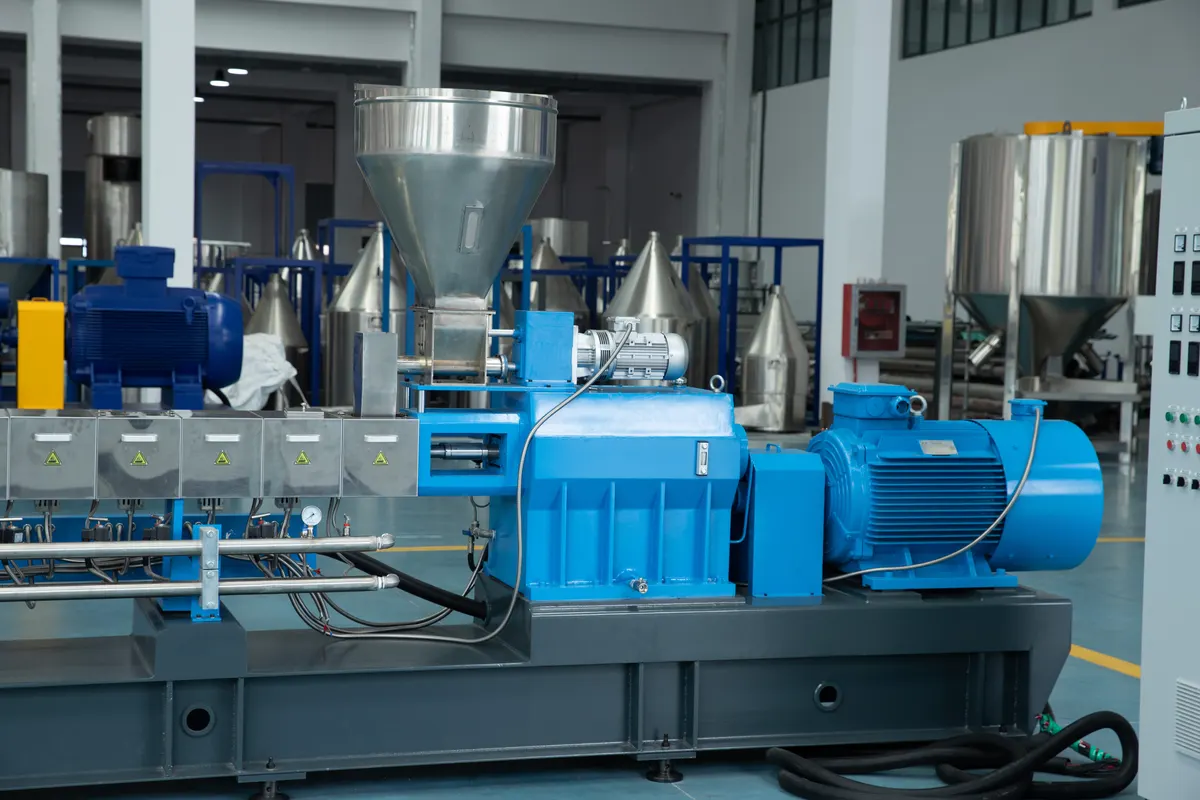
Reference formulations (patent-confirmed)
| Grade | Composition | Process |
|---|---|---|
| Antibacterial PET MB | Active 3–8% + PE wax 0.3–0.7 + coupling 0.1–0.3 + PET balance | 190/200/240/230/230/235/235/235/225°C, die 230 · 180 rpm · L/D 40 · water-strand → 3×3 mm |
| Antibacterial PP MB | Active 5–20% + lubricant 0.3–0.7 + coupling 0.1–0.3 + PP balance | 165/175/190/200/200/205/205/205/195°C, die 200 · 180 rpm · L/D 40 · same cutting |
| Vapor-phase rust-inhibitor MB | Rust inhibitor blend 30–50% + carrier 40–60% + additives 10–20% (talc 4.8–6.5 phr as release) | Ferrotype corrosion protection |
| Plant-based antibacterial PP | Biomass active + PP | Food-contact direction |
Process rules that protect the active
| Rule | Why |
|---|---|
| Slow screw: 180–200 rpm median (patent band 170–500) | Protect the ionic network and organic actives |
| Silver ≤230°C, organic ≤240°C | Discoloration and decomposition |
| Coupling agent on the inorganic carrier | Dispersion of zeolite powders into PE/PP |
| PE wax 0.3–0.7% | Just enough wetting; excess plasticizes |
| Water-strand cutting to 3×3 mm | The family-standard pellet format |
The family-consistency lesson
Both antibacterial PET and PP patents from the same applicant share speed, L/D, cutting and pellet format — only the temperature profile shifts with the carrier. That is what a mature process package looks like: one recipe family, fixed machine parameters, carrier-driven temperature. When a customer quotes you "our antibacterial recipe," ask for exactly these four numbers before discussing machines.
Machine matching
Standard B-class gearbox suffices — the loads are modest. What matters is gravimetric feeding precision (actives at 3–8% dosing need ±0.5% accuracy) and a vent stage. KTE-50/65 covers most antibacterial MB volumes.
Typical published practice — run trials on your own material before production.
Line setup that delivers this formulation
| Element | Specification | Reason |
|---|---|---|
| Frame | KTE-50B, 40:1 | 150–300 kg/h; small frames hold the temperature window better |
| Screw | Low-shear: 2 kneading groups, 45°/5 | Active protection, not dispersion aggression |
| Feeding | Main feed pellets, side feed carrier powder | Zeolite powder bridges in the main throat |
| Venting | −0.06 MPa, single port | Moisture from the zeolite carrier |
| Pelletizing | Water-strand to 3×3 mm | Matches the patent family's pellet format |
Keep the melt below 230°C for silver systems and below 240°C for organic actives. A 180–200 rpm screw speed is the median across the patent set and costs little output compared with a discoloured batch.
What this line costs
A 50 mm line with side feeder and water-strand pelletizing sits at USD 58,000–68,000 in 2024 terms; the 50B-48 filler configuration quoted at USD 56,500 is the closest reference point. Per kg/h it runs USD 190–380 because antibacterial masterbatch is a low-volume product — 150–300 kg/h on a 50 mm frame. The economics come from the active, not the machine: at 5–20% loading, the silver carrier is 80%+ of the cost of goods.
Trials before production
- Verify the active's actual content by assay before blending, not from the certificate alone.
- Run a 30-minute blank at production temperature and inspect for discoloration from the barrel itself.
- Pull samples at 10-minute intervals for the first hour to check dispersion consistency of the zeolite.
- Test antibacterial efficacy after extrusion, not before; the process can deactivate the carrier.
- Check pellet surfaces under 30× for silver specks — a sign of agglomeration, not of dosage.
The failure this recipe is known for
Antibacterial masterbatch fails quietly. The pellet looks right, the assay is right, and the finished part still grows bacteria — because the active never reached the surface. Silver-ion zeolite works by contact, so dispersion into the carrier is the whole mechanism. A masterbatch that disperses well but sits in the core of a thick part delivers nothing. Ask for a surface silver concentration test on the moulded part, not on the pellet.
FAQ
Can I use a twin screw with a strong kneading block?
No. High-shear elements raise local temperature 10–20°C and deactivate organic actives. Keep two kneading groups maximum.
Does the silver system discolour in sunlight?
Yes, above roughly 230°C during processing and on prolonged UV exposure in the finished part. That is a formulation issue, not a machine issue.
What pellet size should I aim for?
3×3 mm water-strand is the family standard in the patent set and disperses predictably in downstream let-down.
Is a lab trial enough to predict production?
Only if the lab frame reproduces the same residence time. Use a 25 mm frame at the production temperature profile rather than a 16 mm machine.
Does the carrier MFR affect antibacterial performance?
Indirectly. A low-MFR carrier keeps the active better dispersed but migrates more slowly to the surface; a high-MFR carrier blooms faster and loses effect sooner in service. ## What these numbers do not settle
The patent bands describe composition, not efficacy. Antibacterial performance depends on the active's surface availability after processing, which no composition table can predict. Nor do the bands tell you how the active behaves after the customer's second processing step at 230–250°C. Test efficacy on the finished part, not on the masterbatch.
Where these numbers come from
Figures in this page are drawn from patent-set process statistics, commissioning records, cross-checked against delivered-line commissioning records. They are typical published practice — run trials on your own material before fixing production settings.
Antibacterial Masterbatch — the short version
Related on this site: Screw speed by material · Functional MB overview · Vacuum level
Bottom line. Antibacterial masterbatch carries silver-ion zeolite or phosphate carrier actives at 5–20% concentration, and its defining constraint is thermal: organic antibacterials decompose above ~240°C and silver systems discolor above ~230°C. Numbers above are typical published practice, not guarantees. The deciding test is your own material — send 25–50 kg for a lab run with full parameters back in 3–7 days.