
Service · 9 min read
Twin Screw Extruder Troubleshooting: Nine Symptoms, Nine Causes
Most faults reported as 'the machine is not working' resolve to feeding, vacuum, temperature or wear. This is the tree we use on the phone before anyone books a flight. A reference twin screw extruder troubleshooting page from Kerke.
Diagnose in the order the material travels: feeder → feed zone → melting → vent → die → pelletizer. A symptom that appears at the die is usually caused two metres upstream.
Symptom → cause → action
| Symptom | Most likely cause | Check first |
|---|---|---|
| Output falls with no change in settings | Wear on screw elements or liner, or feeder drift | Weigh a 60-second sample at the die; compare with the feeder setpoint and with the commissioning record. |
| Torque high, output low | Cold barrel zone, blocked die hole, or over-long mixing section | Zone-by-zone temperature against the profile; die pressure; last screw configuration change. |
| Melt temperature runs away | Screw speed too high for the formulation, or worn elements generating shear without conveying | Reduce rpm 10% and watch the trend. If temperature follows rpm linearly, the screw is doing shear work instead of conveying. |
| Vent spitting melt | Melt seal not established, vacuum too high, or vent insert worn | Vacuum level (−0.06 to −0.09 MPa), feed rate stability, vent insert clearance. |
| Black specks in natural product | Degraded material on the screw, dead spots behind the die, or a worn screw flight | Purge and inspect; check the die plate radius and the last 3D element. |
| Strands break in the water bath | Die hole count too high for the polymer, water too warm, or filler loading too high for strand cutting | Water temperature (15–25 °C), bath length, and whether loading has moved above 50%. |
| Pellets with tails or twins | Blunt pelletizer blades, wrong blade clearance, or die face temperature too low | Blade gap (0.05–0.1 mm), blade wear, die heater band. |
| Fines above 2% | Brittle melt, blade speed too high, or water ring nozzle misalignment | Pelletizer rpm, water flow and angle, melt temperature at the die. |
| Gearbox oil temperature alarm | Blocked oil cooler, low oil level, or sustained torque above rating | Cooler water flow, oil level and colour, torque history for the last 24 h. |
When it is wear, not settings
Screw and liner wear is progressive and silent. Two measurements catch it early: output at fixed rpm and feeder setting (falls 5–10% before the operator notices anything) and clearance between screw flight and liner at the wear zone. For 85% CaCO3, plan on a wear inspection at 4,000–6,000 hours; for glass fibre, at 3,000–4,000.
Rule of thumb
If a change of settings fixes the symptom within one shift, it was a setting. If the symptom returns within a week at the same settings, it is wear, feeding or material — stop adjusting and start measuring.
What to send us
- Barrel profile, screw speed, feeder rates, vacuum, die pressure and torque at the moment of the fault
- Photos of the extrudate and of the die face
- Material batch, filler grade and any change in supplier
- Hours run since the last screw inspection
With those four items we can usually name the cause before a technician leaves Nanjing.
FAQ
Output dropped 15% overnight — where do I look?
First the feeder: weigh a timed sample at the die. If the feeder is delivering what it should, check die pressure and the last barrel zone temperature, then screw wear. A 15% overnight drop is almost never wear — wear is gradual.
Why does the vent spit only at high output?
The melt seal is being pushed downstream by the higher fill ratio. Either lower the vacuum slightly, move the vent one barrel back, or add a reverse-flight element before the vent.
How often should screws be inspected?
Every 2,500 hours for abrasive filler, every 4,000 for general compounding. Inspection means measuring flight width and liner clearance, not looking at the screw.
Where these numbers come from
Values are drawn from the Kerke parameter table, commissioning records and service reports from lines in the field. Temperature windows and consumption figures are typical ranges — confirm on your own material before they become a production setpoint.
Send 25–50 kg and we run it on our lab extruder: pellets, running video and a capacity report back in 3–7 days.
Twin screw extruder troubleshooting — the short version
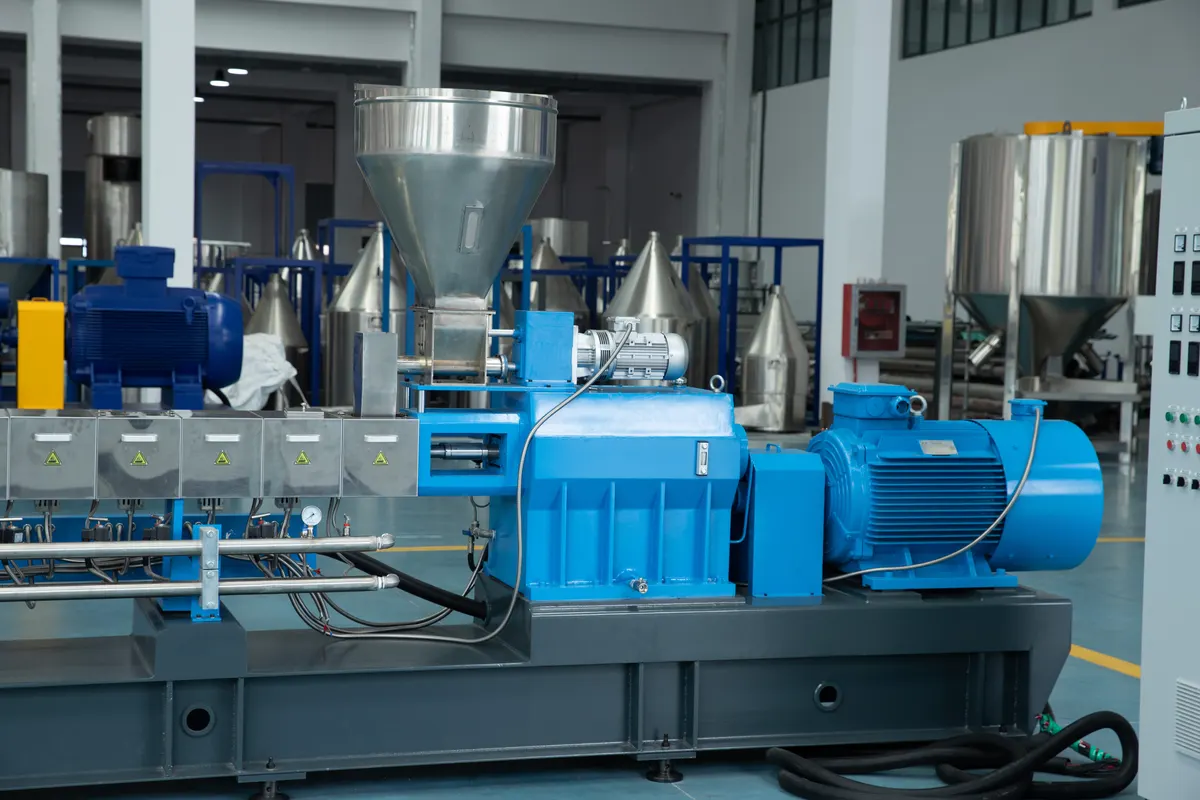
Note on Twin screw extruder troubleshooting: every figure on this page is a reference range measured on Kerke's own test line in Nanjing, not a catalogue maximum. If your material differs from the one in the table, send 25–50 kg and we will replace the range with a measured number.
Planning a twin screw extruder troubleshooting upgrade this quarter? Send the material and the target output — the configuration comes back within one working day.
Related on this site: Twin screw extruder range · Extrusion lines by application · free extrusion line quotation · Wikipedia: Pelletizing