
Machine · Co-rotating twin screw KTE
Co-Rotating Twin Screw Extruder (KTE-50B to KTE-135D)
Fifteen models from 50.5 mm to 135 mm, two gearbox classes and a custom L/D for every formulation. Most customers only need one decision explained clearly: B or D. A reference co-rotating twin screw extruder page from Kerke.
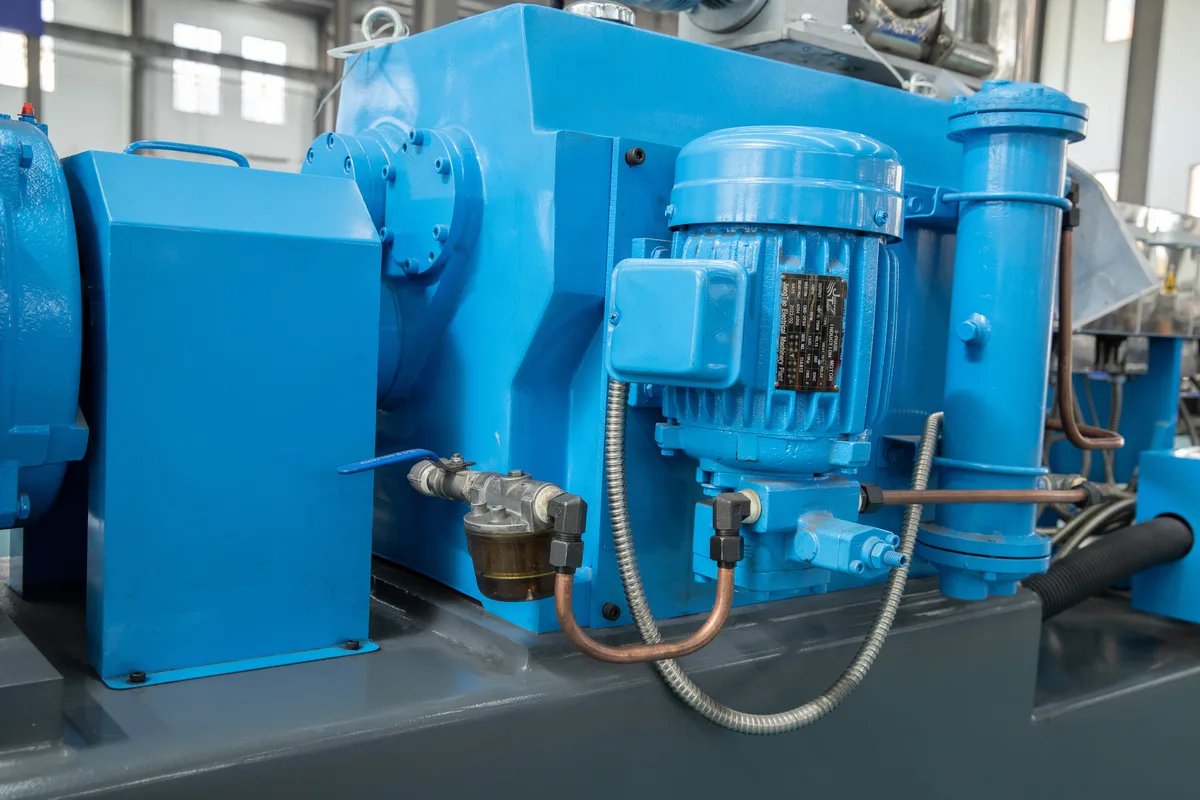 Co-rotating twin screw KTE — workshop photo 1, Kerke workshop, Nanjing
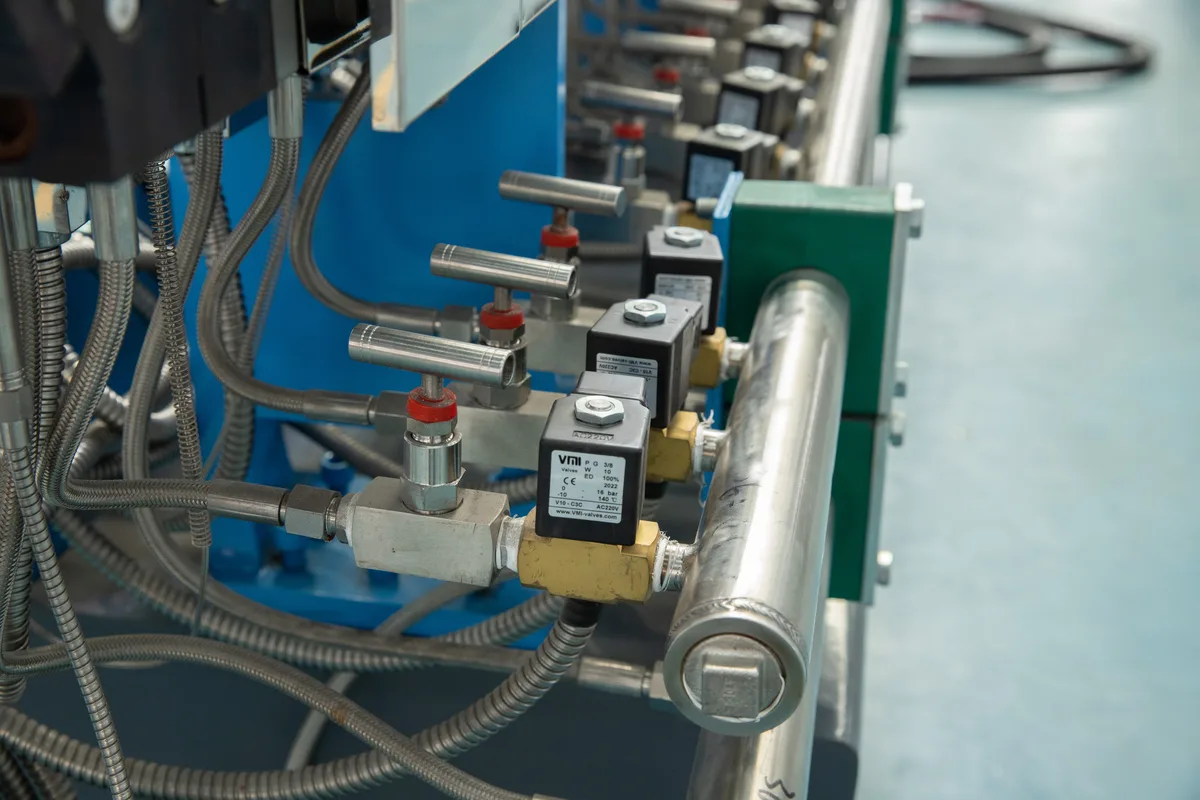 Co-rotating twin screw KTE — workshop photo 2, Kerke workshop, Nanjing
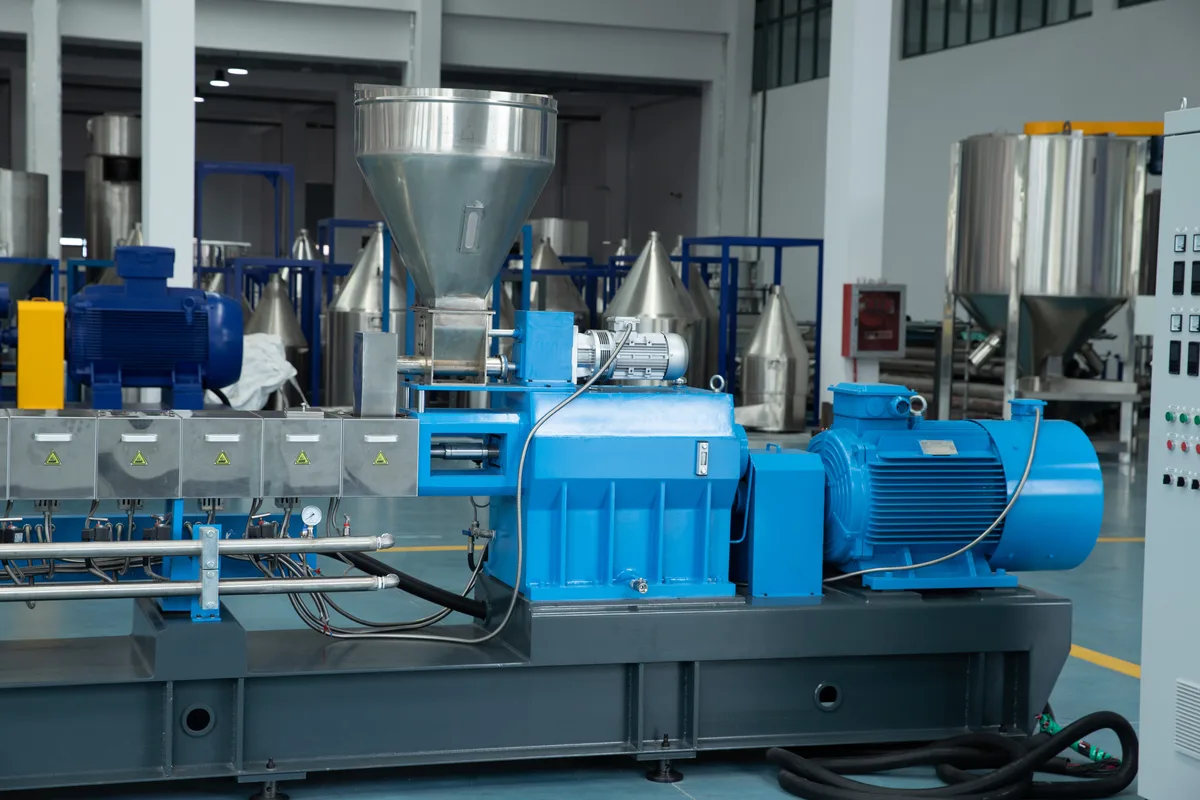 Co-rotating twin screw KTE — workshop photo 3, Kerke workshop, Nanjing
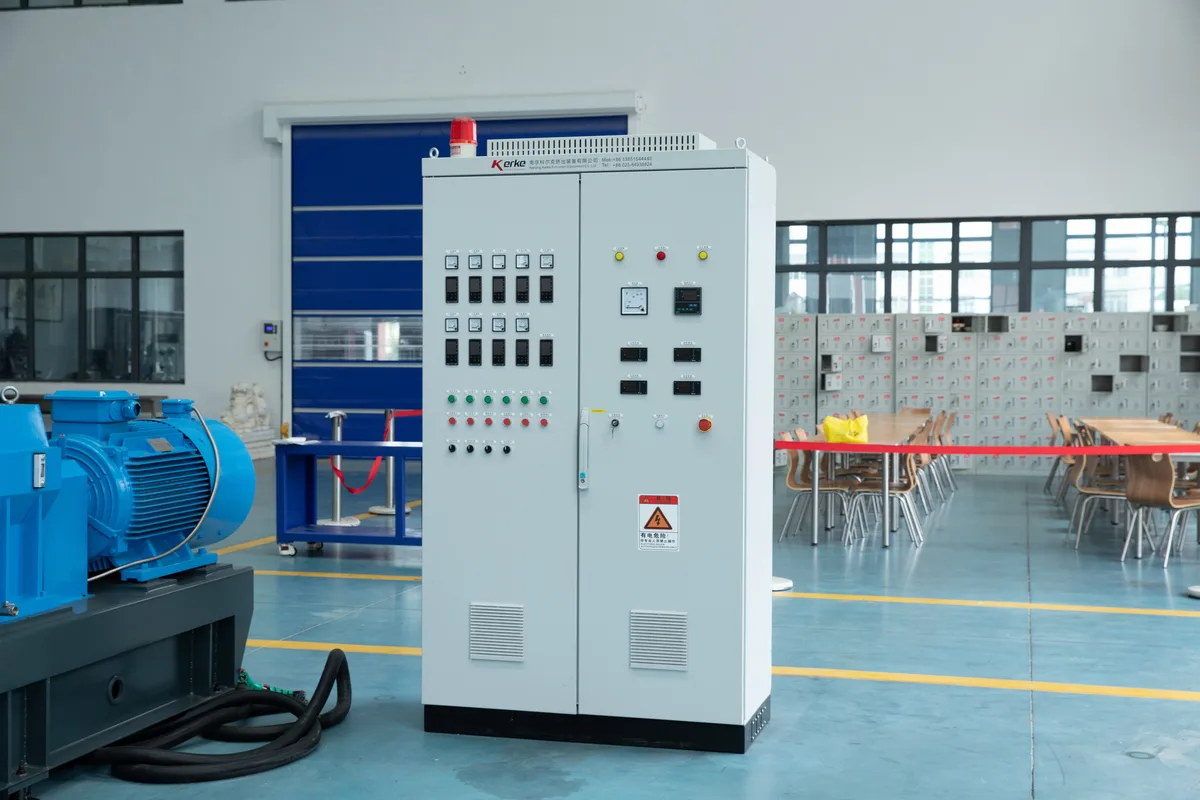 Co-rotating twin screw KTE — workshop photo 4, Kerke workshop, Nanjing
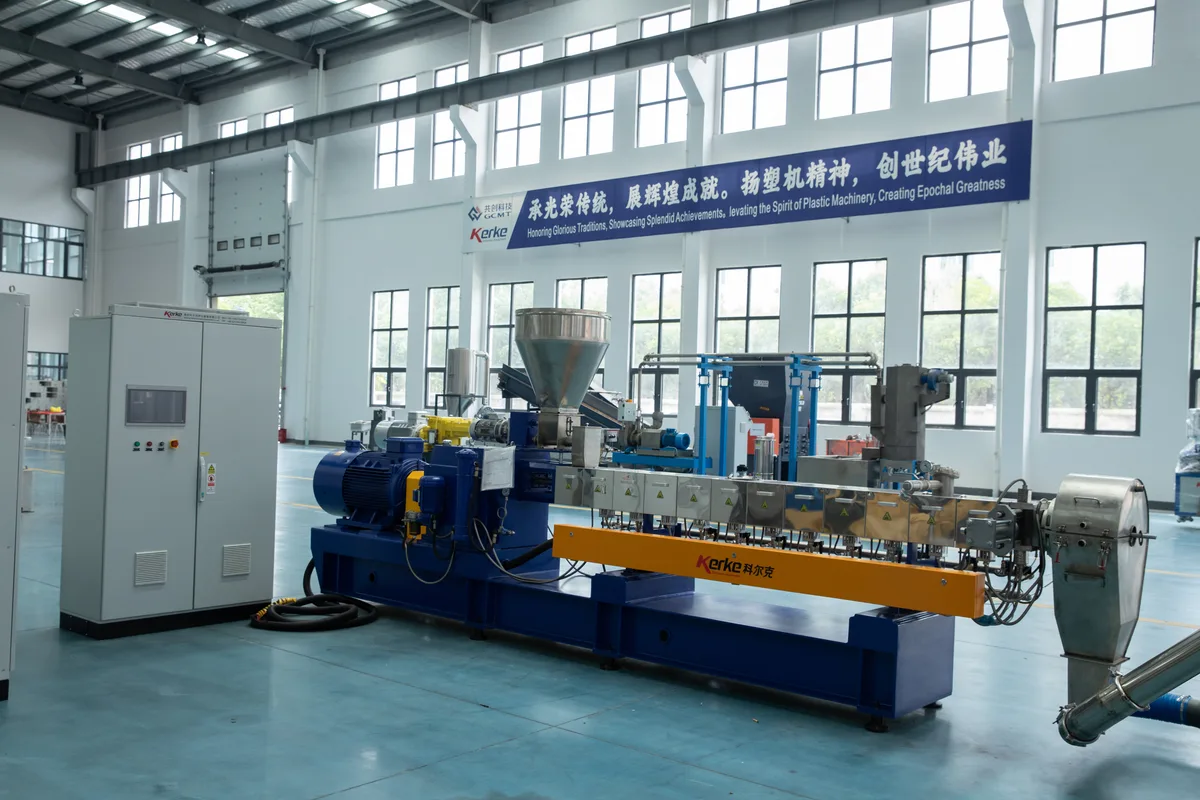 Co-rotating twin screw KTE — workshop photo 5, Kerke workshop, Nanjing
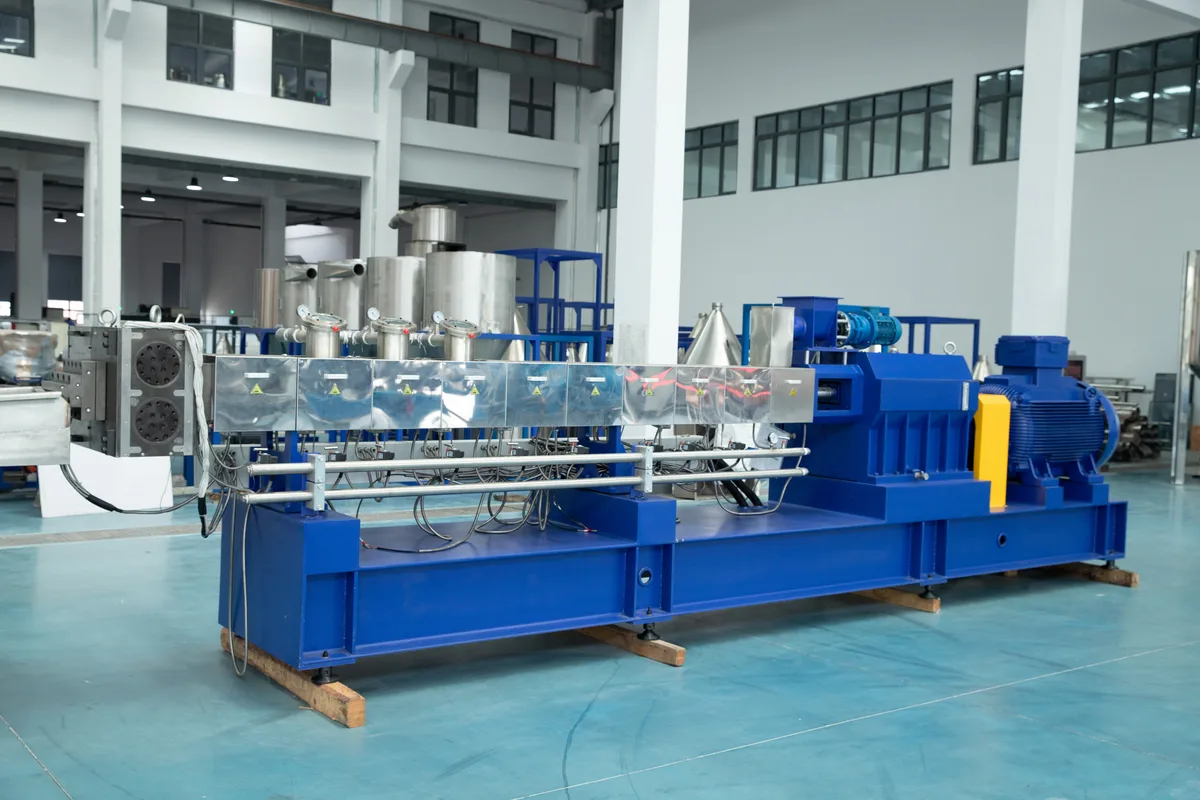 Co-rotating twin screw KTE — workshop photo 6, Kerke workshop, Nanjing
Quick answer
The KTE twin screw range runs from 50.5 mm to 135 mm screw diameter at 80–4,000 kg/h. Two gearbox classes: B (T/A³ 6–8) for general masterbatch and compounding, D (T/A³ 8–12) for high filler, glass fibre and high output. L/D is custom from 28 to 60.
Workshop photos and a running video — shot on our own lines, not stock images.
Parameter table
| Model | Dia. (mm) | Speed (rpm) | Motor (kW) | Torque (N·m) | Output (kg/h) |
|---|---|---|---|---|---|
| KTE-50B | 50.5 | 500–600 | 55–75 | 2×525 | 80–200 |
| KTE-50D | 50.5 | 300–800 | 75–90 | 2×860 | 100–300 |
| KTE-52B | 51.4 | 500–600 | 55–75 | 2×720 | 80–200 |
| KTE-52D | 51.4 | 500–600 | 75–110 | 2×1050 | 100–400 |
| KTE-65 | 62.4 | 500 | 75–90 | 2×720 | 100–350 |
| KTE-65B | 62.4 | 500–600 | 90–110 | 2×860 | 200–450 |
| KTE-65D | 62.4 | 300–800 | 132–160 | 2×1530 | 350–600 |
| KTE-75 | 71 | 300–800 | 110–132 | 2×1050 | 300–500 |
| KTE-75B | 71 | 500–600 | 132–160 | 2×1530 | 300–800 |
| KTE-75D | 71 | 300–800 | 200–315 | 2×2100 | 500–1000 |
| KTE-85B | 85 | 500–600 | 220–315 | 2×2100 | 550–1000 |
| KTE-95B | 93 | 500–600 | 250–315 | 2×3000 | 800–1500 |
| KTE-95D | 93 | 500–800 | 315–500 | 2×4800 | 1000–2000 |
| KTE-135B | 135 | 500–600 | 315–500 | 2×4800 | 1500–3000 |
| KTE-135D | 135 | 500–800 | 500–1000 | 2×7800 | 1500–4000 |
Reference output measured on the stated material family; subject to a material trial. Motor and torque values are per machine, not per screw shaft.
B or D: the only decision that really matters
B-class gearboxes (T/A³ 6–8) are the volume product: filler and colour masterbatch up to 85%, general compounding, plenty of torque margin for the price. D-class (T/A³ 8–12) exists for two jobs — high filler above 85% and glass-fibre reinforcement, where the machine must push a very viscous melt without stalling.
Same 65 mm screw, three different machines:
| Model | Torque | What it can do | Where it stops |
|---|---|---|---|
| KTE-65 | 2×720 N·m | Colour masterbatch, filling to 75% | High filler above 80% |
| KTE-65B | 2×860 N·m | Filler masterbatch to 85%, compounding | 88%+ filling, glass fibre at high output |
| KTE-65D | 2×1530 N·m | High filler, PA/PBT + 30–50% GF, 350–600 kg/h | — |
Screw and barrel
Building-block screws in W6Mo5Cr4V2 (M2 HSS) as standard, bimetallic liner in the barrel, 40CrNiMo shaft. For abrasive filler and glass fibre we specify a bimetallic barrel plus PM (powder metallurgy) screw elements — this is a wear package, not a marketing option.
Ordering notes
- L/D 28–60 is chosen per formulation: 32–36 simple filling, 40–48 reinforcement plus devolatilization, 52–60 reactive extrusion.
- Voltage and frequency are built for the destination country.
- Standard delivery 30–45 working days; custom ODM 45–70.
What this machine is normally bought for
Filler Masterbatch Extruder Line
Filler masterbatch is sold by the tonne, so the line is judged on two numbers only: how much powder it can swallow, an…
Color Masterbatch Extruder Line
Colour masterbatch is a dispersion business with a cleaning problem attached: the same line has to make 20% pigment di…
Engineering Plastics Compounding Line
Engineering plastics punish shortcuts in two places: drying (PA and PC want 120 °C for four hours, not 80 °C overnight…
Plastic Compounding Extrusion Line
Compounding covers everything from 20% glass fibre in PA6 to 3% additive in PP. The first question is never tonnage bu…
FAQ
How do I choose between B and D gearbox?
B (T/A³ 6–8) covers filler and colour masterbatch up to 85% and general compounding at the best price per kg/h. D (T/A³ 8–12) is for high filler above 85%, glass fibre and high output. Same 65 mm screw, 2×860 N·m against 2×1,530 N·m.
What L/D should I specify?
32–36 for simple filling, 40–48 when side feeding and devolatilization are needed, 52–60 for reactive extrusion. The formulation sets it; a longer screw is not automatically better.
What is the delivery time?
30–45 working days for standard models, 45–70 for ODM configurations. Voltage and frequency are built for the destination country.
Where these numbers come from
Screw diameters, speeds, motor ratings, torque and reference output come from the Kerke parameter table and the product master data sheet, and are cross-checked against commissioning records. Where a catalogue value and a trial value disagree, the trial value is the one we quote.
Reviewed by the Kerke process team, Nanjing. Page updated 6 November 2026.
Send 25–50 kg — we return pellets, a video and a report with the parameters we used, in 3–7 days.
Co-rotating twin screw extruder — the short version
Note on co-rotating twin screw extruder: what separates one machine from another is torque class, L/D and the wear package matched to your material, not the build standard. Shortlist from the tables, then confirm the choice on a trial with your own powder.
Planning an upgrade this quarter? Send the material and the target output — the configuration comes back within one working day.
Every quotation lists the wear package as a separate line, so its cost is visible from day one.
Questions are answered the same day, in English or Chinese.
Note on co-rotating twin screw extruder: the data on this page was last verified on our own test line in Nanjing.
Not sure which co-rotating twin screw extruder configuration fits? Describe the material and the pellet shape required — we answer with a recommendation, not a brochure.
A co-rotating twin screw extruder from Kerke ships with CE documentation, a test-run record and a recommended spare set.
Related on this site: Extrusion lines by application · Extruder selection guide · free extrusion line quotation · Wikipedia: Twin-screw extruder