
Process · 5 min read
Extruder Energy Consumption: kWh per kg, and Where It Goes
Specific energy for compounding typically lands between 0.12 and 0.35 kWh/kg. This article shows which of the two ends you are on, and what actually moves the number. A reference extruder energy consumption page from Kerke.
Energy is 5–12% of conversion cost, which is small until you run 6,000 hours a year. The useful question is not 'how many kW is the motor' but 'how many kWh does a kilo cost at my filling level'.
Benchmarks
| Application | kWh/kg | Why |
|---|---|---|
| Filler masterbatch 80% | 0.10–0.16 | Filler is easy to convey and needs little melting energy. |
| Colour masterbatch | 0.18–0.28 | Dispersion work dominates; pigment loading is low. |
| Glass fibre reinforced PA | 0.22–0.35 | High torque, high temperature, side-feed compression work. |
| PET recycling | 0.15–0.22 | Drying and devolatilization dominate the energy bill. |
| PVC compound (two-stage) | 0.12–0.18 | Low temperature, low shear by design. |
The four levers that move it
- Run near rated output. Specific energy at 50% output is 20–40% higher than at 90%; the motor and gearbox losses are nearly constant.
- Do not over-mix. Every extra kneading block adds 3–6% to specific energy. If dispersion tests pass at 40D, 48D is a donation to the electricity supplier.
- Insulate the barrel. Barrel heating is 15–25% of total energy on a cold shop floor; insulation pays back in about a year.
- Check the water circuit. A fouled heat exchanger raises pelletizer and chiller load without showing up in extruder data.
A quick calculation
Motor 110 kW, average load 72%, output 420 kg/h → 110 × 0.72 ÷ 420 = 0.19 kWh/kg. At 6,000 h/year and 0.10 USD/kWh, that is 479,000 kWh and 47,900 USD a year. A 10% improvement — mostly from running at higher output and removing one mixing block — is 4,800 USD a year per line.
Induction heating, honestly
Induction barrel heaters save 20–30% of heating energy, which is 4–7% of total energy — a real but modest number. They pay back faster on machines that run cold-start cycles than on lines that run continuously at high output.
FAQ
How do I measure specific energy properly?
Read motor input power from the drive for a full hour at steady state and divide by the weighed output. Using the nameplate kW gives a number that is 25–35% too high.
Does higher screw speed reduce energy per kg?
Up to a point: output rises faster than power. Beyond the point where melt temperature forces you to back off, it reverses.
Is a two-stage line less efficient?
Per kg it is comparable: two motors but less total shear work. The gain is stability at high filler, not kWh.
Where these numbers come from
Values are drawn from the Kerke parameter table, commissioning records and service reports from lines in the field. Temperature windows and consumption figures are typical ranges — confirm on your own material before they become a production setpoint.
Send 25–50 kg and we run it on our lab extruder: pellets, running video and a capacity report back in 3–7 days.
Extruder energy consumption — the short version
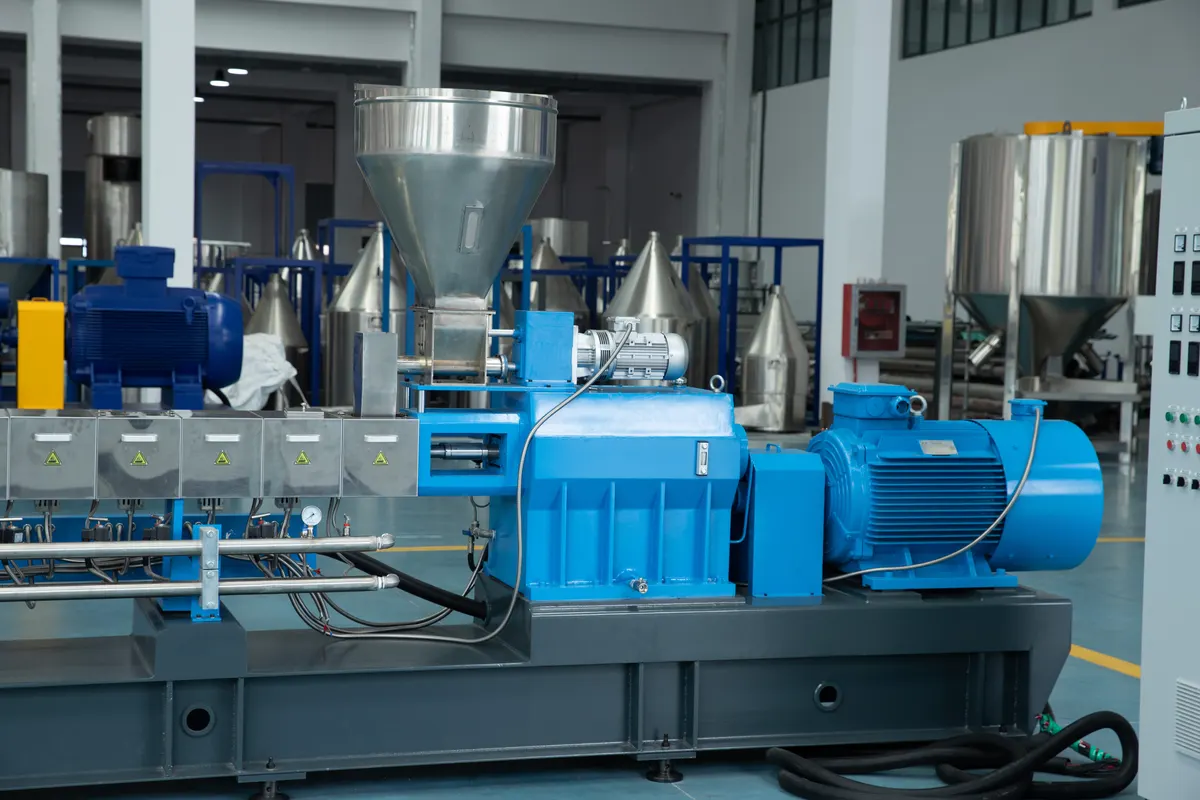
Note on Extruder energy consumption: every figure on this page is a reference range measured on Kerke's own test line in Nanjing, not a catalogue maximum. If your material differs from the one in the table, send 25–50 kg and we will replace the range with a measured number.
Related on this site: Twin screw extruder range · Extrusion lines by application · free extrusion line quotation · Wikipedia: Pelletizing