
Pelletizing · Water Ring Hot Die-Face Pelletizing
Water Ring Hot Die-Face Pelletizing: How Kerke Builds It
Pellets cut at the die face and flung into a ring of cooling water — the filler and black masterbatch standard up to 85% filler, with lens-shaped pellets and no strands to break.
 Water Ring Hot Die-Face Pelletizing — workshop photo 1, Kerke workshop, Nanjing
 Water Ring Hot Die-Face Pelletizing — workshop photo 2, Kerke workshop, Nanjing
 Water Ring Hot Die-Face Pelletizing — workshop photo 3, Kerke workshop, Nanjing
 Water Ring Hot Die-Face Pelletizing — workshop photo 4, Kerke workshop, Nanjing
 Water Ring Hot Die-Face Pelletizing — workshop photo 5, Kerke workshop, Nanjing
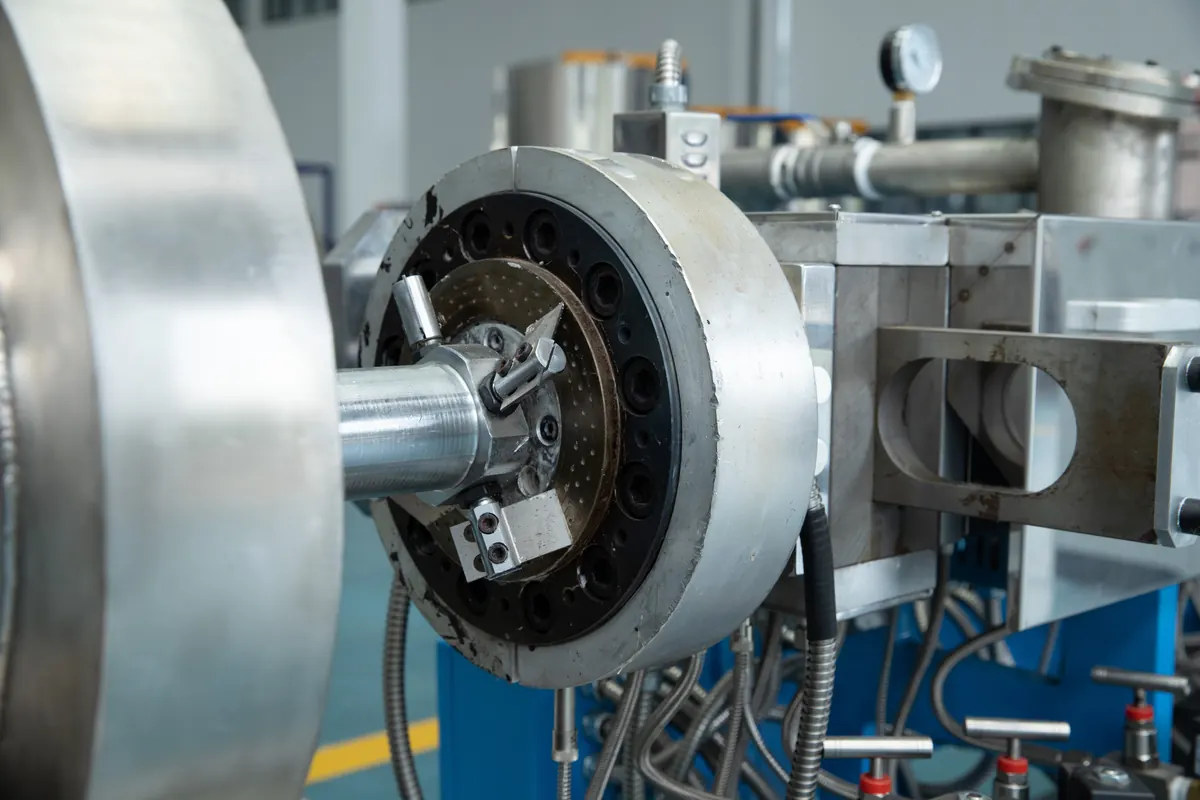 Water Ring Hot Die-Face Pelletizing — workshop photo 6, Kerke workshop, Nanjing
Quick answer
In water ring hot die-face pelletizing, rotating knives cut the melt at the die face and a ring of sprayed water catches and cools the pellets as they leave. Because nothing is cut after the die, high-filler melts that would snap as strands — 70–85% CaCO₃, carbon black masterbatch — pelletize without trouble.
Workshop photos — shot on our own lines in Nanjing, not stock images.
How the water ring hot die-face pelletizing line works
- Melt is pushed through a multi-hole hot die plate; hole count sets capacity.
- Rotating knives cut pellets flush at the die face.
- An annular water ring sprays at an angle, cooling pellets as they are flung outward.
- Slurry leaves through a chute into a dewatering screen.
- Centrifugal dryer and vibrating screener bring pellets below 0.3% moisture.
Where this method wins
Water ring is the masterbatch workhorse: filler masterbatch at 70–85% loading, carbon black and colour masterbatch where strand guides would blind, and PE/PP compounds. Pellets are lens or half-round with 8–12% surface moisture before drying. At very high filler the die holes can bridge — the die heater and knife geometry are what we tune on trial.
Reference data
| Item | Value |
|---|---|
| Best for | Filler/black masterbatch, PE/PP compounds |
| Output range | 200–2,000 kg/h |
| Pellet shape | Lens / half-round |
| Watch out | Die hole blockage at high filler, moisture before drying |
Reference output measured on the stated material family; subject to a material trial. Die hole count sets the capacity ceiling — check the die, not the label.
Selection notes from our floor
Two settings decide pellet quality: knife-to-die gap and water ring angle. Gap too tight gives fines and die wear; too wide gives tails. The water angle must carry pellets away without flooding the cutter motor. We ship both settings pre-tuned from the trial.
FAQ
Why not use strand cutting at 80% filler?
Strands stiffen as filler rises and break between die and cutter — the line stops every few minutes. Hot face cutting removes the strand entirely, which is why nearly all high-filler masterbatch is die-face cut.
How dry do pellets come out?
8–12% surface moisture off the ring; a centrifugal dryer brings it under 0.3%, and a hot-air drying stage can reach below 0.1% for extrusion-critical grades.
Can the cutter be retrofitted to an existing extruder?
Often yes — the die, water ring and drive are a bolt-on module. We check shaft bearing load and discharge height before quoting.
Where these numbers come from
Output ranges, pellet shapes and watch-outs come from Kerke commissioning records and the pelletizing systems parameter table. Where a catalogue value and a trial value disagree, the trial value is the one we quote.
Reviewed by the Kerke process team, Nanjing. Page updated 11 November 2026.
Send 25–50 kg — we return pellets, a video and a report with the parameters we used, in 3–7 days.
Water Ring Hot Die-Face Pelletizing — the short version
Hot die-face cutting under a water ring suits high-filler and black masterbatch where strand guides clog. Pellets are rounder than strand cut but carry surface moisture that needs a short drying pass.
Related on this site: Pelletizing systems (all 7 methods) · Pelletizing methods compared · free extrusion line quotation