
Selection guide · 5 min read
How to Calculate Twin Screw Output (Q = 2mnV) with Worked Examples
The theoretical maximum output of a fully intermeshing twin screw is Q_max = 2·m·n·V, where m is the number of flight starts, n the screw speed (r/min), and V the volume of one C-shaped chamber.
This page collects our floor notes on Twin Screw Output: how the line is laid out, the numbers we reference most, and the checks that prevent the usual startup problems.
Short answer: The theoretical maximum output of a fully intermeshing twin screw is Q_max = 2·m·n·V, where m is the number of flight starts, n the screw speed (r/min), and V the volume of one C-shaped chamber. Real output is set by the feed rate — a starve-fed twin screw with gravimetric feeding produces what you feed it, and the calculation tells you whether the screw can keep up.
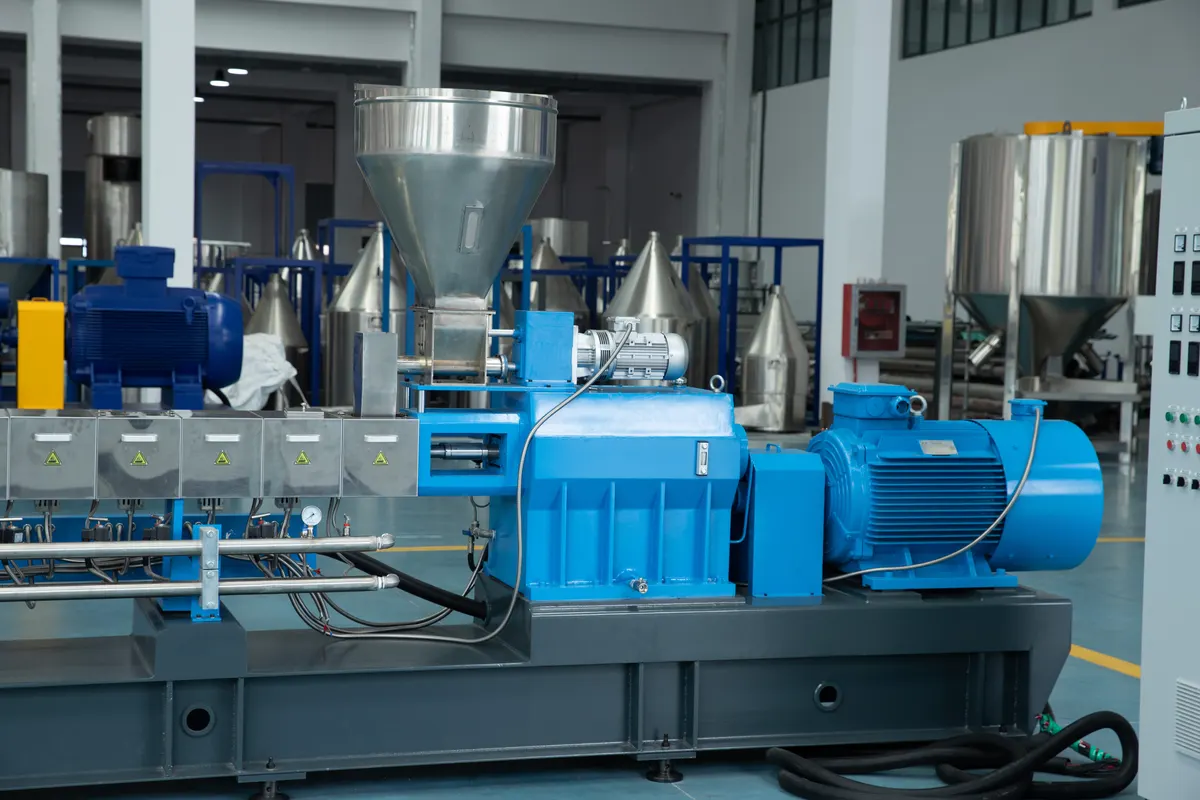
The formula pieces
`` V = ½ · π · D · h · sinφ · (D − √(2Dh)) (one C-chamber volume, cm³) Q_actual ≈ F · T · n_p · η · γ F = cross-section channel area of both screws T = lead (pitch), n_p = speed in r/h η = fill factor: 0.4–0.9 for co-rotating γ = bulk density of feed ``
Worked example: KTE-65B at 600 rpm, PP + 40% CaCO₃
- D = 6.24 cm, channel depth h ≈ 0.155·D ≈ 0.97 cm, lead angle φ ≈ 10° → sinφ ≈ 0.17
- V = ½·π·6.24·0.97·0.17·(6.24−√(2·6.24·0.97)) ≈ ½·3.34·(6.24−3.48) ≈ 4.6 cm³ per chamber
- Q_max = 2 · m(2) · n(600) · V(4.6) ≈ 11,040 cm³/min ≈ 662 L/h of chamber volume
- At fill factor 0.5 and bulk density 0.55 g/cm³ → ≈ 182 kg/h theoretical drag contribution; with pressure flow and the actual starve-fed balance, the catalog value 200–450 kg/h is consistent.
The sanity check that matters: your theoretical number must land inside the catalog band for that material row (KTE-65 filler masterbatch: 200–400 kg/h). If it is far outside, the fill factor or bulk density assumption is wrong.
What actually sets real output
| Factor | Effect | Fix |
|---|---|---|
| Feed rate (starve-fed) | Output = feed rate, full stop | Calibrate the loss-in-weight feeder |
| Bulk density of feed | Fluffy film/filler starves the screw | Force feeder or pre-agglomeration |
| Fill factor in melting zone | Too low = poor melting, too high = surging | Adjust screw config, not just rpm |
| Vent/vacuum losses | Volatiles occupy capacity | Raise vacuum, stage the venting |
The practical takeaway
Customers ask "how many kilos per hour on my material?" The honest answer chain is: catalog row for the material family → narrow it by filler % and feed form → confirm with a trial on your own material. Published values are references, not promises.
Worked example on a 65 mm frame
Take a KTE-65B: D = 62.4 mm, centre distance A = 58 mm, flight starts m = 2, channel depth ratio 1.55. Compute Q_max at 400 rpm, then apply the fill factor and the material factor.
| Step | Value | Note |
|---|---|---|
| Geometric chamber volume V | ≈ 105 cm³ | From D² × A × depth ratio |
| Q_max = 2·m·n·V | 2 × 2 × 400 × 105 ≈ 168,000 cm³/min | Theoretical, fully filled |
| Realistic fill factor | 0.25–0.35 | Starve-fed operation |
| Bulk density factor | 0.55–0.75 | Pellets vs 0.4 g/cm³ powder |
| Practical output | 250–450 kg/h | Matches the catalogue band |
The catalogue figure for KTE-65B is 200–450 kg/h, so the formula brackets reality within ±15%. When a quote claims 700 kg/h on a 65 mm frame at 40:1, either the fill factor is being ignored or the material is a low-bulk-density foam.
What actually limits output
- Feeder capacity, not screw capacity, on starve-fed lines. A 65 mm machine with a 300 kg/h loss-in-weight feeder will never exceed 300 kg/h.
- Torque at high filler. Above 60% CaCO₃ the screw runs out of torque before it runs out of volume.
- Die and screen pressure. A blinded screen costs 10–20% of output before anyone notices.
- Vent capacity. Adding 15% output without adding vacuum capacity pushes volatiles through the die.
Cost implication of the number
Output drives the per-kg/h economics more than any option. In 2024 quotation terms, a 65 mm filler line at USD 70,850 over 300 kg/h is USD 236 per kg/h of capacity; the same money spread over 450 kg/h is USD 157. That is why a correctly sized frame is cheaper than a small frame run flat out — the second one wears out first.
What to send with your enquiry
- Bulk density and particle size of every solid component.
- The output you need per hour and per shift, so surge capacity can be sized.
- Whether the machine runs starve-fed with gravimetric control or flood-fed.
- Pelletizing method, because die pressure sets the practical ceiling.
- The highest filler loading you intend to run, now or in three years.
Bottom line
Q = 2mnV gives the ceiling, the feeder sets the floor, and torque decides which one you hit first. When a supplier quotes output without stating the fill factor and the bulk density, the number cannot be checked — ask for both. Then buy one frame size above your current need: output targets grow faster than machines do.
FAQ
Why is my output lower than the formula?
Check three things in order: feeder calibration, screen condition, and vacuum level. In field data, those three account for most of the gap — not screw design.
Does screw speed increase output linearly?
No. Above roughly 70% of maximum speed, conveying efficiency drops and melt temperature rises 8–12°C per 100 rpm. Output gains flatten while wear accelerates.
Can I raise output by changing the screw configuration?
Yes, up to 10–15%, by shortening the kneading section on easy dispersions. Beyond that you are trading dispersion quality for kilos.
How do I compare two vendors' output claims?
Ask for the fill factor and the material bulk density behind the number, then recompute. A claim without those two inputs is a catalogue entry, not a calculation.
Where these numbers come from
Figures in this page are drawn from KTE parameter tables, shaft design notes, cross-checked against delivered-line commissioning records. They are typical published practice — run trials on your own material before fixing production settings.
How to Calculate Twin Screw Output — the short version
Related on this site: Capacity by material · Loss-in-weight calibration · Specific torque
Bottom line. The theoretical maximum output of a fully intermeshing twin screw is Q_max = 2·m·n·V, where m is the number of flight starts, n the screw speed (r/min), and V the volume of one C-shaped chamber. Ranges here come from our floor notes and typical published practice — they set the design direction, not your setpoints. Send 25–50 kg and we return pellets, a running video and a capacity report to confirm against your targets.