
Process guide · 5 min read
Masterbatch Carrier Selection: MFR, Compatibility & the One Rule
One rule covers 90% of carrier selection: use the same or a compatible resin as the customer's end polymer, with an MFR slightly higher than the end resin. Everything else — cost, pellet quality, dispersion — follows from that.
Short answer: One rule covers 90% of carrier selection: use the same or a compatible resin as the customer's end polymer, with an MFR slightly higher than the end resin. Everything else — cost, pellet quality, dispersion — follows from that. The carrier is 12–45% of a masterbatch by weight and 100% of its ability to disperse into the customer's process.
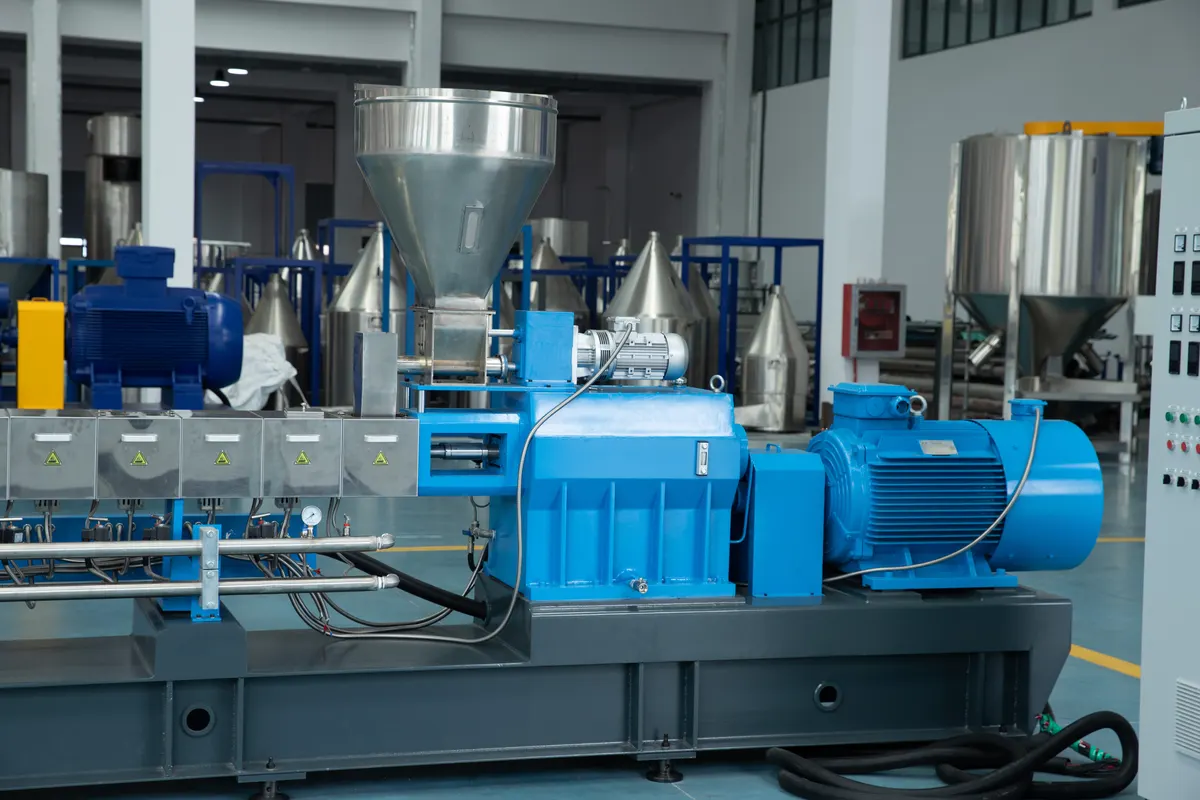
Carrier choices by masterbatch type
| Masterbatch | Preferred carrier | Why |
|---|---|---|
| Filler (CaCO₃, talc) | PP powder or LLDPE; recycled PP + LDPE for cost grades | Wetting + cost; amorphous PP wets mineral best |
| Color, general | LLDPE/LDPE MFR ≈ 20 | Universal compatibility with polyolefins |
| Color, engineering | PA, PC, ABS, PBS matched to end resin | Incompatible carrier = dispersion failure downstream |
| Black | LLDPE MFR 20–50 (food grade 30–50) | High black loading needs flow |
| White (TiO₂) | LLDPE, higher MFR than end resin | 50–70% pigment needs mobility |
| Flame retardant | Same family as end resin (PE/PP/ABS/PA) | FR must disperse where it must perform |
| Biodegradable color | PBS/PLA carriers at 240–260°C | Carrier sets the temperature window, not the pigment |
The MFR logic in one table
| End resin MFR | Carrier MFR | Result |
|---|---|---|
| 2 (pipe grade HDPE) | 5–8 | Disperses; no flow lines |
| 8 (film LLDPE) | 15–20 | Standard |
| 30 (thin-wall injection) | 40–50 | Keeps cycle time |
| Carrier MFR below end resin | — | Undispersed pigment, specks, strength loss |
Cost levers that work (and traps)
- Recycled carrier (recycled PP 10–20% + LDPE + PP-g-MAH + peroxide to set MFR): documented cost reduction, but MFR drift between lots must be compensated by the peroxide dose
- Filler mesh down one grade: saves cost, costs impact strength at high dosage — test before quoting
- Trap: cheap carrier with lower MFR than the customer's resin — the masterbatch "works" in your trial on your own resin and fails at the customer
The compatibility footnote
For blends (PC/ABS, PA/PP), a single carrier cannot serve both phases — that is when compatibilized carriers (MAH-g-PP, SMA) enter. If the customer is running a blend, ask which phase the masterbatch must live in; the answer changes the carrier, not just the dosage.
Typical published practice — run trials on your own material before production.
Carrier choice mapped to process consequences
| End polymer | Carrier | MFR rule | Process note |
|---|---|---|---|
| PE film | LDPE/LLDPE | 2–8 g/10min higher than end resin | Low melting, keep Z1 cool |
| PP injection | PP homopolymer | 8–15 higher | Watch die swell on high-MFR |
| ABS/PC | SAN or ABS | Match end MFR | Dry before use, 80°C × 4 h |
| PET fibre | PET | 0.60–0.64 IV | Dry to <50 ppm, air-cooled cut |
| PVC | PVC or acrylic | Plasticiser-compatible | 150–170°C ceiling |
The carrier is 12–45% of masterbatch weight, which means a wrong choice is not a small error: at 30% carrier, a mismatch with the end polymer shows up as delamination, weld-line weakness or a 15–25% impact loss in the moulded part.
What carrier choice costs
A carrier upgrade from commodity LDPE to a matched engineering grade adds USD 0.15–0.45/kg to the masterbatch, which is 3–8% of selling price at typical loadings. On a 65 mm line quoting around USD 70,850, the machine cost is unaffected — this is a formulation decision with a nine-figure-free price tag attached. The expensive mistake is the opposite: using a cheap carrier that forces the customer to over-dose by 30%.
Trials before production
- Measure the end resin's MFR yourself; certificates drift by 10–20% between lots.
- Run a 2% let-down on the customer's actual machine, not on your lab press.
- Check dispersion after let-down, not on the masterbatch pellet.
- Test weld-line strength if the part has one — carrier mismatch shows there first.
- Store the masterbatch 30 days and re-test; some carrier pairs migrate and bloom.
What goes wrong when the carrier is wrong
Three symptoms cover most carrier mistakes. Delamination at a weld line means the carrier is incompatible with the end resin and no amount of dispersant will fix it. Blooming after two weeks means the carrier is too low in molecular weight and migrates. Over-dosing — the customer needs 4% instead of 2% to hit colour — means the carrier's MFR is far from the end resin's, so the masterbatch dilutes unevenly. All three are visible in a 2 kg let-down trial and invisible in the pellet.
FAQ
Can I use one carrier for several end polymers?
For PE and PP yes, with a compromise MFR. For engineering resins no — the polarity difference is too large and dispersion fails at let-down.
Does a higher-MFR carrier always disperse better?
Up to a point. Above roughly 25 g/10 min the carrier wets the pigment faster but the pellet becomes sticky and feeder performance suffers.
Why does my masterbatch work in PP but not in PP copolymer?
Copolymer has a different crystallinity and melt elasticity. Drop the carrier MFR by 3–5 points, or accept 10–20% higher dosing.
Is carrier the same as compatibilizer?
No. A compatibilizer is grafted (MAH-PP, for example) and reacts at the interface; a carrier is a passive vehicle. Confusing the two is a common and expensive specification error.
Can I blend two carriers to split the difference?
Yes, and it is common practice for PE film grades. Keep the MFR difference between the two carriers under 10 g/10 min or you get phase separation in the pellet.
What these numbers do not settle
The MFR rule holds for polyolefins and roughly for styrenics. It does not hold for PET and PA, where moisture and IV/crystallinity dominate, nor for PVC, where the carrier must match the plasticiser system. Read the table as a starting rule and confirm on the customer's machine.
Where these numbers come from
Figures in this page are drawn from patent-set process statistics, commissioning records, cross-checked against delivered-line commissioning records. They are typical published practice — run trials on your own material before fixing production settings.
Masterbatch Carrier Selection — the short version
Related on this site: Color MB formulation · Filler skeleton · MAH grafting