
Process guide · 5 min read
Color Masterbatch Formulation Guide: Pigment, Carrier & Dispersion
A color masterbatch is pigment 10–50% (organic 10–25%, inorganic 20–50%), carrier resin chosen to match the customer's end polymer, dispersant 5–8%, and a stabilizer package.
Short answer: A color masterbatch is pigment 10–50% (organic 10–25%, inorganic 20–50%), carrier resin chosen to match the customer's end polymer, dispersant 5–8%, and a stabilizer package. What the customer actually buys is batch-to-batch color consistency — which is produced by dispersion discipline and filtration precision, not by the pigment itself.
Reference formulation
| Component | Range | Notes |
|---|---|---|
| Pigment | Organic 10–25% / inorganic 20–50% | Organics fear over-shear (color shift) |
| Carrier | LLDPE/LDPE MFR ≈ 20, or matched system | Carrier MFR above end resin |
| PE wax / oxidized wax | 5–8% | Wetting is the product |
| Stearates + antioxidant | 1–2.3% |
Patent highlights worth quoting
- UV-resistant nylon color MB (2020): PA carrier 20–30 + pigment 8–15 + dispersant 4–12 + stabilizer 6–15 + UV absorber 7–10 + nano-TiO₂ 5–15 — the complete engineering-plastic additive stack
- Antibacterial degradable color MB (2020): PBS carrier + pigment + dispersant at twin-screw 240–260°C — biodegradable carriers raise the temperature window, not lower it
- TiO₂ surface treatment (2020): wet-mill → SiO₂/Al₂O₃ coat → 300–500°C dry — white MB quality is decided at the pigment supplier
Process window
| Parameter | Setting |
|---|---|
| Premix | HIM 3–5 min; heavy pigments pre-wet as paste/master slurry |
| Feeding | Gravimetric main feed; micro-side-feeding for pigment beats main-feed on dusting and stratification |
| Shear | 2–3 kneading groups (45°/90°) + toothed elements; drop one shear grade for organic pigments |
| Filtration | 80–120 mesh |
| Vent | One stage — pigment powder carries air |
| Pelletizing | Water-strand (most economical) or water-ring; strand breakage on high-pigment recipes comes from low melt strength |
| Temperature | Carrier decides: PE 160–190 · PP 180–220 · PS/ABS 200–230°C; PET fiber-grade black runs 270–285°C with special vacuum, L/D 48 |
Speed reality check
Patent statistics for color masterbatch: median 245 rpm but quartiles 100–550 — the widest band of any family, because the carrier (not the pigment) sets the rheology. There is no universal color-masterbatch speed.
What breaks batch consistency
- Pigment stratification in feeding → micro-side-feeder
- Incomplete pigment wetting → dispersant first, shear second
- Screen breakthrough → mesh discipline + changeout schedule
- Thermal history shifts → fix carrier MFR, fix profile, log zone temps per batch
Typical published practice — run trials on your own material before production.
Line setup that delivers this formulation
| Pigment type | Loading | Frame | Screw | Output |
|---|---|---|---|---|
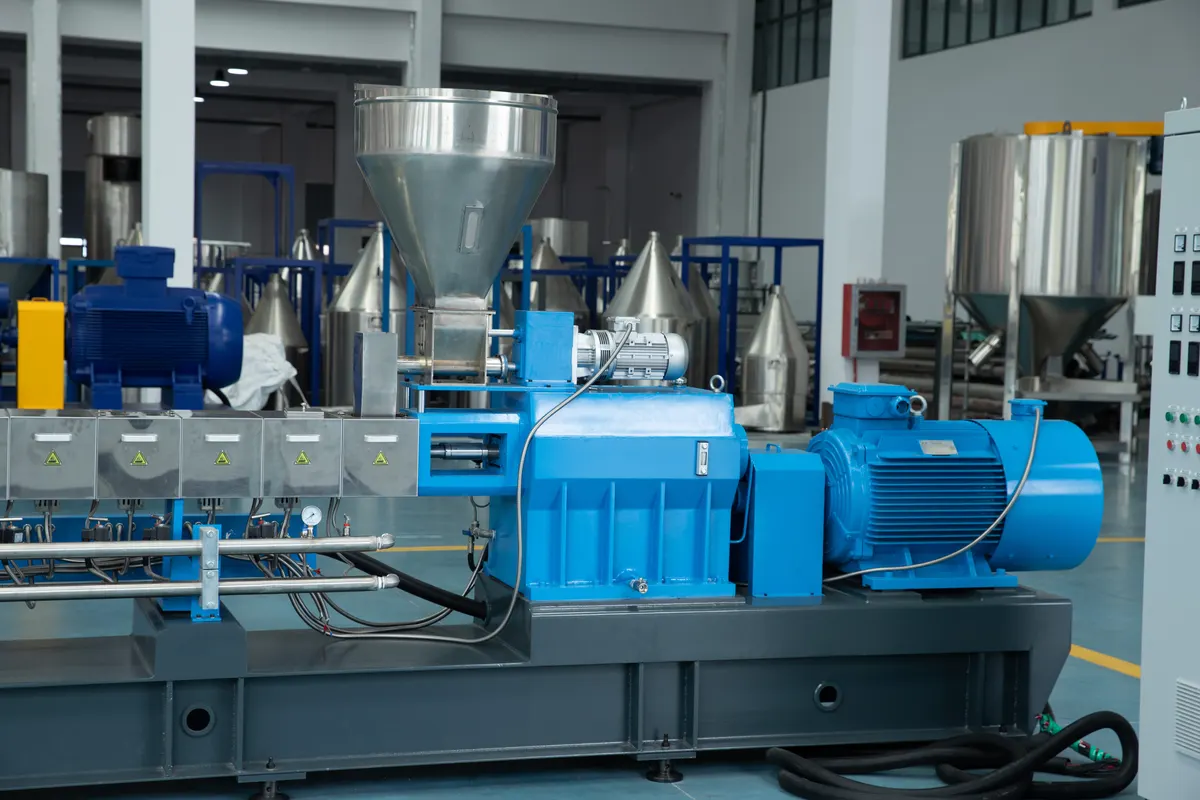
| Organic (phthalocyanine, azo) | 10–25% | KTE-50B | 40:1, 2 kneading groups | 150–300 kg/h |
| Inorganic (TiO₂, iron oxide) | 20–50% | KTE-65B | 40:1, 3 kneading groups | 300–450 kg/h |
| High-transparency | 10–30% | KTE-T-50B triple | 600 rpm, low-shear | 400–1,200 kg/h |
The transparency case is the one where machine choice shows: a triple screw splits the melt interface three times instead of two, and that is visible as fewer streaks in a 2 mm plaque.
What this line costs
A 50 mm color masterbatch line with gravimetric feeding and water-ring pelletizing lands at USD 55,000–65,000 in 2024 terms, against the 50B-48 filler reference at USD 56,500. Per kg/h at 250 kg/h it is USD 220–260 — color masterbatch is a low-rate, high-margin product, so the machine cost per kilo is less important than changeover speed.
Trials before production
- Check pigment dispersion with a grind gauge before extrusion; above 15 µm the extruder cannot fix it.
- Run a let-down trial at the customer's actual ratio (typically 2%) and measure ΔE, not just visual match.
- Record torque at each pigment loading; organic pigments at 25% can double the torque of a 10% batch.
- Clean between colours with a purge compound and count the kilos needed — that number is your changeover cost.
- Check pellet surface for pigment specks under 30× before shipping any sample.
The failure this recipe is known for
Colour masterbatch fails at let-down, not at production. A masterbatch that measures ΔE 0.6 at 5% dosing can measure ΔE 1.4 at 2%, because dispersion differences amplify as the pigment is diluted. Always qualify at the customer's let-down ratio, and keep the ratio in writing — half of all colour disputes are a dosing disagreement, not a quality problem.
FAQ
Why does my colour shift between batches?
Three causes in order: pigment lot variation, feeder drift, and dispersion differences from screw wear. Standardise the pigment lot first.
Is a twin screw necessary for colour masterbatch?
For organic pigments at 10–25%, yes — a single screw cannot wet the pigment adequately. For inorganic at high loading, a two-stage single screw can work.
How do I hit ΔE below 1.0?
Control three things: pigment lot, dispersant level, and melt temperature within ±5°C. The machine contributes less than the formulation discipline.
Does the pellet size affect colour measurement?
Yes. Measure on a moulded plaque, never on pellets — pellet surface geometry changes the reading by 0.3–0.8 ΔE.
Can I fix a streak problem with more dispersant?
Only to about 8%. Above that the dispersant plasticises the carrier and the streaks get worse while the pellet gets sticky. ## What these numbers do not settle
Colour is a formulation-and-measurement problem more than a process problem. The bands tell you what loading is practical; they cannot tell you the ΔE your customer's spectrophotometer will read under D65 versus TL84. Ask for the customer's illuminant and geometry before promising a match — a 0.4 ΔE difference between instruments is normal.
Bottom line: colour masterbatch is a dispersion business dressed as a pigment business. The loading decides the price, the carrier decides whether the customer can use it, and the ΔE at their let-down ratio decides whether they reorder.
Where these numbers come from
Figures in this page are drawn from patent-set process statistics, commissioning records, cross-checked against delivered-line commissioning records. They are typical published practice — run trials on your own material before fixing production settings.
Color Masterbatch Formulation Guide — the short version
Related on this site: Carbon black formulation · White MB formulation · Screw elements
Bottom line. A color masterbatch is pigment 10–50% (organic 10–25%, inorganic 20–50%), carrier resin chosen to match the customer's end polymer, dispersant 5–8%, and a stabilizer package. Use the references above to shortlist, then let the material decide: a 25–50 kg lab trial settles filler ceiling, pellet shape and output before you commit to a line.