
Application · Plastic Masterbatch
Talc Filler Masterbatch Line: Dispersion & Wear Solutions
Talc is a platelet, not a bead. It resists wetting, abrades the barrel along its own flat faces, and at 60–70% loading it turns a filler line into a wear test. A reference talc filler masterbatch line page from Kerke.
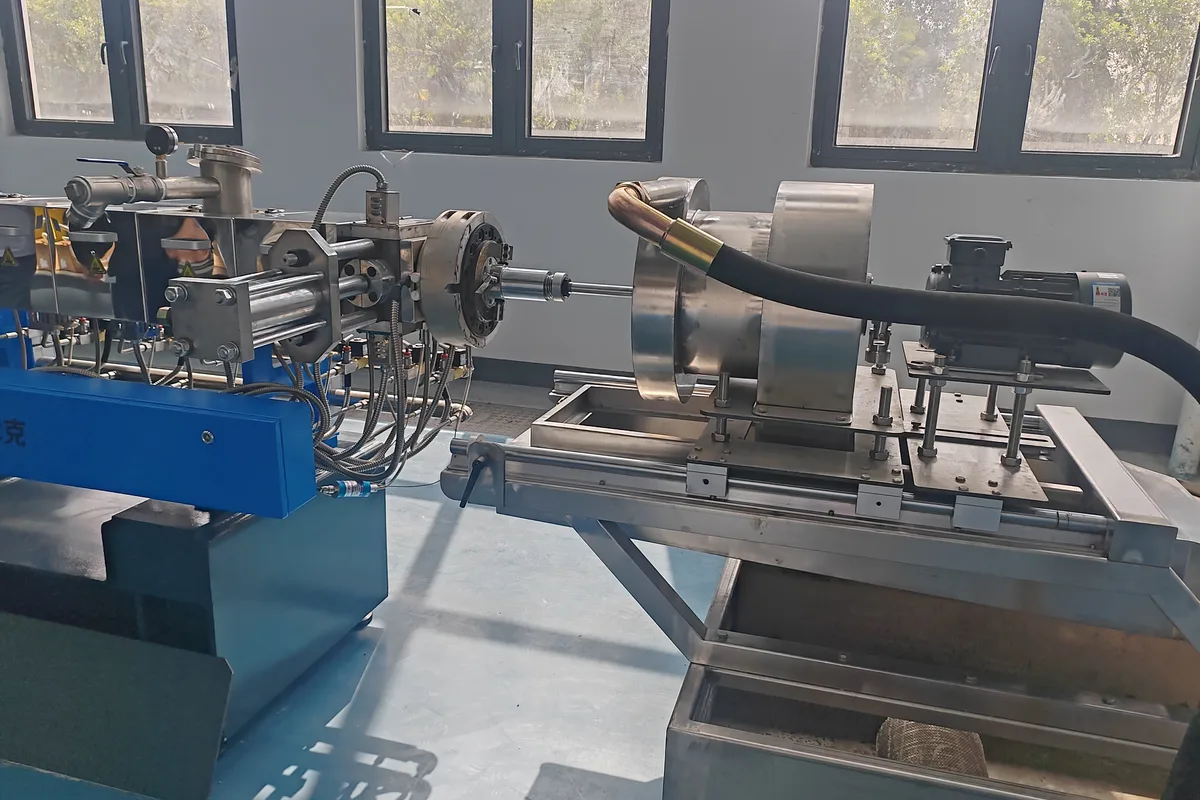 Talc Filler Masterbatch Line — workshop photo 1, Kerke workshop, Nanjing
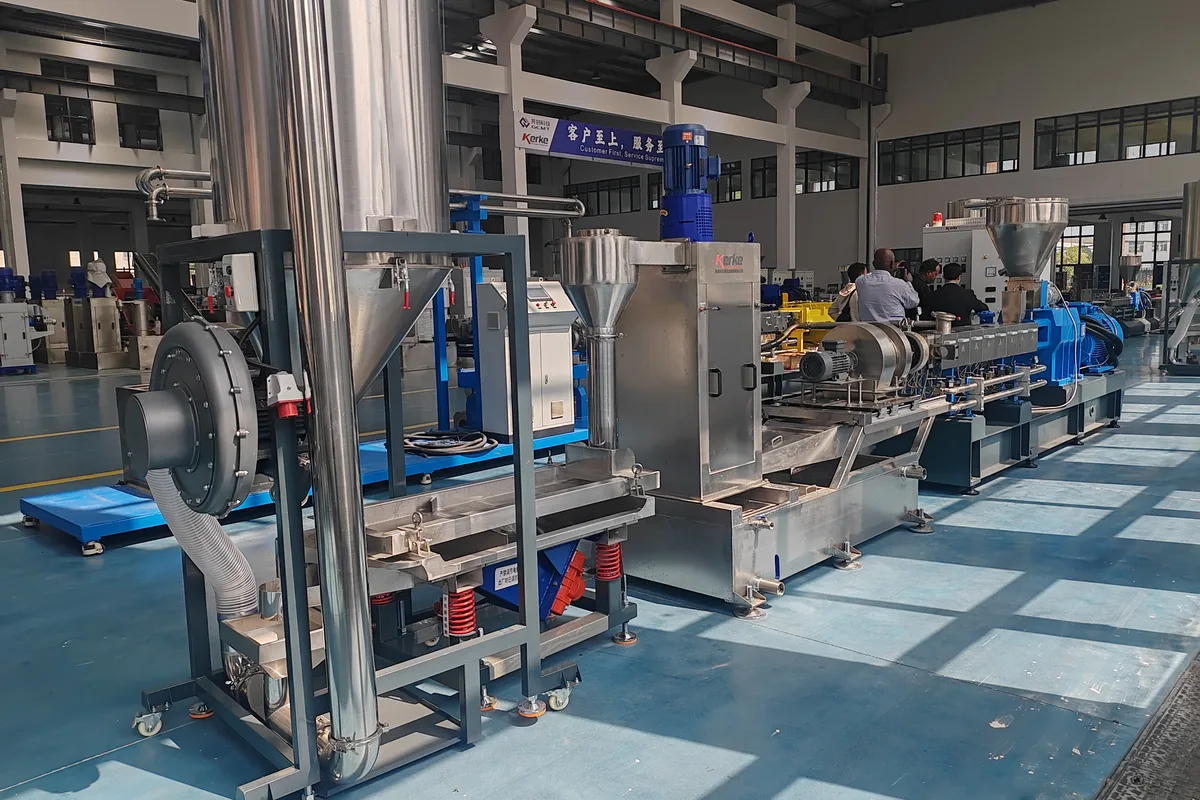 Talc Filler Masterbatch Line — workshop photo 2, Kerke workshop, Nanjing
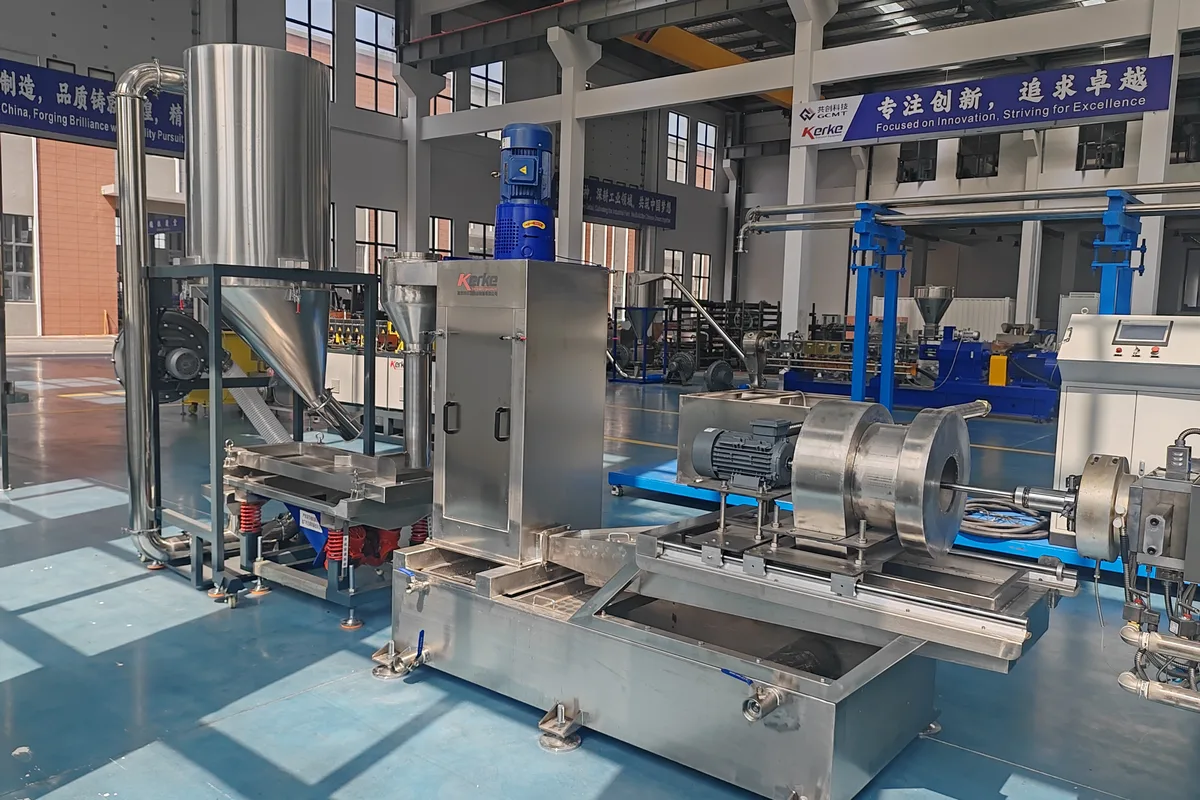 Talc Filler Masterbatch Line — workshop photo 3, Kerke workshop, Nanjing
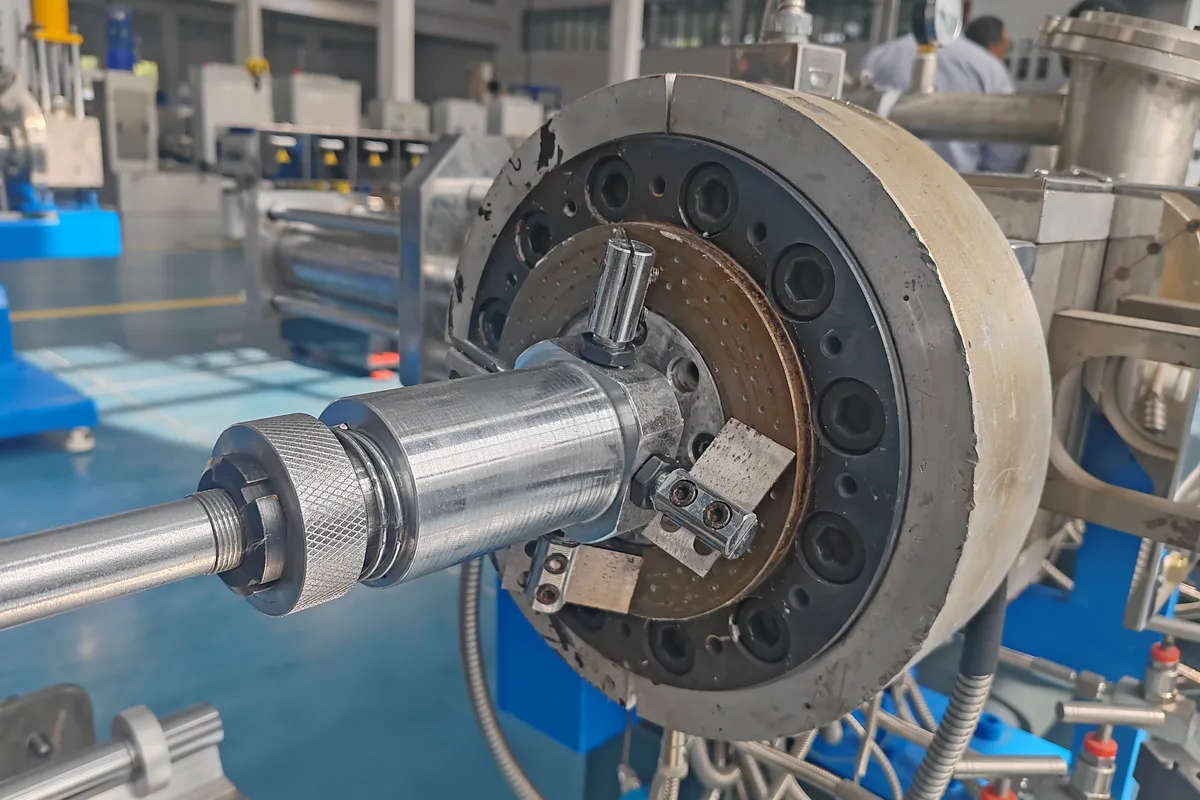 Talc Filler Masterbatch Line — workshop photo 4, Kerke workshop, Nanjing
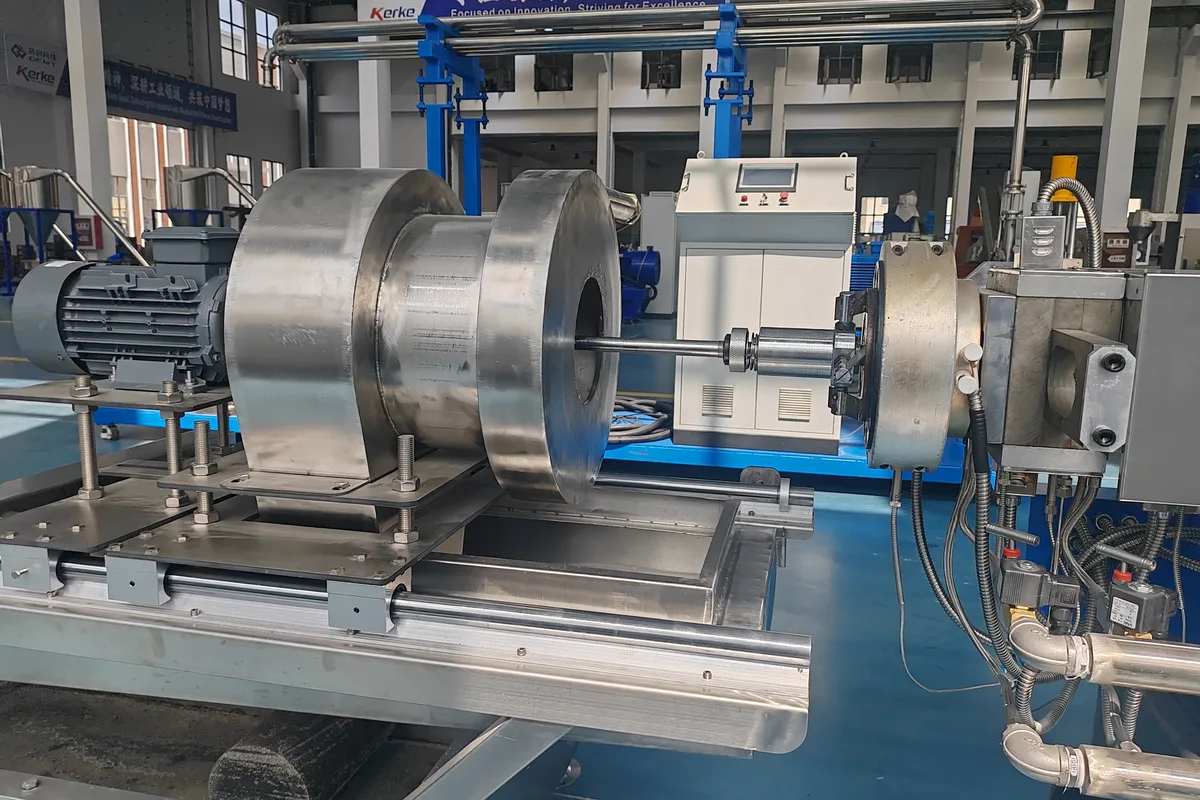 Talc Filler Masterbatch Line — workshop photo 5, Kerke workshop, Nanjing
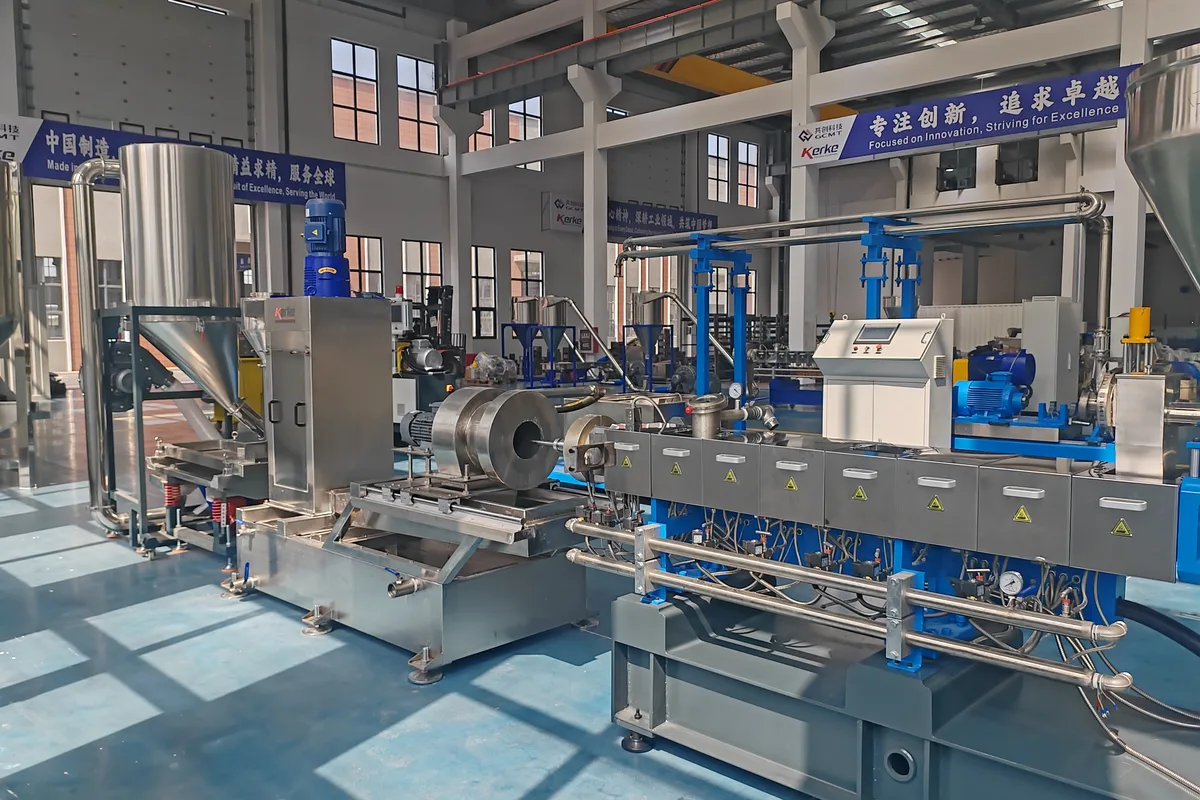 Talc Filler Masterbatch Line — workshop photo 6, Kerke workshop, Nanjing
Quick answer
Talc masterbatch at 70–85% loading needs two things beyond a standard filler line: a dispersive screw design for the plate-like talc particles and a bimetallic barrel/screw for abrasion. Output 200–1,000 kg/h on KTE-65B/75B.
Workshop photos and a running video — shot on our own lines, not stock images.
What sets the limit
Talc is fed by a crammer to prevent rat-holing, dispersed with a wide kneading block, devolatilized and pelletized. Plate-like talc raises melt viscosity more than CaCO3 at the same loading, so torque margin is critical.
| Parameter | Value / range |
|---|---|
| Talc loading | 70–85% |
| L/D | 48–52 |
| Wear protection | Bimetallic liner + PM screw elements |
| Pelletizing | Water ring / air-cooled strand |
| Output (reference) | 200–1,000 kg/h |
| Model | KTE-65B, KTE-75B with wear package |
Output figures for the talc filler masterbatch line are measured on the reference material stated above. Filler grade, bulk density and surface treatment move output by ±15% — that is why every quotation we issue is tied to a trial report.
Process flow, step by step
- FeedingLoss-in-weight dosing of polymer and filler; side feeder or liquid injection where the formulation needs it.
- Melting and dispersingScrew geometry with 45°/90° kneading blocks; barrel profile set by the polymer.
- DevolatilizationVacuum vent at −0.06 to −0.09 MPa removes moisture and volatiles before the die.
- Pressure build-upThrottle or discharge section stabilises die pressure; a melt pump where gauge control matters.
- Pelletizing and packingWater ring / air-cooled strand; then centrifugal dryer, vibrating screen and bagging.
Equipment configuration
| Stage | Equipment | Why this choice |
|---|---|---|
| Main machine | Co-Rotating Twin Screw Extruder | Architecture follows the filling level and the mixing duty, not the required tonnage. |
| Screw geometry | Building-block elements, W6Mo5Cr4V2, bimetallic liner | Wear package for abrasive filler; mixing blocks only where dispersion demands them. |
| Feeding | Loss-in-weight feeder, side feeder where needed | Recipe accuracy: ±0.5% short term on the weighed component. |
| Pelletizing | Pelletizing system | Chosen by polymer and filler ceiling — water contact is the deciding column. |
| Downstream | Centrifugal dryer, vibrating screen, bagging | Fines below 2% and moisture below the specification of your downstream process. |
Output by model
| Model | Dia. (mm) | Speed (rpm) | Motor (kW) | Torque (N·m) | Output (kg/h) |
|---|---|---|---|---|---|
| KTE-50B | 50.5 | 500–600 | 55–75 | 2×525 | 80–200 |
| KTE-50D | 50.5 | 300–800 | 75–90 | 2×860 | 100–300 |
| KTE-52B | 51.4 | 500–600 | 55–75 | 2×720 | 80–200 |
| KTE-52D | 51.4 | 500–600 | 75–110 | 2×1050 | 100–400 |
| KTE-65B | 62.4 | 500–600 | 90–110 | 2×860 | 200–450 |
| KTE-65D | 62.4 | 300–800 | 132–160 | 2×1530 | 350–600 |
| KTE-75B | 71 | 500–600 | 132–160 | 2×1530 | 300–800 |
| KTE-75D | 71 | 300–800 | 200–315 | 2×2100 | 500–1000 |
| KTE-85B | 85 | 500–600 | 220–315 | 2×2100 | 550–1000 |
| KTE-95B | 93 | 500–600 | 250–315 | 2×3000 | 800–1500 |
| KTE-95D | 93 | 500–800 | 315–500 | 2×4800 | 1000–2000 |
| KTE-135B | 135 | 500–600 | 315–500 | 2×4800 | 1500–3000 |
| KTE-135D | 135 | 500–800 | 500–1000 | 2×7800 | 1500–4000 |
Three mistakes that cost the most
1. Standard barrels wear through in under a year at 80% talc.
Standard barrels wear through in under a year at 80% talc.
2. Talc bridging in the hopper
Talc bridging in the hopper — a crammer feeder is not optional.
3. Wet talc steaming at the vent
Wet talc steaming at the vent — dry the filler below 0.5% moisture or the vacuum line loads up within a shift and the pellets go porous.
FAQ
Why does talc masterbatch cost more than CaCO3?
Higher wear on the machine, lower bulk density and slower feeding. The line cost is similar; consumables are not.
Can talc be run on a two-stage line?
Yes above 80%, and it is the safer choice if you also run CaCO3 at high loading.
What output can you guarantee for this application?
The reference band is 200–1,000 kg/h, measured on the stated material. We quote a guaranteed figure only after a trial on your own material, because filler grade, bulk density and moisture move output by ±15%.
Can we run our material before ordering?
Yes — for the talc filler masterbatch line, send 25–50 kg of your filler–carrier blend; the report adds intake rate and melt temperature against loading level. You also receive pellets, a running video, and the temperatures, screw speed and feeder settings we used. The trial is free; you cover the freight.
What is the delivery time?
30–45 working days for standard configurations of the talc filler masterbatch line, 45–70 for custom screw geometry and ODM work — side feeders and high-torque drives ship from the same frame stock. Voltage and frequency are built for the destination country.
Where these numbers come from
Parameters on this page (the talc filler masterbatch line) are taken from the Kerke product parameter table and the product master data sheet, and cross-checked against commissioning records for filler masterbatch lines built in the last few seasons. Formulations and temperature windows are typical industry values for mineral filling, not a recommendation for your specific compound — every figure marked reference must be confirmed on a material trial before it becomes a contractual number.
Reviewed by the Kerke process team, Nanjing. Page updated 6 November 2026.
Send 25–50 kg for a trial of the talc filler masterbatch line on our lab extruder: pellets, running video and a capacity report back in 3–7 days — the report shows how far the loading climbs before dispersion or torque gives out.
Talc filler masterbatch line — the short version
Note on talc filler masterbatch line: the numbers above are reference ranges from Kerke's own trial runs, not catalogue promises. Screw geometry, wear package and pelletizing method are set on the trial bench first, so the output you compare is the output you get. If your grade is not in the tables, send it — the closest configuration is usually a change of screw set, not a different machine.
Related on this site: Machine range: KTE-50B to 135D · Pelletizing methods compared · quotation and free trial · Wikipedia: Masterbatch
Bottom line. Talc is a platelet, not a bead. It resists wetting, abrades the barrel along its own flat faces, and at 60–70% loading it turns a filler line into a wear test. Use the references above to shortlist, then let the material decide: a 25–50 kg lab trial settles filler ceiling, pellet shape and output before you commit to a line.