
Screw design · 9 min read
How to Specify Twin Screw Extruder L/D Ratio by Formulation
L/D is not a quality score. It is the amount of process length you buy for feeding points, a melt seal, dispersive mixing, devolatilization and pressure build-up. This page gives the ranges we actually quote, by filler level and additive count, and the four questions that expose an inflated L/D claim.
Short answer: for a PP or PE additive-compounding line, 32–36 L/D covers a single-feed, low-additive formulation; 40–44 L/D is the normal choice once you add side feeding or one vent; 48–52 L/D is for high filler loadings, two or more feed points and vacuum devolatilization; 56–60 L/D only pays for itself when the formulation needs both a long dispersive section and multi-stage venting. Above 60 L/D you are usually buying conveying length that does nothing.
L/D by formulation: the table we quote from
The ranges below come from lines we have commissioned. They assume a co-rotating intermeshing screw with a standard 4 mm flight depth class and a screw speed window of 300–800 rpm. Read the row that matches your additive package, not your machine size — a 75 mm and a 95 mm machine doing the same formulation sit in the same L/D band.
| Formulation | Feeds | Vents | L/D band | Notes |
|---|---|---|---|---|
| PE/PP + 1–3% masterbatch, pellet feed | 1 | 0–1 | 32–36 | Compact melt + distributive sequence is enough |
| PE/PP + 5–15% additive package, powder blend | 2 | 1 | 40–44 | Side feed for shear-sensitive additives |
| Filled compound, 20–40% CaCO3/talc | 2–3 | 1–2 | 44–48 | Filler side feed after melt seal |
| Filler masterbatch, 70–85% CaCO3 | 2–3 | 2 | 48–52 | Two-stage venting, high wear protection |
| Glass-fibre reinforced PA/PBT, 20–35% GF | 2–3 | 1–2 | 48–56 | Fibre side feed downstream of melt seal, low-shear conveying after |
| Reactive extrusion / compatibilised alloy | 3+ | 2+ | 52–60 | Residence time and staged injection drive length |
What each 4 L/D actually buys you
On a 44 mm screw, one diameter is 44 mm of axial length. Four diameters is roughly one full process function. Thinking in 4 D blocks keeps the specification honest:
| Block | Function | What it needs |
|---|---|---|
| 4–6 D | Feed and solids conveying | Deep-flighted elements, crammer if bulk density < 0.35 g/cm³ |
| 6–8 D | Melting and melt seal | Kneading blocks; the seal is what makes the first vent work |
| 4–8 D | Dispersive mixing | 30°/60°/90° kneaders, width chosen by pigment or filler |
| 4–6 D | Side feed and incorporation | Feed opening, then low-shear conveying to avoid fibre breakage |
| 4–6 D | Devolatilisation | Vent opening after a pressure seal, vacuum port |
| 4–6 D | Pressure build-up | Throttle elements or gear pump; melt temperature control |
Add the blocks you need, then round up to the nearest standard barrel. This is why two suppliers can both quote "48 L/D" and deliver completely different machines: one has 8 D of dispersive mixing and one has 8 D of dead conveying.
Why a 52 L/D machine can be worse than a 44 L/D one
Every extra diameter adds polymer inventory inside the barrel. On a 52 L/D, 65 mm machine running 700 kg/h, the additional 8 D holds on the order of 4–6 kg of melt. That inventory has three costs:
- Start-up scrap. The extra volume must be flushed with on-spec material before the pellet stream stabilises. More inventory means more kilograms per start.
- Thermal history. Longer residence time at melt temperature degrades heat-sensitive additives; a stabiliser package sized for 90 seconds may not survive 150 seconds.
- Grade change. The transition slug between two colours or two filler levels scales with inventory, not with throughput.
The counter-argument is real: if the extra length carries a genuine process function (a second vent, a downstream fibre feed, a reaction zone), it pays for itself. The test is simple — ask the supplier to mark, on a barrel-by-barrel drawing, what each zone does. If two adjacent zones are both "conveying", the length is decorative.
How to audit an L/D claim before you sign
Screw diameter and L/D are the two numbers most often quoted loosely, because both can be presented as a range that flatters the machine. Four questions settle it:
- Is the L/D measured on the screw or on the barrel? Process length should be stated as the effective length from the first feed opening to the die, not the total screw length including the shaft coupling.
- How many barrels, and what is each one for? A 12-barrel 48 L/D machine and a 10-barrel 48 L/D machine have different granularity for future changes.
- What is the maximum screw speed at that L/D? Long screws and high speed fight each other: the shaft must carry more torque over more length, and whirling limits appear. If a supplier quotes 1,200 rpm at 60 L/D, ask for the torque derating curve.
- Can the screw configuration be re-arranged without cutting the shafts? Standard-element shafts allow re-configuration; a splined or welded design locks the process you buy today.
Get answers in writing on the quotation, with a barrel numbering drawing attached. This single attachment prevents most scale-up arguments later.
FAQ
Is a higher L/D always better for mixing?
No. Mixing quality is set by the kneading elements and the number of passes over them, not by total length. A 40 L/D screw with a well-placed 6 D dispersive section mixes better than a 56 L/D screw with the same kneaders spread thin over 12 D of conveying.
What L/D do I need for 30% talc-filled PP?
Normally 44–48 L/D with two feed points: polymer at barrel 1, talc side-fed after the melt seal, one atmospheric vent and optionally one vacuum vent before the die. Below 44 L/D the vent usually ends up too close to the side feed to hold a stable seal.
Can I add L/D later by bolting on barrels?
Only if the machine was designed for it. Extension requires a longer shaft, a longer barrel stack, additional heating zones and a gearbox with reserve torque. Retrofits exist but cost 25–40% of a new processing section; decide the L/D before the order, not after.
How does L/D change with screw diameter at the same output?
It does not need to. L/D is a process-length ratio. What changes with diameter is specific torque and free volume. Two machines at the same L/D and the same specific torque produce the same formulation quality at different absolute outputs.
Does L/D affect energy consumption?
Indirectly. Longer screws add drive and heating load but also allow gentler mixing at lower speed. Specific energy (kWh/kg) usually improves with proper L/D up to a point, then flattens; beyond 60 L/D the curve typically turns upward because conveying losses grow.
Where these numbers come from
The L/D bands are compiled from Kerke commissioning records between 2023 and 2026 across KTE 27 to KTE 95 machines, cross-checked against the published parameter tables of four Jiangsu-based suppliers. They are reference ranges for specification, not guaranteed outputs. Zone allocations in Table 2 are typical values — a formulation with a very low bulk density filler will need one or two extra diameters in the feed zone. If your formulation is not in Table 1, send 25–50 kg of polymer and additive and we will return a measured recommendation instead of an estimated one.
Twin screw extruder L/D ratio — the short version
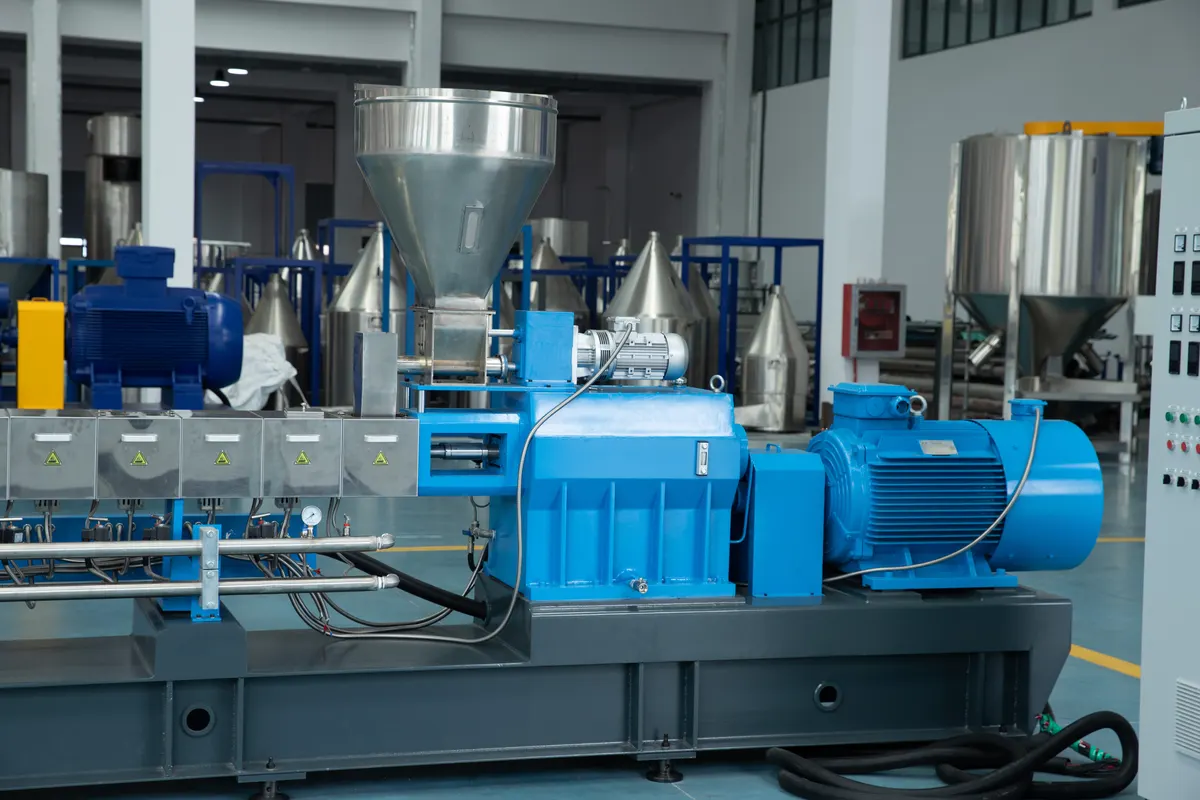
The practical rule: count the process functions your formulation needs, convert them to 4 D blocks, add them up, then pick the nearest standard barrel count. Do not start from a competitor's L/D number — start from your additive package and your venting requirement.
Related on this site: where the vacuum vent belongs · why feeding caps throughput · co-rotating twin screw range · free line quotation · Wikipedia: twin-screw extruder