
Selection guide · 5 min read
Side Feeder: When Your Line Needs One (and Where to Put It)
Add a side feeder whenever the material must enter after melting: glass fiber, wood powder, high-percentage filler powder, liquid-incompatible additives.
Short answer: Add a side feeder whenever the material must enter after melting: glass fiber, wood powder, high-percentage filler powder, liquid-incompatible additives. Main feeding these materials shears them before they can disperse, and in the case of fiber, destroys the length that carries the strength. Kerke side feeders cover 4,300–5,500 USD per unit depending on size — cheap insurance on a six-figure line.
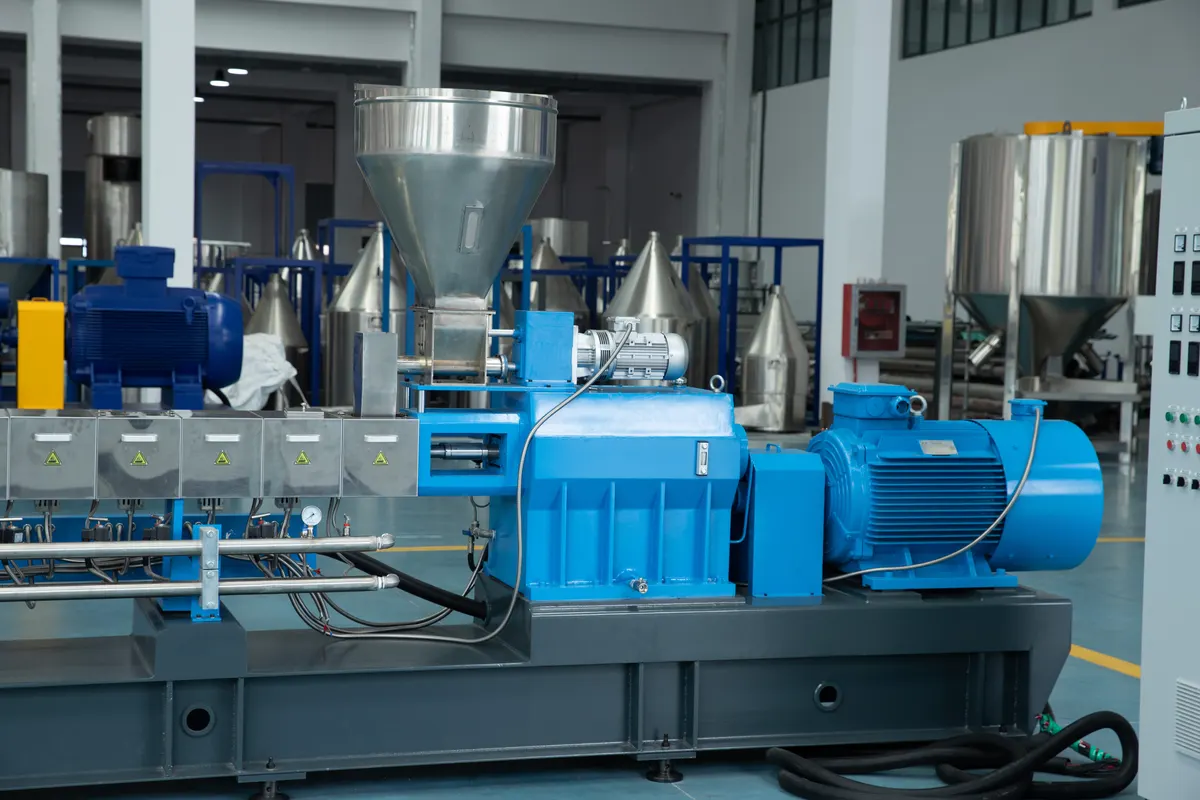
The three decisions
1. Does this job need side feeding?
| Material | Main feed OK? | Why |
|---|---|---|
| Glass fiber (chopped strand, 3–4.5 mm) | No | Main-feed shear pulverizes fiber into powder; barrel wear multiplies |
| Wood powder 40–60% | No | Fluffy, bridges in main hopper; must force-feed |
| Filler powder when masterbatch >30% | Better via side | Spreads the dispersion load along the barrel |
| Talc / CaCO₃ pre-activated powder | Either | Pre-activated powder tolerates main feed below 50% |
| Resin pellets, masterbatch carrier | Yes | Clean pellets melt first — nothing to protect |
2. Where does the port go?
After the melting zone is fully complete, before the vacuum vent: typically barrel sections 4–6 on a 10-section (L/D 40) machine. Fibers added before melting get chopped during melting; fillers added after vacuum escape through the vent.
3. How many ports?
Glass fiber at GF30 usually uses 2–3 side ports in sequence — feed, disperse, feed again. Distributive loading protects fiber length. Wood powder and talc: 1–2 ports with force feeding.
Configuration notes
- Element set after the fiber entry point: large-pitch conveying + 30–45° light kneading only. A 90° block after glass fiber is the single most expensive screw-configuration error in this industry (impact strength drops up to 3×).
- Feeder types: twin-screw metering for granules/powder, single-screw for flakes, cone force-feeder for bridging-prone powders, spring-type screws for light sticky powders.
- Wear: fiber and filler are abrasives — specify bimetallic liners from day one on any side-fed abrasive job.
Typical published practice — run trials on your own material before production.
Where the side feeder goes, and why position matters
| Material | Feed position | Distance from main feed | Reason |
|---|---|---|---|
| Glass fiber 30–50% | After complete melting | 20–24 D | Fiber must meet melt, not solids |
| Talc / CaCO₃ 60–80% | After first kneading block | 12–16 D | Avoids feed-zone bridging |
| Wood powder 40–60% | After melting, before vent | 16–20 D | Moisture escapes downstream |
| Glass microsphere | Late, gentle conveying | 28–32 D | Crush strength is the limit |
| Liquid additives | Before vent, injection nozzle | 24–28 D | Needs dispersion time before devolatilization |
Too early and the powder bridges in the feed throat; too late and there is not enough length left to disperse. The window is usually 6–8 D wide, and outside it the symptom is either torque spikes or visible agglomerates.
What it adds to the line
A side feeder unit runs USD 4,300–5,500 depending on screw diameter and hopper size, plus a forced-feeding screw for powders that fluidize. On a 65 mm line quoting around USD 70,000, that is 6–8% of the price for the ability to run formulations that would otherwise be impossible. The ancillary cost people forget is the platform and the extra height: side feeders need 1.2–1.5 m of working height at the feed point.
Installation and running checks
- Verify the side feeder screw speed is independently controlled — tied to the main screw it cannot compensate for bulk density drift.
- Set the side feeder 5–10% above the target ratio at start, then trim; running it starved causes pulsation.
- Check for powder accumulation in the hopper throat after 30 minutes at rate; accumulation means the agitator speed is too low.
- Confirm the vent downstream is pulling −0.04 MPa or better; side-fed powders carry air.
- Inspect the first 100 kg for unmelted specks — that is the signature of a feed point too far upstream.
What to send with your enquiry
- The percentage and bulk density of the side-fed component.
- Its temperature sensitivity: wood powder and natural fiber degrade above 190°C.
- Available height at the feed point; most retrofits fail on headroom, not on price.
- Whether the material fluidizes (fine talc, fumed silica) and needs forced feeding.
- The number of downstream vents, since side-fed powder carries air into the vacuum system.
Bottom line
Side feeding costs 6–8% of line value and unlocks formulations that are otherwise impossible: fiber, wood, high filler, shear-sensitive additives. Position it 16–28 D downstream, give it independent speed control, and make sure the vent after it has real vacuum capacity. Getting the position wrong turns a dispersion problem into a feeding problem.
FAQ
Can I side-feed into a machine without a spare barrel section?
Not properly. The side feeder needs a dedicated barrel with an opening and a downstream conveying element; retrofitting usually means replacing one barrel section.
Do I need a side feeder for 40% CaCO₃?
No. Up to roughly 50% the main feed handles it if the feeder is correctly sized. Above 60%, bridging becomes the constraint.
What is the difference between a side feeder and a downstream feed port?
A side feeder is a powered screw that forces material in; a downstream port relies on gravity and works only for pellets.
Why does output drop when I start side feeding?
Because the side-fed material bypasses the melting section, so the melt has less time to homogenize. Compensate with 5–10% more screw speed and one extra dispersive element, not with more heat.
Where these numbers come from
Figures in this page are drawn from KTE parameter tables, shaft design notes, cross-checked against delivered-line commissioning records. They are typical published practice — run trials on your own material before fixing production settings.
Side Feeder — the short version
Related on this site: Glass fiber compounding · Screw elements · WPC pelletizing
Bottom line. Add a side feeder whenever the material must enter after melting: glass fiber, wood powder, high-percentage filler powder, liquid-incompatible additives. Numbers above are typical published practice, not guarantees. The deciding test is your own material — send 25–50 kg for a lab run with full parameters back in 3–7 days.