
Process guide · 5 min read
CaCO₃ Filler Masterbatch: Typical Formulation & Process Window
A production-credible CaCO₃ filler masterbatch runs 70–85% mineral, 12–25% carrier, 0.8–1.5% aluminate coupling agent and 3–5% PE-wax/stearate package.
Short answer: A production-credible CaCO₃ filler masterbatch runs 70–85% mineral, 12–25% carrier, 0.8–1.5% aluminate coupling agent and 3–5% PE-wax/stearate package. Patent records for inorganic-filled masterbatch (e.g. PE 10–30% + inorganic 60–85% + surface agent 0.5–3% + wax) confirm the same window, with high-intensity premixing at 130–150°C and twin-screw extrusion at 100–150°C zone 1 rising to 190–230°C.
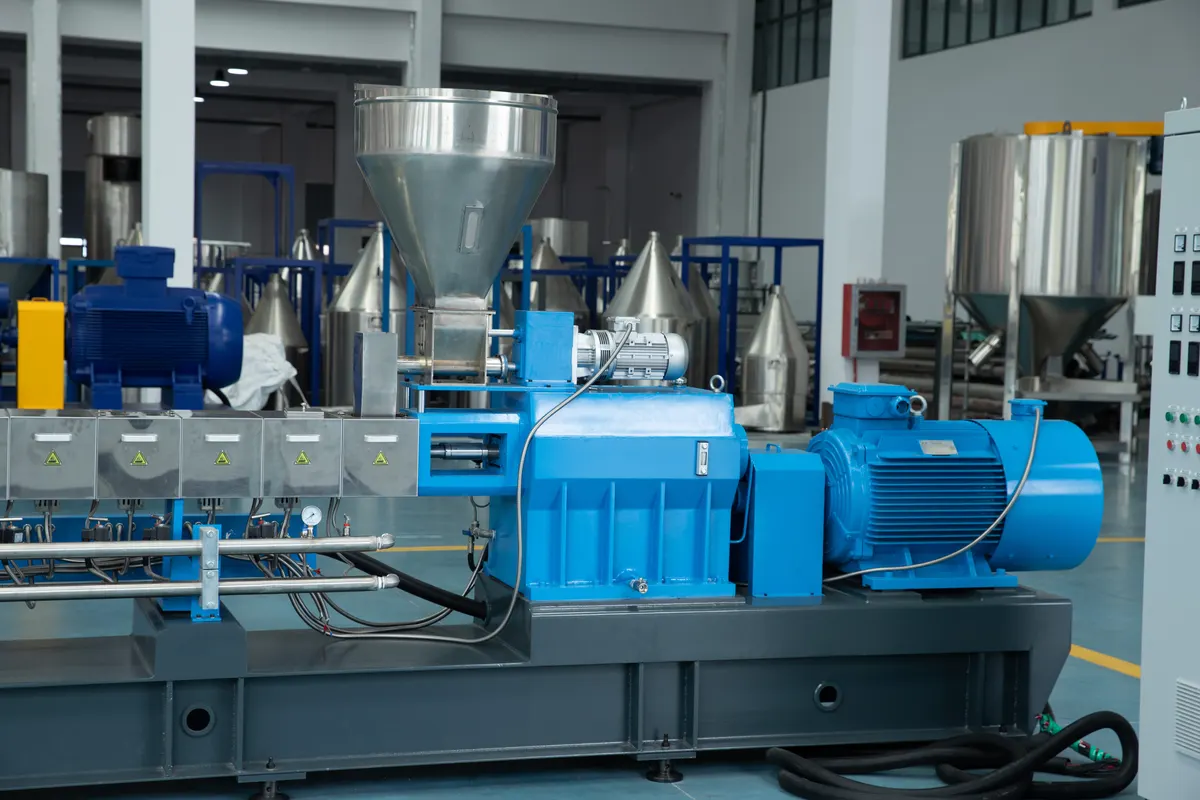
Reference formulation
| Component | Range | Function |
|---|---|---|
| Heavy CaCO₃, 800–2500 mesh, moisture <0.3% | 70–85% | Cost reduction + stiffness |
| Carrier: PP powder / LLDPE (MFR above end resin) | 12–25% | Wet-out & transport |
| Aluminate coupling agent | 0.8–1.5% | Filler-resin interface |
| PE wax | 3–5% | Dispersion |
| Calcium stearate + stearic acid | 0.5–1% | Lubrication, stabilizer synergy |
| Antioxidant (1010/168 blend) | 0.1–0.3% | Thermal history |
Documented variants: calcium-silicate grades (PP 18–38% + silicate 60–80%, low-odor automotive grades); epoxy-resin-protected silicate grades (epoxy 0.2–0.8% shields the coupling agent from thermal loss); recycled-carrier grades (recycled PP 10–20% + LDPE 10–30% + PP-g-MAH 2–6% + peroxide 1.5–1.7% to set MFR).
Process window
| Stage | Setting |
|---|---|
| Activation | HIM 110–120°C (CaCO₃) / 130–150°C (patent premix), 10–20 min |
| Zone 1 | 80–120°C — anti-bridging, deliberately cold |
| Melting zones | 190–230°C |
| Metering | 210–230°C; die = last zone + 0–20°C |
| Screw speed | ~325 rpm median (band 300–500) |
| Pelletizing | <50% filler: water-strand · 30–82%: water-ring · 82–90%: air-cool hot-face |
| L/D | 44 dominant in patent statistics (60 mentions vs 1 for 40) |
What the numbers translate to commercially
- Nano-CaCO₃ masterbatch dosed at 20% in PP woven bags cuts finished-bag cost ~7% versus an 8%-dosage ordinary masterbatch — the customer's real KPI is product cost per ton, not masterbatch price per ton
- Patent-side statistics put talc masterbatch at up to 80% mineral content; CaCO₃ grades at 85–90% demand the two-stage machine
The three failure modes
- Moisture above 0.3%: bubbles, whitish strands, output drop — dry the powder, always
- No activation: interface debonding; impact strength halved at dosage
- Wrong pelletizer for filler %: strand cutting above 50% filler breaks strings continuously
Typical published practice — run trials on your own material before production.
Line setup that delivers this formulation
| Loading | Frame | L/D | Configuration | Output |
|---|---|---|---|---|
| 70–75% | KTE-65B | 44:1 | Side feed at 16 D, single vent | 350–450 kg/h |
| 80% | KTE-65D | 44:1 | Side feed, two vents | 350–600 kg/h |
| 85%+ | KTE-65B + SE-150 | 44:1 | Two-stage, vacuum transfer | 300–500 kg/h |
The L/D question is settled by the patent data: 44 appears 60 times against 40 for filler masterbatch, and the reason is dispersion length, not torque. A 44:1 barrel gives the extra 4 D that the coupling agent needs to wet the mineral.
What this line costs
The reference is exact here: a 65 mm 48:1 CaCO₃ filler line quoted at USD 70,850 FOB in 2024 with high-speed mixer, screen changer, air-cooled strand and gantry pelletizer; the 50 mm version of the same line quoted at USD 56,500. Per kg/h that is USD 157–236 at 300–450 kg/h. Grinding and surface treatment are separate — if you buy coated filler, the line is a compounding line, not a treatment line.
Trials before production
- Measure the filler's D97 and oil absorption; both change the coupling agent dosage and the achievable loading.
- Run the coupling agent activation separately and check wetting by a water-flotation test before committing to the extruder.
- Start at 70% and raise loading in 5% steps, recording torque and die pressure — the wall appears suddenly, not gradually.
- Check the vent for powder carry-over at each step; carry-over means the melt seal is too short.
- Pull 20 kg at the final loading and measure tensile and elongation after 48 hours.
The failure this recipe is known for
Filler masterbatch fails at the customer's mould, not at your die. A pellet that disperses perfectly in your 3 mm strand can still contain 20–50 µm agglomerates that show as white specks in a 0.8 mm film. Run a thin-film test at the customer's thickness before shipping a new formulation: press 0.05 mm film and count specks per 100 cm². Under five is commercial; twenty is a complaint.
FAQ
Why does my 80% filler masterbatch break strands?
Melt strength, not formulation. Either drop the loading 3–5% or add 0.3–0.5% of an acrylate or EVA-based compatibilizer to raise melt strength.
Do I need a two-stage line at 80%?
No. 80% runs on a single D-class frame with a 44:1 barrel. The two-stage crossover sits nearer 85%.
How much coupling agent is enough?
0.8–1.5% of filler weight for stearate or aluminate systems. Below 0.6% the tensile drop is measurable; above 2% you are paying for lubricity, not bonding.
Can I use the same line for talc?
Yes, with a different screw configuration and lower loading. Talc's 78–80% ceiling is set by bulk density, not by the machine.
Why does my masterbatch absorb moisture in storage?
The coupling agent's hydrophilic head is left unreacted. Either raise activation temperature to 120°C or add 0.2% stearic acid to cap the surface. ## What these numbers do not settle
The formulation bands assume a coated, D97-under-10-µm ground CaCO₃. Precipitated calcium carbonate behaves differently at the same loading — higher oil absorption, lower achievable percentage, better whiteness. If your filler is precipitated or uncoated, shift the loading ceiling down 5–8 points before you start trialling.
Where these numbers come from
Figures in this page are drawn from patent-set process statistics, commissioning records, cross-checked against delivered-line commissioning records. They are typical published practice — run trials on your own material before fixing production settings.
CaCO₃ Filler Masterbatch — the short version
Related on this site: Formulation skeleton · CaCO₃ two-stage line · Coupling activation
Bottom line. A production-credible CaCO₃ filler masterbatch runs 70–85% mineral, 12–25% carrier, 0.8–1.5% aluminate coupling agent and 3–5% PE-wax/stearate package. Ranges here come from our floor notes and typical published practice — they set the design direction, not your setpoints. Send 25–50 kg and we return pellets, a running video and a capacity report to confirm against your targets.