
Process guide · 5 min read
Carbon Black Masterbatch: Formulation Windows from Pipe to Food Grade
Carbon black masterbatch lives in a 35–42% pigment window for general grades, rises to 46–48% for pipe grades (with dispersant doubled to 8–10%), and uses desulfurized black for food-contact grades.
Short answer: Carbon black masterbatch lives in a 35–42% pigment window for general grades, rises to 46–48% for pipe grades (with dispersant doubled to 8–10%), and uses desulfurized black for food-contact grades. Nine readable 2019 patents give a consistent picture of how each grade trades pigment loading against wetting package.
The four patent-confirmed grades
| Grade | Composition (wt%) | Design note |
|---|---|---|
| Food-contact low-odor | Desulfurized CB 40–42 + dispersant/lube 1–3 + LLDPE 56–58 (MFR 30–50) | Desulfurized black kills odor at the source |
| General purpose | LLDPE 55–60 + CB 35–40 + lubricant 2–6 + dispersant 1–3 | The mainstream window |
| Pipe grade | CB 46–48 + dispersant 8–10 + lubricant 1–3 + LLDPE 42–44 (MFR 20–30) | More black demands double dispersant |
| Jet-black specialty | Polyester carrier 67–74 + jet black 25–30 + modifier 1–3 | Non-PE carrier route, twin screw → cast strand → water cut |
The rule embedded in these numbers: pushing carbon black without pushing dispersant produces specks, not savings. Pipe grade's extra 6–8% black is paid for with 6–8% extra dispersant.
Process window
| Parameter | Setting |
|---|---|
| Shear | Maximum dispersion: 2–3 kneading groups 45°/90° + toothed elements |
| Temperature | Carrier-driven: PE base 160–190°C; specialty polyester carrier per patent runs 240–260°C |
| Filtration | 80–120 mesh — always the top of the band |
| Vacuum | One vent stage for entrained air |
| Pelletizing | Water-ring or underwater; high-black melt has low strand strength — water-strand breakage is the classic complaint |
| Output penalty | 20–25% below generic color (KTE-95: 400–600 vs 500–750 kg/h) |
Carbon black selection notes
- Particle size: finer black = deeper color + harder dispersion; pipe grades accept coarser black
- Structure: high-structure black disperses better but raises viscosity
- Volatile content and sulfur drive odor — food grades demand desulfurized or post-treated black
Customer conversation anchors
"40% carbon black is the practical ceiling on standard carriers; 46–48% exists for pipe with a doubled wetting package; food grade is a carrier-and-black cleanliness conversation, not a recipe-strength conversation." Output economics: the 20–25% capacity penalty is priced into the line configuration (bigger filtration, better pelletizer), not into a hidden surcharge.
Typical published practice — run trials on your own material before production.
Line setup that delivers this formulation
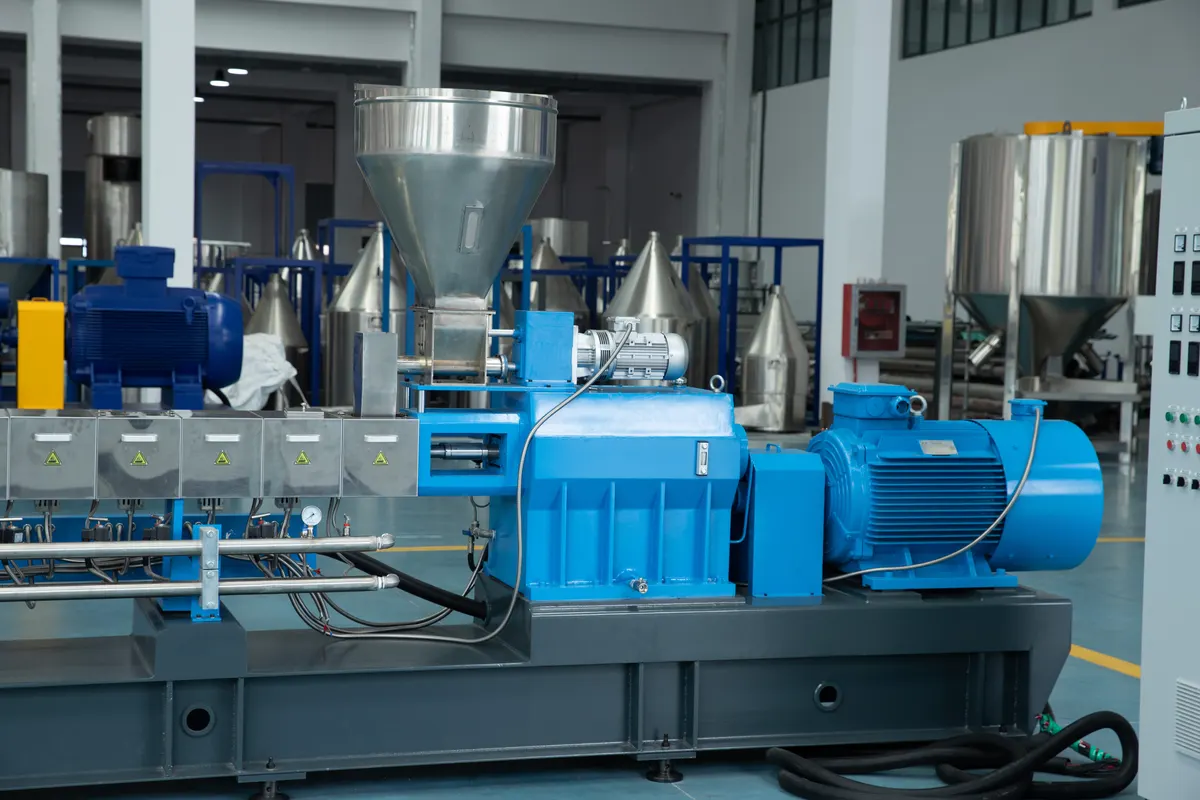
| Grade | Loading | Frame | Configuration | Output |
|---|---|---|---|---|
| General purpose | 35–40% | KTE-65B | 40:1, side feed, water-ring | 400–600 kg/h |
| Pipe grade | 46–48% | KTE-65D | 44:1, two kneading groups | 300–450 kg/h |
| Food contact | 35–40% | KTE-50B | 40:1, desulfurized black, single vent | 150–300 kg/h |
The dispersant level rises with loading: 4–6% at 35–40%, 8–10% at 46–48%. That extra dispersant is what allows the higher loading without a torque wall, and it is also why high-loading black masterbatch costs more per kilo of pigment than the number suggests.
What this line costs
A 65 mm black masterbatch line (single stage, water-ring) sits at USD 62,000–72,000 in 2024 terms; the two-stage version with an SE-150 quoted at USD 66,600. Per kg/h at 500 kg/h that is USD 125–145 — one of the better ratios available, because black masterbatch runs at high rate on a modest frame. Add USD 4,300–5,500 if a side feeder is needed.
Trials before production
- Measure the black's bulk density and oil absorption (DBP); high-structure blacks need more dispersant and run hotter.
- Run a torque sweep at fixed loading to find the speed where dispersion is adequate but melt temperature stays under 220°C.
- Check dispersion by filter pressure test at 40% loading; a rise above 0.05 MPa means agglomerates are passing.
- Verify feeder accuracy at the pigment rate — a 1% error at 40% loading is a 0.4% shift in the final compound.
- Inspect pellets for surface bloom after 24 hours; bloom indicates over-lubrication, not under-dispersion.
The failure this recipe is known for
Pipe-grade black masterbatch fails by smell. At 46–48% loading with double dispersant, residual volatiles from the black and the wax come off in the customer's extruder and the pipe smells of solvent. The fix is upstream: hold the last two zones 5–8°C lower and add 0.1% of a low-volatility antioxidant. Customers test pipe by nose before they test it by spec.
FAQ
Why is pipe-grade black masterbatch harder to make?
It runs at 46–48% loading with double dispersant, so torque and dispersion both sit near the limit. The window between good dispersion and degradation narrows.
Can I use recycled carbon black?
Yes for non-critical grades, with a 5–10% higher dosage and a dispersion check. Ash content is the variable that bites.
Does pellet shape matter for black masterbatch?
Yes for downstream feeding: 3×3 mm cylindrical pellets feed more evenly than spherical, which matters at low let-down ratios.
What causes a torque spike at start-up?
Cold material in the kneading zone. Pre-heat the barrel to 80°C above the polymer's softening point and start at 40% feed rate for the first two minutes.
Does pellet size affect dispersion measurement?
Yes for the filter pressure test. Coarse pellets melt unevenly and show pressure spikes that look like agglomerates; grind the sample before testing. ## What these numbers do not settle
The loading windows assume a standard furnace black. Channel blacks, acetylene blacks and recycled blacks each have their own ceiling, and the dispersant demand differs by a factor of two. The tables give the shape of the trade-off; the numbers on your black come from one torque sweep and one filter pressure test.
Where these numbers come from
Figures in this page are drawn from patent-set process statistics, commissioning records, cross-checked against delivered-line commissioning records. They are typical published practice — run trials on your own material before fixing production settings.
Carbon Black Masterbatch — the short version
Related on this site: Black MB output economics · Color MB formulation · White MB formulation
Bottom line. Carbon black masterbatch lives in a 35–42% pigment window for general grades, rises to 46–48% for pipe grades (with dispersant doubled to 8–10%), and uses desulfurized black for food-contact grades. Numbers above are typical published practice, not guarantees. The deciding test is your own material — send 25–50 kg for a lab run with full parameters back in 3–7 days.