
Process guide · 5 min read
Antistatic & Conductive Masterbatch: Formulation and the CNT Dosing Problem
Antistatic masterbatch comes in two chemically opposite formats: migratory surface agents (GMS/ethoxylated amines, 15–25% in the MB) and permanent conductive networks (carbon black 20–35% or CNT at 0.1–0.6 parts).
This page collects our floor notes on Conductive Masterbatch Formulation: how the line is laid out, the numbers we reference most, and the checks that prevent the usual startup problems.
Short answer: Antistatic masterbatch comes in two chemically opposite formats: migratory surface agents (GMS/ethoxylated amines, 15–25% in the MB) and permanent conductive networks (carbon black 20–35% or CNT at 0.1–0.6 parts). The CNT route is the interesting one for extrusion engineers — at those dosages, feeding accuracy is the process, and loss-in-weight feeding is not optional.
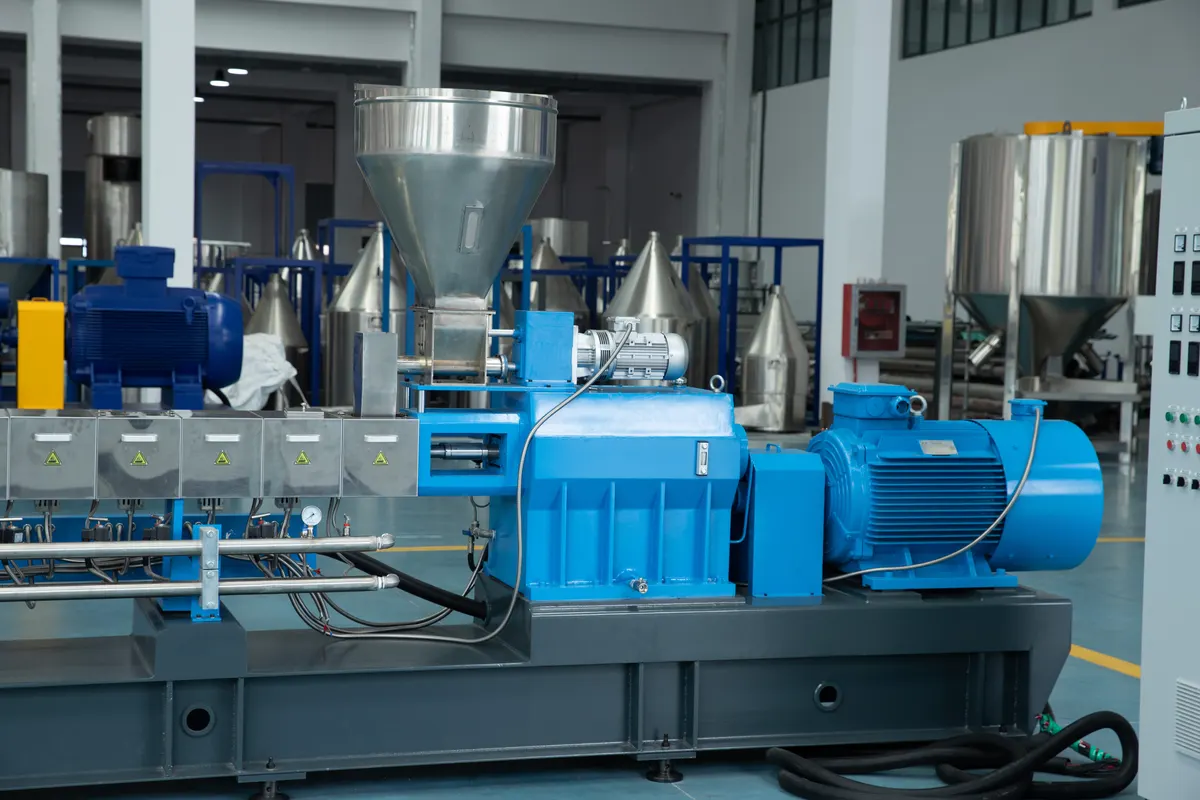
Reference formulations
| Type | Composition | Note |
|---|---|---|
| Surface antistatic | GMS or ethoxylated amine 15–25% + PE/PP carrier | Migratory; overdosing plate-out and sticks |
| Conductive carbon black | CB 20–35% + PE/PP carrier | Needs carbon-black-grade dispersion discipline |
| CNT permanent antistatic | CNT 0.1–0.6 phr | Percolation network at tiny dosage |
| Graphene hybrid MB (2019 patent) | Graphene 1–30% + CNT 1–20% + nano-metal 1–20% + CB 1–30% | Magnetic-field-assisted premix |
| Multifunction PC/ABS | Phosphate FR 10–30% + CNT 0.1–0.6 + Ag antibacterial 0.1–0.6 | One-pass three-function |
The CNT dosing problem
At 0.1–0.6 parts per hundred, CNT antistatic performance lives or dies on dose accuracy: 0.05 phr below target can leave the compound above the percolation threshold; 0.1 above can alter mechanical properties. Volumetric feeders cannot hold this tolerance — gravimetric (±0.5%) or liquid/slurry injection is the minimum specification. This is the cleanest sales argument for weighing feeders in the conductive segment.
Process window
| Parameter | Setting |
|---|---|
| Screw speed | 200 rpm median (patent band 100–450) — protect the conductive network |
| Shear | Moderate: distribution mixing; aggressive kneading breaks CNT networks |
| Temperature | PE/PP base 150–190°C; patent record for carbon-fiber conductive MB: 210→250°C at 50 rpm |
| Feeding | Gravimetric; side feeding for powder conductives |
| Pelletizing | Water-strand or air-cool hot-face per carrier |
Surface vs permanent — how to advise customers
- Migratory antistatic: cheap, works immediately, wears off (humidity-dependent), can contaminate downstream processes
- Carbon black permanent: robust, colors the product black, moderate conductivity
- CNT permanent: transparent-ish, lowest loading, permanent — but demands feeding precision and dispersion quality that only a well-equipped line delivers
Typical published practice — run trials on your own material before production.
Line setup that delivers this formulation
| Route | Frame | Key configuration | Output |
|---|---|---|---|
| Migratory antistatic (GMS/amine) | KTE-50B, 40:1 | Liquid injection at 24 D, single vent | 150–300 kg/h |
| Carbon black conductive 20–35% | KTE-65B, 44:1 | Two kneading groups, side feed | 300–450 kg/h |
| CNT 0.1–0.6 parts | KTE-50D, 44:1 | Ultrasonic or high-shear dispersion, dust extraction | 100–250 kg/h |
CNT dosing is a weighing problem before it is a dispersion problem. At 0.4 parts in 1,000, a 0.01% feeder error is a 2.5% change in conductivity — which is why the gravimetric feeder, not the extruder, decides whether the batch passes.
What this line costs
The carbon-black route is the cheap one: a 65 mm line with side feeder and water-ring pelletizing lands at USD 70,000–85,000 in 2024 terms, comparable with the 65B-48 filler reference at USD 70,850. The CNT route needs finer feeding and dust control and typically adds 20–30%. Migratory antistatic is the cheapest of the three — a 50 mm line with one liquid injection point starts near USD 55,000.
Trials before production
- Calibrate the feeder at the actual CNT dosage, not at a convenient 1% test rate.
- Measure surface resistivity after 24 hours, 7 days and 30 days — migratory systems drift upward as the agent blooms.
- Run a blank between grades; carbon black contamination shows up as a conductivity spike in the next batch.
- Check the vent for carbon carry-over every 30 minutes during the first run.
- Confirm pellet dust level; conductive dust is a housekeeping and safety issue, not just a quality one.
The failure this recipe is known for
Conductive masterbatch fails at the seam between two batches. Carbon black left in the die or the pelletizer from the previous run creates a low-resistivity streak in an otherwise insulating product, and the customer sees it as a cosmetic defect before they see the electrical one. Run a purging compound through the die and cutter, then discard the first 5 kg. It costs 5 kg; skipping it costs the order.
FAQ
Why is my surface resistivity inconsistent between batches?
Nine times in ten it is feeder drift on the conductive component, not dispersion. Log the feeder setpoint and actual rate per batch.
Can I make conductive masterbatch without a side feeder?
Up to about 25% carbon black, yes. Beyond that the main feed cannot swallow the bulk density and output collapses.
Do CNT masterbatches need special screws?
They need gentler conveying and better dust sealing rather than special elements; the risk is airborne nanotubes at the feed, not dispersion failure.
Does antistatic masterbatch expire?
Migratory grades lose effect over 6–12 months as the agent migrates to the surface and evaporates. Store sealed, below 30°C.
Why does resistivity drift upward over weeks?
The conductive network relaxes and the polymer crystallises around it. A 10–20% rise in the first month is normal; more than that means the loading is below the percolation knee. ## What these numbers do not settle
Percolation is a property of the dispersed network, not of the dosage alone. Two suppliers' carbon blacks at 25% can differ by three orders of magnitude in surface resistivity. The tables give the loading range; only a dispersion curve on your specific black tells you where the knee sits. Build that curve once and keep it.
Bottom line: the migratory route is a formulation sale, the conductive route is a feeder sale. If a quotation starts with the extruder and not with the dosing system's accuracy at 0.4 parts, the project will fail at the resistivity test, not at the pellet.
Where these numbers come from
Figures in this page are drawn from patent-set process statistics, commissioning records, cross-checked against delivered-line commissioning records. They are typical published practice — run trials on your own material before fixing production settings.
Antistatic & Conductive Masterbatch — the short version
Related on this site: Loss-in-weight calibration · Screw speed by material · Antibacterial MB
Bottom line. Antistatic masterbatch comes in two chemically opposite formats: migratory surface agents (GMS/ethoxylated amines, 15–25% in the MB) and permanent conductive networks (carbon black 20–35% or CNT at 0.1–0.6 parts). Use the references above to shortlist, then let the material decide: a 25–50 kg lab trial settles filler ceiling, pellet shape and output before you commit to a line.