
Selection guide · 5 min read
Specific Torque (T/A³): The Number That Actually Compares Extruders
Specific torque — free volume normalized torque, written T/A³ — is the only fair way to compare two twin screw extruders of different sizes.
Short answer: Specific torque — free volume normalized torque, written T/A³ — is the only fair way to compare two twin screw extruders of different sizes. Motor power alone misleads: a large motor on a weak gearbox still cannot run high-filler recipes. Kerke grades its gearboxes into three classes: A (≤500 rpm, T/A³ < 6), B (500–600 rpm, 6–8), D (600–800 rpm, 8–12).
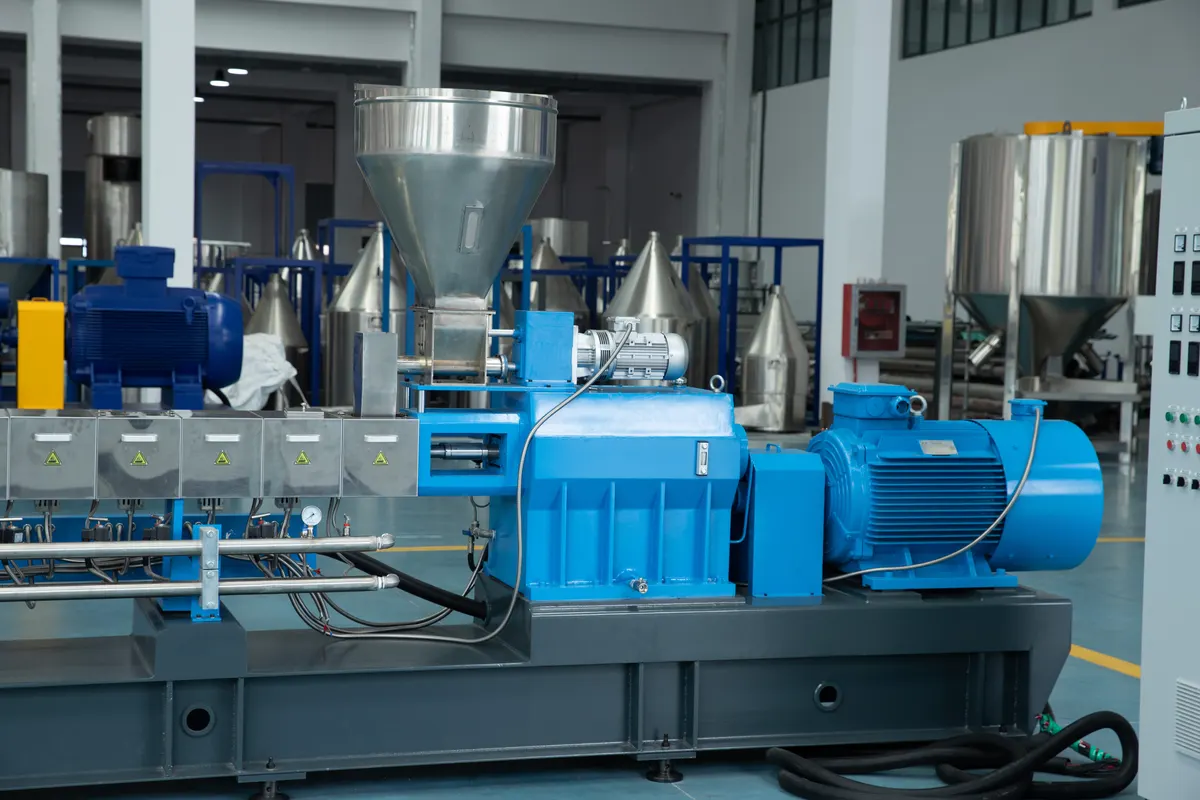
Why rated torque scales with diameter cubed
Transmissible torque follows M = 10·k_m·D³ (N·m), where k_m is the specific torque coefficient. Textbook ranges: co-rotating standard 0.55–0.85, co-rotating high-efficiency 1.0–1.25. Cross-checking Kerke catalog torques against this formula:
| Machine | Rated torque | Back-calculated k_m | Class |
|---|---|---|---|
| KTE-95D | 2×4,800 N·m | 1.19 | High-efficiency ✓ |
| KTE-75D | 2×2,100 N·m | 1.17 | High-efficiency ✓ |
| KTE-65B | 2×860 N·m | 0.71 | Standard ✓ |
Within one diameter, D-series torque is 1.7–2× the B-series (65: 860 → 1,530 N·m; 95: 3,000 → 4,800 N·m).
What each class can run
| Gearbox | T/A³ | Realistic work |
|---|---|---|
| A | <6 | Generic compounding, low filler; China market only |
| B | 6–8 | Filler masterbatch to ~50%, color masterbatch, recycling |
| D | 8–12 | Glass fiber, >60% filler, magnetic/ceramic powder, high output |
Two buying mistakes this number prevents
- Specifying motor kW instead of gearbox torque. A 90 kW motor on a B-class box does less useful work on 70% talc than a D-class box at the same kW — the gearbox slips the load first.
- Comparing quotes from different vendors without T/A³. Two "65 mm machines" can differ by 40% in free-volume torque. Ask every vendor for rated torque and screw diameter, then compute.
Rule of thumb for buyers: if filler exceeds 50%, or fiber content above 30%, start at D-class. If the recipe is a soft masterbatch under 40% filler, B-class delivers the same kilos for less money.
Turning T/A³ into a selection decision
| Recipe pressure | Required class | Kerke frames | Typical job |
|---|---|---|---|
| Low (filler <40%, color, recycling) | A or B | KTE-50, KTE-65 | General compounding, cost-driven |
| Medium (filler 40–60%, black MB) | B | KTE-65B, KTE-75B | Masterbatch at scale |
| High (filler >60%, fiber >30%, powder) | D | KTE-65D, KTE-75D, KTE-95D | Glass fiber, magnetic, ceramic |
The gap inside one diameter is large: on 65 mm, B-class carries 2×860 N·m and D-class 2×1,530 N·m — 78% more torque from the same barrel. That is the difference between 450 and 600 kg/h on a 70% talc recipe, and between a stable and a stalling line on 85% CaCO₃.
What the class costs
Torque class is not a line item on a quotation, but it moves the price more than most options. A D-class 65 mm machine typically quotes 15–25% above the B-class of the same diameter, and that premium buys output rather than speed. Per kg/h, a D-class 65 mm on high filler usually beats a B-class 75 mm: less floor space, less connected power, same kilos.
How to verify a vendor's torque claim
- Ask for rated torque and centre distance. T/A³ = torque ÷ centre distance cubed, in N·m per cm³.
- Back-calculate k_m from M = 10·k_m·D³. Values above 1.25 are marketing, not metallurgy.
- Ask what speed the rated torque applies to. A torque figure quoted at 300 rpm cannot be delivered at 800 rpm.
- Ask for the gearbox safety factor. Below 1.8 on a D-class box, expect a rebuild inside five years.
What to send with your enquiry
- Filler or fiber percentage, and whether it is a powder below 20 µm.
- The melt index or viscosity grade of the carrier resin.
- Target output and the screw speed you expect to run at — torque at 300 rpm is not torque at 800 rpm.
- Motor power and gearbox class of the machine you are replacing, so the comparison is like for like.
- Whether the line must run multiple recipes; a D-class box is inefficient on soft formulations.
Bottom line
Ask every vendor two numbers — rated torque and centre distance — and compute T/A³ yourself. A 50D out-torques a 65A, so diameter-only comparisons mislead. On high filler the class decides output; on color and compounding the class is mostly a way to spend money you did not need to spend.
One field case worth knowing
Two quotes for a 70% CaCO₃ line: a 75B at 620 kg/h and a 65D at 540 kg/h. On paper the 75B won. In the trial it ran at 88% torque and produced 480 kg/h, while the 65D held 520 kg/h at 74% torque with a 9°C lower melt temperature. Per kg/h installed, the smaller D-class machine was 11% cheaper and used 6% less energy. Torque headroom is what buys the last 15% of output.
FAQ
Is higher T/A³ always better?
No. High specific torque costs money and reduces free volume slightly. If your recipe runs at 30% filler, an A or B class machine delivers the same kilos for less capital.
How does specific torque relate to motor kW?
Motor kW sets speed under load; torque sets how much material the shafts can turn. A 160 kW motor on a B-class box cannot out-run a 132 kW motor on a D-class box at high filler.
Can I compare a 65 mm and a 95 mm machine by torque?
Only through T/A³ or through output on the same recipe. Raw torque favours the bigger machine by definition — it scales with D³.
What is a realistic T/A³ for Chinese-built machines?
Modern high-torque Chinese gearboxes reach 8–12 N·m/cm³. Anything quoted above 13 should come with a gearbox drawing and a safety-factor calculation.
Is T/A³ the same as torque density?
In practice yes — both normalise torque by the cube of centre distance. Be careful with units: N·m/cm³ and N·m/dm³ differ by a factor of 1,000, and vendors mix them.
Where these numbers come from
Figures in this page are drawn from KTE parameter tables, shaft design notes, cross-checked against delivered-line commissioning records. They are typical published practice — run trials on your own material before fixing production settings.
Specific Torque — the short version
Related on this site: Two-Stage Extruder · Output calculation · Glass fiber compounding
Bottom line. Specific torque — free volume normalized torque, written T/A³ — is the only fair way to compare two twin screw extruders of different sizes. Use the references above to shortlist, then let the material decide: a 25–50 kg lab trial settles filler ceiling, pellet shape and output before you commit to a line.