
Machine selection · 7 min read
Triple Screw vs Twin Screw: Where Three Screws Actually Win
A co-rotating triple screw adds a third intermesh zone, which splits the melt stream more often per revolution. That is a dispersion advantage, not a throughput magic trick. Here is where it wins, where it loses, and the honest comparison we make when customers ask.
Short answer: choose a triple screw when dispersion quality is the specification — transparent or high-pigment masterbatch, polymer alloys, and high-filler masterbatch where you want one machine instead of a two-stage line. Choose a twin screw for glass fibre (triple screws break fibre harder), rigid PVC (go two-stage), and any application where torque headroom matters more than splitting frequency.
What the third screw actually changes
In a co-rotating twin screw there is one intermesh zone between the two screws. A triple screw has three, arranged around the centre. Every pass through an intermesh zone splits the melt stream, reorients it, and exposes new surfaces — the mechanism behind dispersive and distributive mixing. The KTE-T geometry puts more than 35% of the screw surface in self-cleaning contact, against roughly 20–25% on a comparable twin. Practical consequences:
- More splitting events per revolution → finer pigment agglomerate breakdown at the same screw speed.
- More free volume per diameter → the same 62 mm frame carries a wider capacity band.
- Higher shear density in the mesh zones → the flip side is faster fibre attrition and more shear heat per revolution.
Where the triple screw wins
| Application | Why triple fits | Reference output |
|---|---|---|
| Transparent and premium colour masterbatch | Mesh zones break "specks and streaks" without raising temperature | KTE-T-50: 400–1200 kg/h |
| High-filler masterbatch on one machine | Dispersion plus pressure build on one shaft — avoids the two-stage layout | KTE-T-65: 500–2000 kg/h |
| Polymer alloys (PC/ABS, PA/PP) | Repeated interface splitting gives finer phase dispersion | KTE-T-65D class, 600 rpm |
| Large-volume universal colour masterbatch | 600 rpm ceiling plus free volume sustains rate | KTE-T-95: 1500–4000 kg/h |
Where the twin screw is the better answer
- Glass-fibre reinforcement. The fibre-shear discipline (side feed, no 90° kneaders downstream) is hard enough on a twin; the triple's denser mesh zones cut fibre length harder. Stay twin + side feeder.
- Rigid or heat-sensitive PVC. The answer there is a two-stage or a conical machine, not a faster mixer.
- Torque-critical reactive extrusion. Torque grades between twin and triple families are annotated differently in catalogue data, so a like-for-like torque comparison is not honest. We compare by application trial, not by nameplate.
The comparison we make when customers ask
Same frame size, same formulation, side-by-side trial: KTE-65B (twin, 200–450 kg/h catalogue) versus KTE-T-65 (triple, 500–2000 kg/h band). The triple's capacity band is wider because of free volume, but on a given masterbatch the realistic comparison is dispersion quality at equal throughput and melt temperature. In trials on TiO₂ and carbon black systems, the triple reaches target filter-pressure-rise thresholds at lower screw speed — that is the real, measurable advantage. On unfilled PE/PP blending, the difference shrinks to noise, and the twin's simpler screw inventory wins on cost.
FAQ
Is a triple screw always faster than a twin?
No. The catalogue bands are wider because of free volume, but actual output is formulation- and feed-limited. On a demanding dispersion job the triple may reach the same kg/h as the twin — at lower speed and lower melt temperature, which is the win.
Can a triple screw run glass fibre?
It can run, but we do not recommend it: the denser intermesh zones break fibre harder, and retained fibre length is what buys impact strength. Twin screw with side feeding remains the fibre standard.
Are spare parts interchangeable with twin screws?
No. Element geometry and shaft arrangement differ. Budget the triple's element inventory separately — it is a different screw family, not an add-on.
What about maintenance cost?
Mechanically similar (modular barrels, segmented elements), with one more shaft and two more mesh clearances to set. Expect comparable barrel life; element change intervals depend on filler abrasiveness, as with twins.
When is the extra machine cost justified?
When dispersion is the customer's specification — transparency, speck counts, filter pressure rise — or when one triple replaces a two-stage layout and saves floor space and a gearbox.
Where these numbers come from
Capacity bands are from the KTE-T parameter table (2026 edition). The twin-side comparison uses the KTE-65B catalogue band. Torque grades are annotated differently between the two families, so we deliberately do not publish a direct torque table — application trials settle it. Send your formulation and the dispersion spec (filter pressure rise, speck count) and we will run the side-by-side trial on your material.
Triple vs twin — the short version
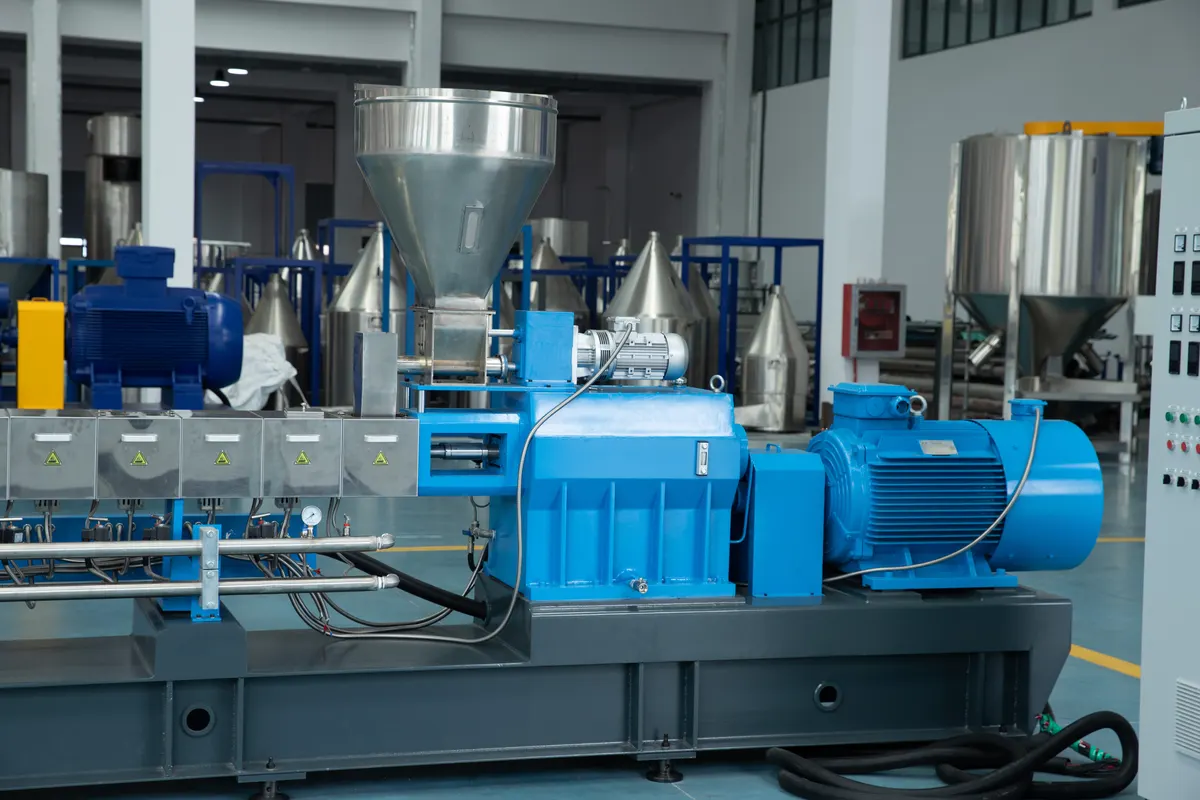
The third screw buys splitting events, not horsepower. Buy it when dispersion is your specification; stay twin when fibre, PVC or torque headroom defines the job.
Related on this site: KTE size chart 16–135 · specific torque, explained · twin screw range · free line quotation