
Application · 7 min read
PLA & Biodegradable Pelletizing: The 170–200°C Window
Biodegradable polymers fail by chemistry, not by mechanics: moisture and heat break the chain, and nothing downstream repairs it. This page gives the PLA processing window and drying discipline, the pelletising choice that protects the molecules, and where the chain-extender route fits.
Short answer: PLA pellets at 170–200°C barrel temperature — above roughly 210°C the molecular weight falls off a cliff — after drying at 80°C × 4 h to below 0.05% moisture. Screw configuration runs mild (wide-pitch conveying, weak kneading), a vacuum vent is standard, and the pelletising choice matters: air-cooling strand cutting never touches water, which is exactly what a hydrolysing polymer does not need. Output reference on a 65-class machine: 140–200 kg/h.
The window and the cliff
PLA's processing window is 170–200°C — narrower than polyolefins and, unusually, no hotter than some running temperatures of much tougher plastics. The mechanism is ester-bond hydrolysis and thermal chain scission: every minute above the ceiling, and every ppm of water, cuts molecular weight. The failure is invisible in the pellet (it still looks fine) and shows up in the customer's process — brittle film, weak fibre, blowing failures. This is why degradable compounding is specified as "protect the molecules", and why every setting in this article trades throughput for chain integrity.
Drying: the first red line
PLA dries at 80°C × 4 h to <0.05% moisture (PETG: 70°C × 6 h). Under-dried feed is the most common cause of molecular-weight loss on degradable lines — the extruder cannot outrun hydrolysis that starts in the feed pocket. Practical checks: desiccant dryer with dew-point monitoring, dried-material hopper sealed against ambient humidity, and Karl Fischer verification at startup — not "the dryer was on overnight".
Screw and pelletising choices
| Decision | Choice | Why |
|---|---|---|
| Barrel profile | 170–200°C | Above ~210°C molecular weight falls sharply |
| Screw configuration | Mild: wide-pitch conveying, weak kneading | Shear heat is chain damage by another name |
| L/D | 36–44 (36 common for degradables) | Published practice keeps residence short for heat-sensitive systems |
| Vacuum | −0.06 MPa tier, after melt seal | Removes moisture and volatiles; protect against over-depth stripping |
| Filtration | 80–120 mesh (150–200 for 3D-print grades) | Clean melt; fine screens only where nozzles demand it |
| Pelletising | Air-cooling strand (preferred) or short-contact water strand | No water contact protects against hydrolysis after the die |
PBAT/starch and PBAT/PLA film blends follow the same logic with one addition: compatibiliser and plasticiser dosing is recipe territory, and the screw configuration stays mild across all of them.
Chain extenders and 3D-print grades
Where the feedstock is partially degraded (regrind, off-spec lots), an epoxy chain extender at 0.3–0.5% re-links carboxyl-terminated chains during extrusion — molecular weight recovers measurably at the die. The extender is metered after melting and before the vent, and the vent tier is softened so the additive is not stripped. For 3D-print grades the discipline shifts from chemistry to geometry: 150–200 mesh filtration (nozzle protection), tight pellet-diameter control, and the same moisture rules. Output on print grades is typically quoted at 50–60% of the degradable-line band because of the filtration and pellet-shape demands.
FAQ
What temperature window does PLA need for pelletising?
170–200°C barrel temperature. Above roughly 210°C molecular weight falls sharply through thermal scission; the discipline is mild screw work plus a vacuum vent at the −0.06 MPa tier.
Why air-cooling pelletising for biodegradable plastics?
Water contact re-introduces the hydrolysis the whole process fights against. Air-cooling strand cutting never touches water — published practice for degradable systems, and worth the slightly lower rate.
How dry must PLA be before extrusion?
80°C × 4 h to below 0.05% moisture, verified by Karl Fischer at startup. Under-dried feed is the most common cause of molecular-weight loss on degradable lines.
Can a chain extender fix degraded PLA?
Partially. An epoxy extender at 0.3–0.5% re-links carboxyl-terminated chains during extrusion and measurably recovers molecular weight on partially degraded feed — it cannot rebuild what heavy hydrolysis already destroyed.
What is different for 3D-printing PLA pellets?
Filtration tightens to 150–200 mesh (nozzle protection), pellet shape control becomes a specification, and output runs at 50–60% of the standard degradable band. Moisture rules are identical.
Where these numbers come from
The window, drying discipline and pelletising choices follow published degradable-compounding practice and our line trials (application classes: biodegradable compounds, PLA pelletising, 3D-print materials). Send your material and end use — the trial returns the profile, filtration and pelletising setup with molecular-weight verification, which is the metric that matters here.
PLA pelletising — the short version
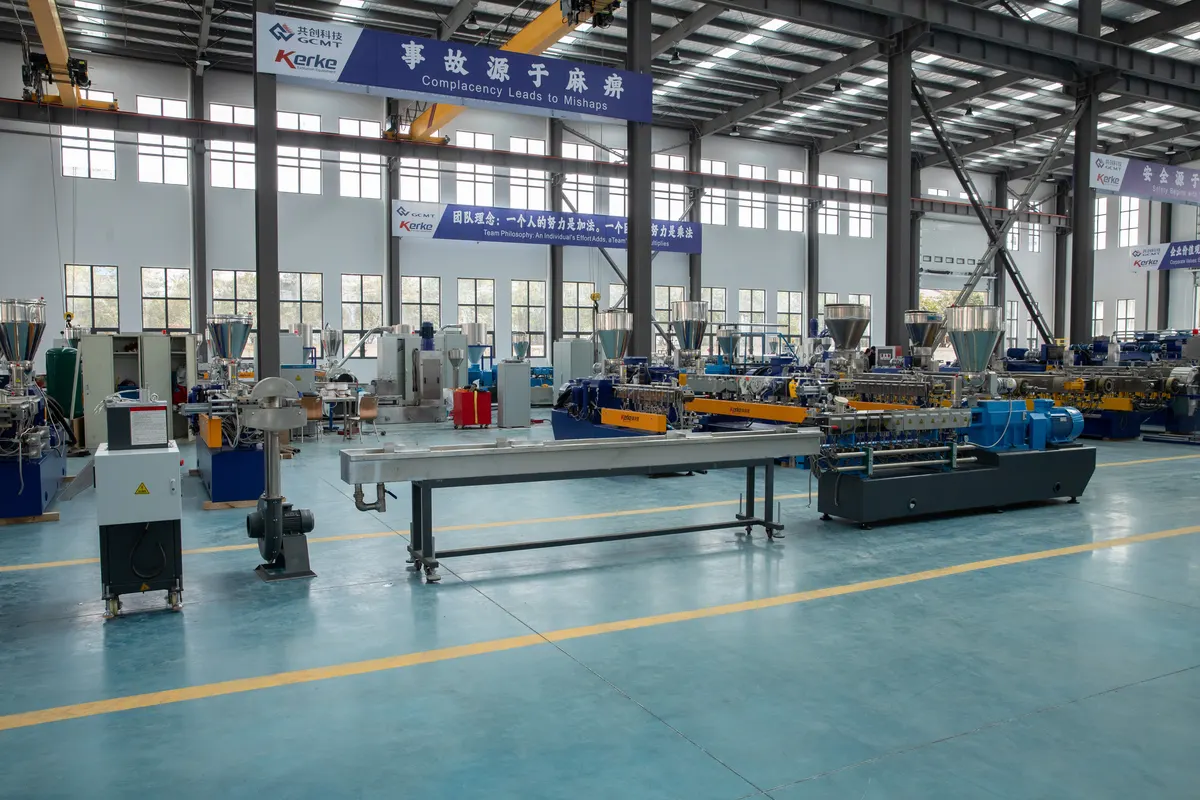
Everything in degradable compounding trades rate for chain integrity — and the customer's test measures the chain, not your throughput.
Related on this site: temperature profiles by material · vacuum tiers · pelletising methods compared · send your material for a trial