
Procurement · 9 min read
How to Compare Twin Screw Extruder Suppliers Without a Ranking
Published "top ten manufacturer" lists are usually written by one of the ten. This page does the opposite: it gives you a weighted scoring method, the eight dimensions that actually separate suppliers, and the three questions that distinguish a real OEM from an assembler — so the shortlist comes from your data, not someone else's ranking.
Short answer: compare suppliers on four verifiable things — a barrel-by-barrel process map for your formulation, the measured scrap figure from a test on your material, the lead time for wear parts, and a binding torque/speed derating curve. Catalogue output in kg/h is not comparable across suppliers because it is quoted against different formulations; the moment two suppliers state the same formulation, screw geometry, L/D, speed, motor load and pelletizing method, the numbers converge and the real differences appear.
The eight dimensions that decide a comparison
These are the columns we would use if we were the buyer. Each can be answered with a document, which is what makes it usable.
| # | Dimension | Evidence to demand | Why it separates suppliers |
|---|---|---|---|
| 1 | Process map | Barrel-by-barrel drawing for your formulation | Reveals whether the L/D carries real functions |
| 2 | Torque & speed | Derating curve at the quoted L/D | Prevents "1,200 rpm" claims that cannot be run at 60 L/D |
| 3 | Wear parts | Exploded drawing, metallurgy per zone, lead time | Sets the 5-year cost, not the purchase price |
| 4 | Test capability | Own lab line, or a booked external trial | Separates designers from copiers |
| 5 | Scrap figure | Weighed kg from first feed to on-spec | The only operating-cost number that is measurable |
| 6 | Feeding scope | Who supplies and calibrates feeders and controls | Interface gaps are where commissioning slips |
| 7 | Documentation | Electrical drawings, PLC logic, spare parts list at handover | Determines whether you can maintain it yourself |
| 8 | Reference access | Two customers running a similar formulation, contactable | Claims versus installed base |
A scoring method you can run in one afternoon
Weight the eight dimensions against your own priorities, score each supplier 1–5 on evidence only (no score without a document), and multiply. The weights below suit a first-time buyer of a filled polyolefin line; a research-heavy plant would shift weight from 5 to 3 and 4.
| Dimension | Weight | Score 1–5 | Weighted | Max |
|---|---|---|---|---|
| Process map | 25% | — | — | 1.25 |
| Torque & speed | 15% | — | — | 0.75 |
| Wear parts | 15% | — | — | 0.75 |
| Test capability | 10% | — | — | 0.50 |
| Scrap figure | 15% | — | — | 0.75 |
| Feeding scope | 8% | — | — | 0.40 |
| Documentation | 7% | — | — | 0.35 |
| Reference access | 5% | — | — | 0.25 |
Two rules make the result honest. First, a dimension scores zero when the evidence is a brochure rather than a document — this alone removes most of the field. Second, price enters only after scoring: divide the weighted score by the total cost of ownership (machine plus five years of wear parts, not the invoice).
Three questions that separate an OEM from an assembler
- Do you machine your own screw elements and barrels? Ask to see the machining cell, or the purchase order for the elements. A supplier that buys complete processing sections is a system integrator, which is a legitimate business — but the process support after sale is limited to what the section supplier provides.
- What is the gearbox source and torque class? Gearboxes are bought in by nearly everyone; the difference is whether the supplier will state the service factor at your operating point, or only the nominal torque.
- Can you run my formulation before I order, and will you report the result in writing? This is the cheapest risk reduction available. A supplier without a test line can usually book time on one; a supplier who will not test at all is selling a catalogue.
Why this site publishes no "top ten" ranking
We build extruders, so any ranking we publish would put us first — and you would be right to discount it. A list written by a participant is marketing with a table around it, and the parameters in it cannot be verified by the reader. What we can do honestly is publish the specification method, the process maps and the measured figures for our own machines, and let you compare them against the other quotations on your desk. If you want the names of suppliers in the Jiangsu cluster, they are easy to find in trade directories and at exhibitions; what is hard to find is a comparison that survives contact with your formulation. That is what the tables on this page are for.
FAQ
Why can't I compare kg/h between suppliers?
Because the figure depends on formulation, filler percentage, bulk density, screw diameter, L/D, screw speed, motor load, feeder arrangement, venting and pelletizing method. Two suppliers quoting 800 kg/h may be describing machines that differ by 40% in capability. Fix the formulation and the operating point first; then the numbers become comparable.
How many suppliers should I shortlist?
Three to four. Fewer gives no price tension; more turns the comparison into an administration project. Use the eight dimensions as a pre-qualification filter to get from eight to four, then run the full FAT protocol on the final two.
Is a lower price ever the right answer?
Yes, when the specification is genuinely simple — unfilled polyolefin, one formulation, one shift, low grade-change frequency. In that case the surplus capability of a premium machine is waste. The scoring weights should reflect that: raise price weight, lower test capability and documentation.
What single document predicts after-sales problems?
The spare parts list with lead times, delivered at order rather than at handover. A supplier who cannot produce it before the deposit usually cannot produce it afterwards either.
Does country of origin matter?
Less than the three OEM questions above. A machine assembled in one country from another country's processing section behaves like that section, and is supported like it too. Ask what is made where, and who supports what.
Where these numbers come from
The eight dimensions and the scoring weights are derived from buyer enquiries handled by Kerke between 2023 and 2026, and from post-purchase feedback on which specification gaps caused delays. The weights are a starting point, not a recommendation for your project — they should be re-weighted against your own production pattern. No supplier is scored on this page, deliberately.
Supplier comparison — the short version
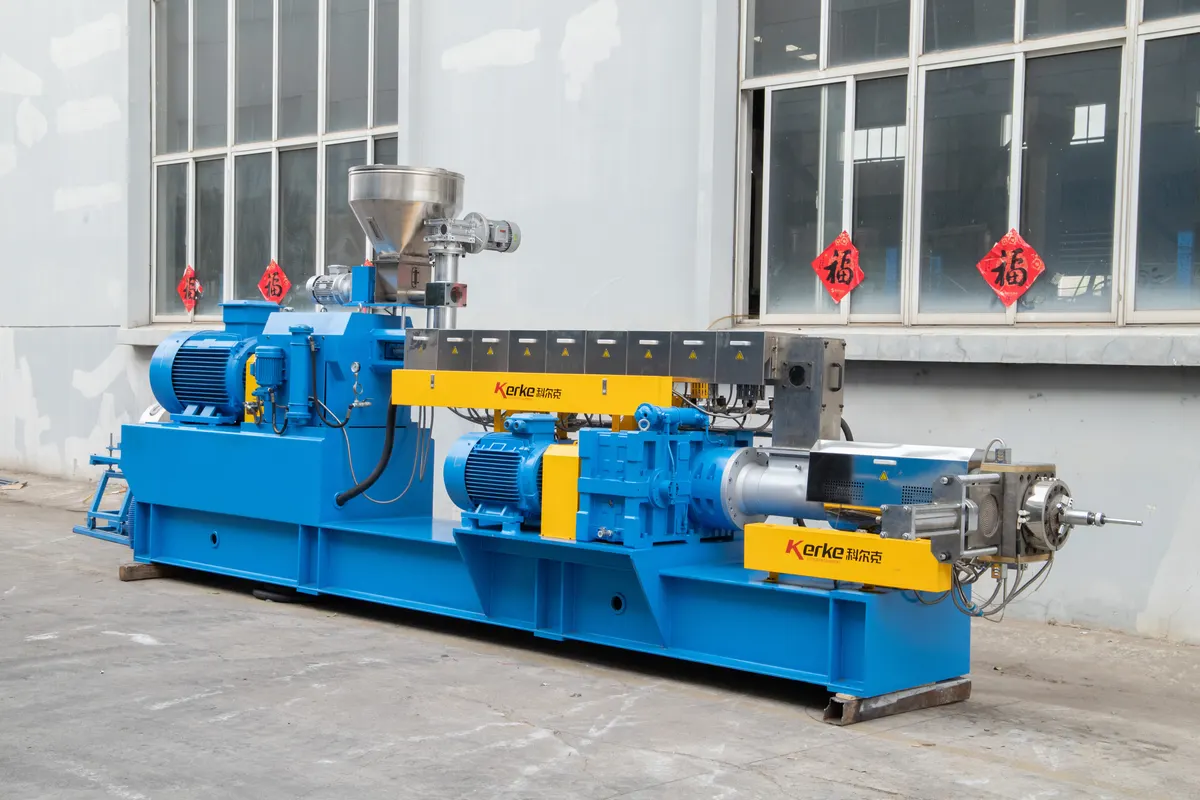
Score on documents, weight by your own production pattern, and let price in last. A shortlist built this way survives the first factory visit; a shortlist built from a published ranking usually does not.
Related on this site: the ten-step FAT protocol · measuring start-up scrap · L/D specification · co-rotating twin screw range · free line quotation