
Procurement · 10 min read
Twin Screw Extruder FAT: A Ten-Step Acceptance Protocol
A factory acceptance test is only meaningful if it runs your formulation, at your target output, long enough to reach steady state, and measures scrap in kilograms. This is the protocol we run, with the acceptance criteria and the instruments for each step — usable as a document to send to any supplier.
Short answer: a valid FAT uses the buyer's own or a formally agreed equivalent formulation, records the screw configuration and every operating point, holds the agreed output for at least 30 minutes at steady state, measures feed deviation on every stream, and weighs both start-up and shutdown scrap. A test that runs the supplier's easy formulation at catalogue maximum proves the machine runs; it does not prove your product can be made on it.
The ten steps
| # | Step | What is measured | Acceptance |
|---|---|---|---|
| 1 | Define the recipe | Grade, MFI, pellet/powder, additive chemistry, filler %, bulk density, moisture | Signed recipe sheet before the test |
| 2 | Record screw configuration | Diameter, L/D, element sequence, barrel number of every feed, inject and vent point | Drawing attached to report |
| 3 | Calibrate every feeder | Actual mass flow vs setpoint at low / normal / max rate | ±0.5% LIW, ±3% volumetric |
| 4 | Run at target output | Screw speed, motor load, gearbox torque, die pressure | Agreed kg/h held ≥ 30 min |
| 5 | Measure melt temperature | Hand probe in the melt stream, not the HMI value | Within ±5 °C of specification |
| 6 | Verify venting | Vacuum level logged 10 min, throat inspection, volatiles before/after | Steady ±0.005 MPa, dry throat |
| 7 | Test product quality | Dispersion, pellet shape, bulk density, moisture, colour | Per buyer specification |
| 8 | Weigh start-up scrap | All material from first feed to first on-spec pellet | Recorded in kg, not described |
| 9 | Weigh shutdown scrap | Purge and off-spec material at controlled stop | Recorded in kg |
| 10 | Restart and repeat | Time and scrap to reach specification again | Within ±15% of first run |
Steps 8 to 10 are the ones most often omitted. They are also the only ones that predict your operating cost, because scrap is the difference between a machine that makes product and a machine that makes product profitably.
What to record, in the format that compares
Insist on a single spreadsheet with one row per operating point, so two suppliers' reports can be read side by side. The minimum fields:
| Group | Fields |
|---|---|
| Machine | Screw diameter, L/D, barrel count, max torque, installed power |
| Operating point | RPM, motor load %, gearbox torque %, die pressure, melt temperature per zone |
| Feeding | Setpoint vs actual for every stream, refill events, hopper level |
| Venting | Vacuum MPa, port barrel number, throat condition |
| Product | Output kg/h, pellet size distribution, bulk density, moisture, dispersion rating |
| Losses | Start-up kg, shutdown kg, grade-change kg, time to specification |
| Utilities | Cooling water flow and temperature, air, total kWh, kWh/kg |
Specific energy (kWh/kg) is the field buyers forget and later wish they had. It is the single number that lets you compare a 55 kW machine against a 90 kW machine at the same output.
Pass and fail criteria
- Output: the agreed figure held for 30 minutes without operator intervention, with product in specification at the end of the run. A short burst above the figure is not a pass.
- Feed deviation: ≤ ±0.5% on loss-in-weight streams at normal rate; volumetric streams are accepted only where the formulation tolerates it.
- Melt temperature: measured with a probe in the melt, within ±5 °C of the agreed value, and stable across the run.
- Product: dispersion rating and pellet quality against a reference sample agreed before the test, not judged on the day.
- Start-up scrap: recorded in kilograms and compared with the figure quoted at order stage. If the supplier did not quote one, that is a finding in itself.
- Repeatability: a restart within ±15% of first-run time and scrap.
Signs of a weak FAT
Watch for these five patterns; each one converts a test into a demonstration:
- The formulation is the supplier's own "easy" grade — high bulk density, no filler, no sensitive additive.
- Output is quoted at maximum screw speed with no statement of motor load or melt temperature.
- Melt temperature is read from the HMI instead of a probe in the stream.
- Product quality is judged visually by the supplier's own operator.
- No weighing of scrap, and no restart test. "Low scrap" is a claim, not a number.
Any one of these is enough to ask for a re-run. All five together mean you are watching a sales demonstration with a machine attached.
FAQ
How long should a FAT run at target output?
At least 30 minutes at steady state after temperatures and feed ratios stabilise, which normally needs 20–40 minutes of running first. Short runs hide thermal drift and feeder instability.
Can the FAT be done on a smaller machine?
Only as a process trial. Scale-up from a 27 mm lab machine to a 95 mm production machine changes fill length, residence time and shear history. Use the small machine to choose the screw configuration, then FAT the production size.
Who supplies the material for the FAT?
The buyer, or the supplier at the buyer's cost with a signed equivalent-formulation sheet. Material supplied by the buyer is the only way to test your real additive package, including the fillers that cause wear.
What if the supplier refuses scrap measurement?
Treat it as a commercial risk signal and price it in. Scrap is the largest controllable operating cost in compounding; a supplier who will not measure it cannot improve it later.
Is a video of the FAT enough?
No. Video does not carry the data table. Require the signed report with the operating-point spreadsheet, the screw drawing and the scrap weights; video is supplementary evidence.
Where these numbers come from
This protocol is the internal FAT checklist used on Kerke lines, refined across more than 60 factory tests between 2021 and 2026 on PP, PE, PA, PBT, ABS and PVC formulations. The acceptance figures (±0.5% feed, ±5 °C melt, ±15% restart) are the tolerances we hold ourselves to; a buyer is free to tighten them. The protocol is published so it can be sent to any supplier — including competitors — and used unchanged.
Twin screw extruder FAT — the short version
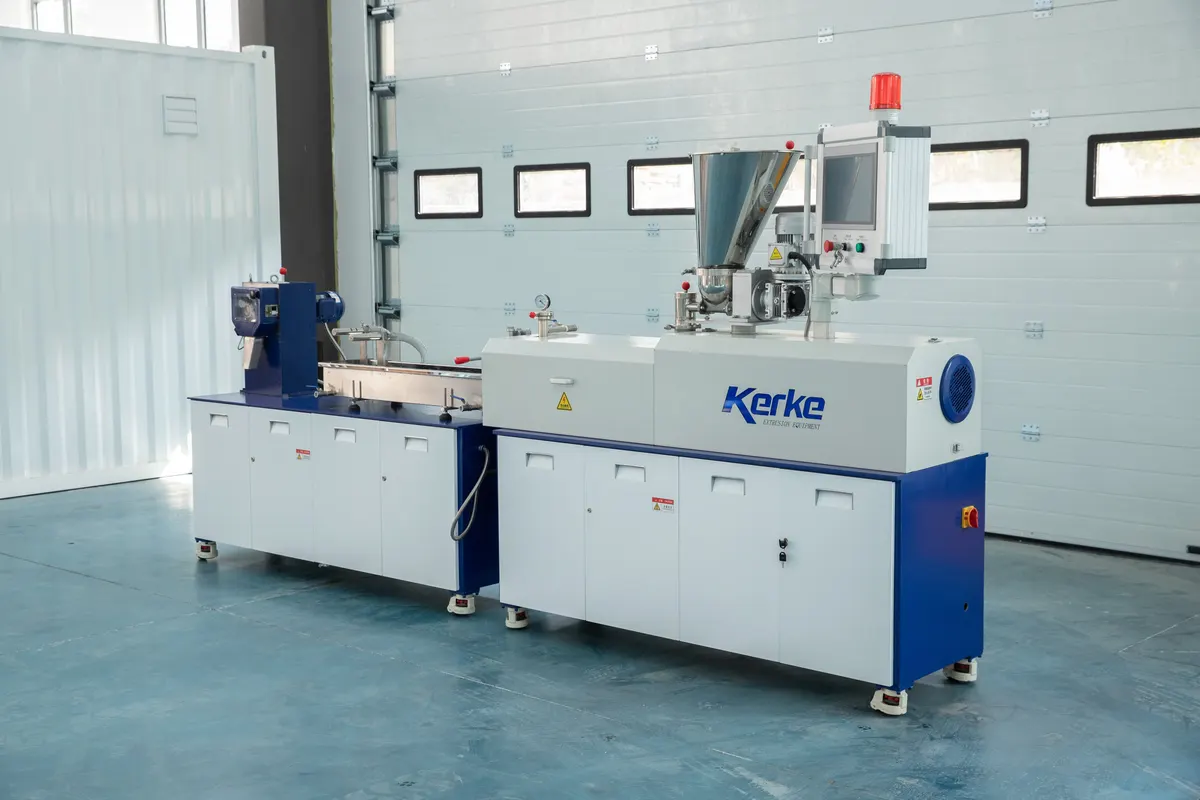
Send the ten-step table to every bidder with the RFQ. The supplier who replies with comments on the protocol is usually the one who has run real acceptance tests; the one who replies "no problem, we always test" has not.
Related on this site: measuring start-up scrap · L/D specification · how to compare suppliers · free line quotation