
Upstream · 8 min read
Why the Feeding System Sets the Throughput Ceiling
Most lines are bought on motor power and screw speed, then limited in practice by a feeder that drifts, a powder that bridges, or a liquid pump that cannot turn down far enough. This page gives feeder accuracy by material, the side-feed position rule, and the arithmetic for setting feed rates from an additive percentage.
Short answer: sustained output equals the lowest stable feed rate your weakest feeder can hold, divided by that component's mass fraction. A 1,000 kg/h gearbox with a volumetric filler feeder that wanders ±5% will not hold a 75% CaCO3 formulation in specification. Buy loss-in-weight feeding for every stream that appears in the formulation above 1%, and size the feeder range so normal operation sits between 30% and 70% of its capacity.
Feeder accuracy by material
The table below is what we specify. Accuracy figures are short-term repeatability at steady state, not the resolution of the display.
| Material | Feeder | Repeatability | Watch out for |
|---|---|---|---|
| Pellet, free-flowing | Single screw LIW | ±0.3–0.5% | Refill surge; use a surge hopper |
| Powder, bulk density > 0.5 | Twin screw LIW | ±0.5% | Screw wear at the outlet |
| Powder, bulk density < 0.35 | Twin screw LIW + agitator | ±0.5–1.0% | Bridging, air entrainment |
| CaCO3, talc (high loading) | Twin screw LIW, wear-lined | ±0.5% | Compaction in the hopper; vent the hopper |
| Fibre (glass, mineral wool) | Twin screw LIW, low shear | ±1.0% | Breakage in the feeder screw itself |
| Liquid additive | Gear or diaphragm pump, mass-flow metered | ±0.5% | Turn-down ratio, line pulsation |
| Masterbatch, 1–5% | Small LIW, 10–50 kg/h range | ±0.5% | Range too wide; a 200 kg/h feeder at 8 kg/h is blind |
Volumetric feeders cost roughly a third of loss-in-weight and are acceptable only for streams where a ±3–5% swing does not change the specification — typically a colour masterbatch below 1% on a product with wide colour tolerance. Everywhere else the drift shows up as batch rejects, not as a feeder fault.
Setting feed rates from a recipe
Convert the formulation into kilograms per hour once, in writing, before commissioning. The arithmetic is simple but it is where most commissioning disputes start.
| Stream | Fraction | Setpoint | Feeder range to buy |
|---|---|---|---|
| PP (base) | 71.5% | 572 kg/h | 300–1,000 kg/h |
| Talc | 25.0% | 200 kg/h | 80–300 kg/h |
| Additive package | 3.0% | 24 kg/h | 10–50 kg/h |
| Liquid | 0.5% | 4 kg/h | 1.5–8 kg/h |
Two sizing rules follow from this table. First, size each feeder so the setpoint falls between 30% and 70% of its maximum — the 4 kg/h liquid stream needs a pump whose minimum controllable flow is under 1.5 kg/h, not a 50 kg/h pump with a valve. Second, state the tolerance: on the talc stream, ±0.5% of 200 kg/h is ±1 kg/h, which is 0.125% of total output. If the specification allows only ±0.3% filler, that feeder accuracy is not enough and the talc needs to be pre-blended or the control loop needs gravimetric total-mass control.
Side feed position rule
A side feeder belongs after the melt seal and before the dispersive section — typically barrel 4–5 on a 10-barrel machine. Three conditions decide the exact barrel:
- The melt must be fully filled and under slight pressure at the feed opening, otherwise filler falls into a starved channel and is conveyed forward unmixed.
- There must be at least 4 D of conveying after the port before the next kneading block, so the filler is wetted before it is sheared.
- For fibre, the feed port goes downstream of all high-shear elements, with low-shear conveying to the die. Fibre fed into a dispersive zone is destroyed, not dispersed.
If a supplier proposes a side feeder at barrel 2 or 3, ask what happens to the air displaced by the filler. Without a vent upstream of the port, that air travels forward and shows up as voids in the pellet.
Liquid injection: the four numbers to fix in the RFQ
- Injection pressure — must exceed melt pressure at the port, typically 2–5 MPa above it, or the melt pushes back into the line.
- Position — after the melt seal, before the distributive section; never at the same barrel as a vent.
- Turn-down ratio — state the minimum and maximum flow. A pump rated 1:10 cannot hold 0.5% dosing if the line also runs 3%.
- Nozzle and heating — injection nozzle diameter, trace heating to the port, and whether the injector is retractable for cleaning.
Liquid streams are the most common cause of "the line will not hold specification at low rates", because a pump sized for the maximum formulation is blind at the minimum one.
FAQ
What accuracy do I need on a 25% filler stream?
±0.5% of setpoint or better, which is ±1 kg/h on a 200 kg/h stream. That requires loss-in-weight feeding. Volumetric feeding typically wanders ±3–5%, which moves the filler content by up to 1.25 percentage points and pushes the batch out of specification.
Can one feeder handle both 1% and 5% masterbatch?
Only if its range covers 5× the minimum flow. A feeder sized 10–50 kg/h handles both, but a 50–200 kg/h unit running at 8 kg/h will show repeatability worse than ±5%. Buy the narrow range and add a second feeder for the high-dose product.
Why does output drop when the filler feeder is switched on?
Usually the melt is being cooled by cold filler and the screw loses fill in the downstream section, or the filler is not being wetted and the melt pressure at the die falls. Check melt temperature at the die and the fill length after the side feeder before blaming the gearbox.
Is gravimetric total-mass control worth it?
For formulations with a tight filler tolerance (±0.3% or better) or frequent grade changes, yes. It corrects all streams against total output instead of each feeder independently, and typically halves the time to reach specification after a change.
How do I know my feeder range is right?
Log the feeder setpoint and actual rate for a full shift. If the setpoint sits below 25% or above 75% of the feeder's rated maximum for most of the run, the range is wrong — that is a sizing error, not an operator error.
Where these numbers come from
Accuracy figures are short-term repeatability measured during feeder calibration on Kerke lines, using check-weighing over 60-second samples. The worked example in Table 2 comes from a 25% talc PP compound line commissioned in 2025. Ranges are typical for gravimetric feeders from mainstream suppliers; the numbers your supplier quotes may differ, but the sizing rules (30–70% of range, turn-down ≥ 10:1) do not.
Feeding and throughput — the short version
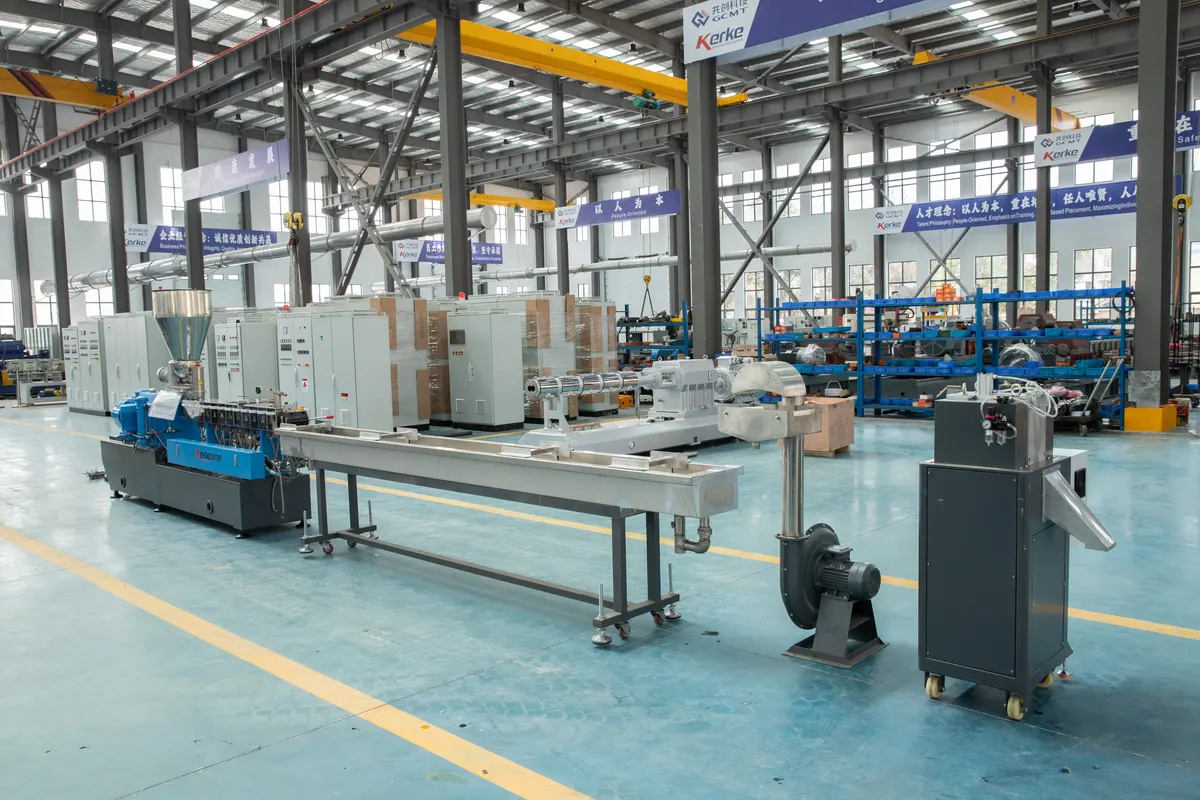
Write the mass balance before you compare quotations. A line is only as fast as its least stable stream, and that stream is almost always the smallest one — the 0.5% liquid, the 1% masterbatch, the low-bulk-density powder.
Related on this site: L/D specification · venting position · filler masterbatch line configuration · free line quotation