
Application · 7 min read
Black Masterbatch: Why 40% Carbon Black Costs You 20–25% Output
Carbon black masterbatch quotes lower output than general colour masterbatch on the same machine, and that is not a conservative quote — it is physics. This page explains where the capacity goes, what the real output bands are, and which machine decisions buy some of it back.
Short answer: carbon black loads at 20–40% in the masterbatch, and its dispersion demand eats capacity: on the same KTE-95 frame, general colour masterbatch quotes 500–750 kg/h while carbon black grades quote 400–600 kg/h — roughly 20–25% lower. The capacity goes into slower screw speeds for shear-controlled dispersion, finer filtration (80–120 mesh), and higher dispersant loading (8–12%) that must be melted and mixed before it works.
Where the 20–25% actually goes
Three mechanisms, all dispersion-driven:
- Shear-controlled speed: carbon black agglomerates need passes through high-shear kneading blocks, not volume. Speed caps at the point where agglomerate breakdown is complete — pushing past it produces black streaks, not more good product.
- Fine filtration: 80–120 mesh screens catch the un-dispersed residue, and fine screens raise die pressure, which caps stable rate at the same melt temperature.
- Dispersant load: 8–12% dispersant (against 5–8% in general colour MB) must be melted and distributed first — real mixing work that displaces throughput.
This is also the honest answer to "why does the same machine quote less for black": the machine is not smaller, the process is more demanding per kg.
The output bands, side by side
| Machine | General colour MB | Carbon black MB (up to 40%) |
|---|---|---|
| KTE-50 | 80–150 kg/h | 60–100 kg/h |
| KTE-65 | 150–250 kg/h | 120–200 kg/h |
| KTE-75 | 250–350 kg/h | 220–300 kg/h |
| KTE-95 | 500–750 kg/h | 400–600 kg/h |
PE carrier at 160–190°C is the reference system; PP carrier runs 180–220°C. Fibre-grade PET black masterbatch is its own discipline — 270–285°C, dedicated vacuum, L/D 48.
Buying some of the capacity back
- Pre-disperse the black. A wetting/pre-mix step (or masterbatch-in-masterbatch carrier premix) reduces the work the extruder must do — the most reliable single lever.
- Choose the element geometry for black. High-shear blocks (90° class) concentrated in a shorter section disperse more efficiently than mild blocks spread over more length — dispersion per D, not per revolution.
- High-torque drive class. The 7–9 N·m/cm³ class buys speed headroom at equal melt temperature — the mechanical lever that matches the process demand.
- Triple screw for premium grades. The third mesh zone raises splitting frequency; on jetness-critical grades it reaches the spec at lower speed — output comes back as a by-product.
How black masterbatch quality is judged
Two tests dominate customer acceptance: jetness/masdust measurement on diluted plaques, and filter pressure rise — pump the diluted masterbatch through a standard screen pack and record pressure growth. FPR is the number that decides film-grade acceptance, and it is also the most honest process metric on your own line: rising die pressure during production is un-dispersed black announcing itself.
FAQ
Why is carbon black masterbatch output lower than general colour masterbatch?
Dispersion demand: slower screw speed for complete agglomerate breakdown, finer 80–120 mesh filtration that raises die pressure, and 8–12% dispersant that must be mixed first. On the same frame the band runs roughly 20–25% lower.
How much carbon black can a masterbatch carry?
Up to 40% is standard practice. Beyond that, wetting becomes the bottleneck — dispersant load rises and output falls faster than loading rises, so the economics typically peak in the 30–40% band.
What machine features matter most for black masterbatch?
High-torque drive class, a concentrated high-shear mixing section, fine-mesh screen capability, and a pre-dispersion step upstream. A triple screw is worth considering for jetness-critical premium grades.
What does filter pressure rise tell me?
How much un-dispersed carbon black is in the melt. It is the standard film-grade acceptance test and the most honest real-time metric on your own production line — rising pressure means dispersion is incomplete at current settings.
Does black masterbatch need a vent?
Yes — carbon black carries a lot of entrained air, and without degassing the strands foam and pellets show voids. A standard −0.06 MPa tier with a proper melt seal handles it.
Where these numbers come from
Output bands are catalogue reference values (2026 edition parameter tables) for PE-carrier systems; the dispersion mechanisms follow filter-pressure-rise trials on delivered lines. Send your black grade and target jetness — the trial returns the speed, screen pack and dispersant loading that meet your spec at the highest sustainable rate.
Black masterbatch — the short version
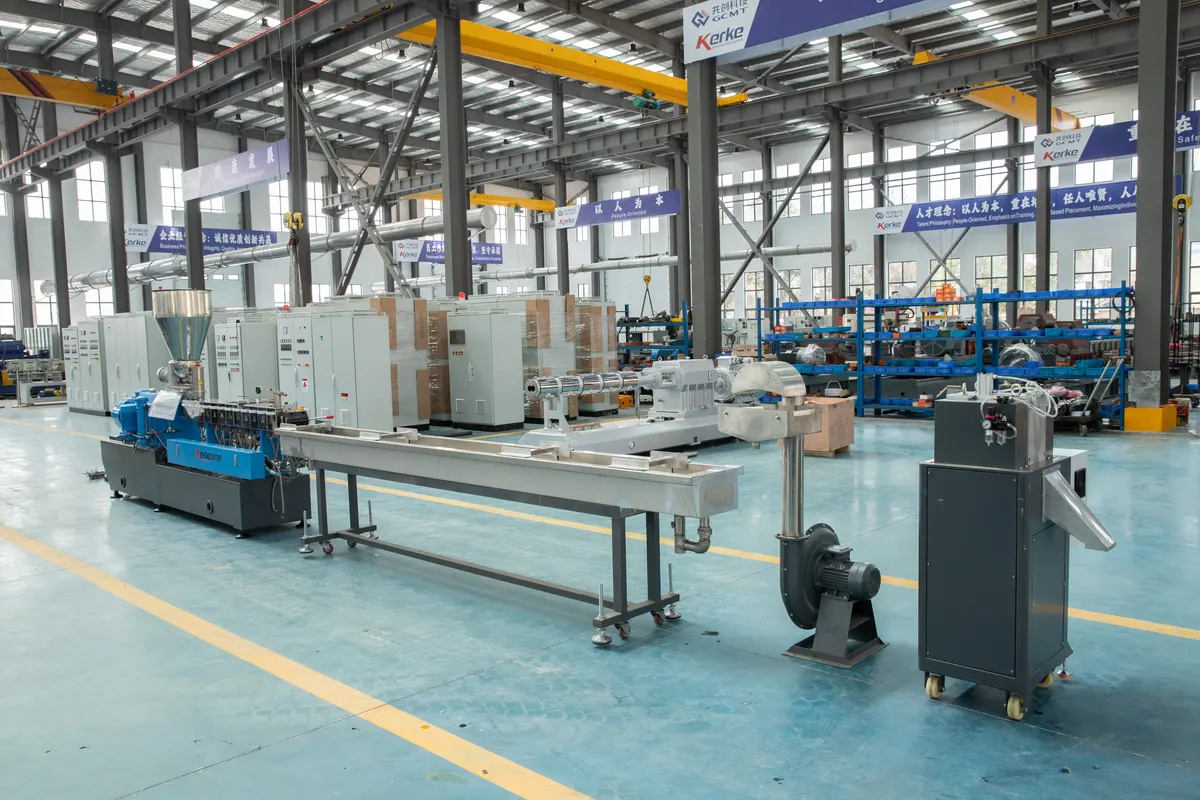
The output gap is the price of jetness. Pre-dispersion, concentrated shear geometry and torque headroom are the levers that buy part of it back.
Related on this site: speed bands by material · torque classes · screen changer selection · send your grade for a trial