
Process guide · 5 min read
Filler Masterbatch Formulation Structure: The Four-Component Skeleton
Every filler masterbatch is the same four-part skeleton with different numbers: filler 70–85%, carrier 12–25%, coupling agent ~1%, dispersant/lubricant ~4%, plus a trace of antioxidant.
Short answer: Every filler masterbatch is the same four-part skeleton with different numbers: filler 70–85%, carrier 12–25%, coupling agent ~1%, dispersant/lubricant ~4%, plus a trace of antioxidant. Understanding what each part does — and which lever moves which property — is more useful than any single recipe.
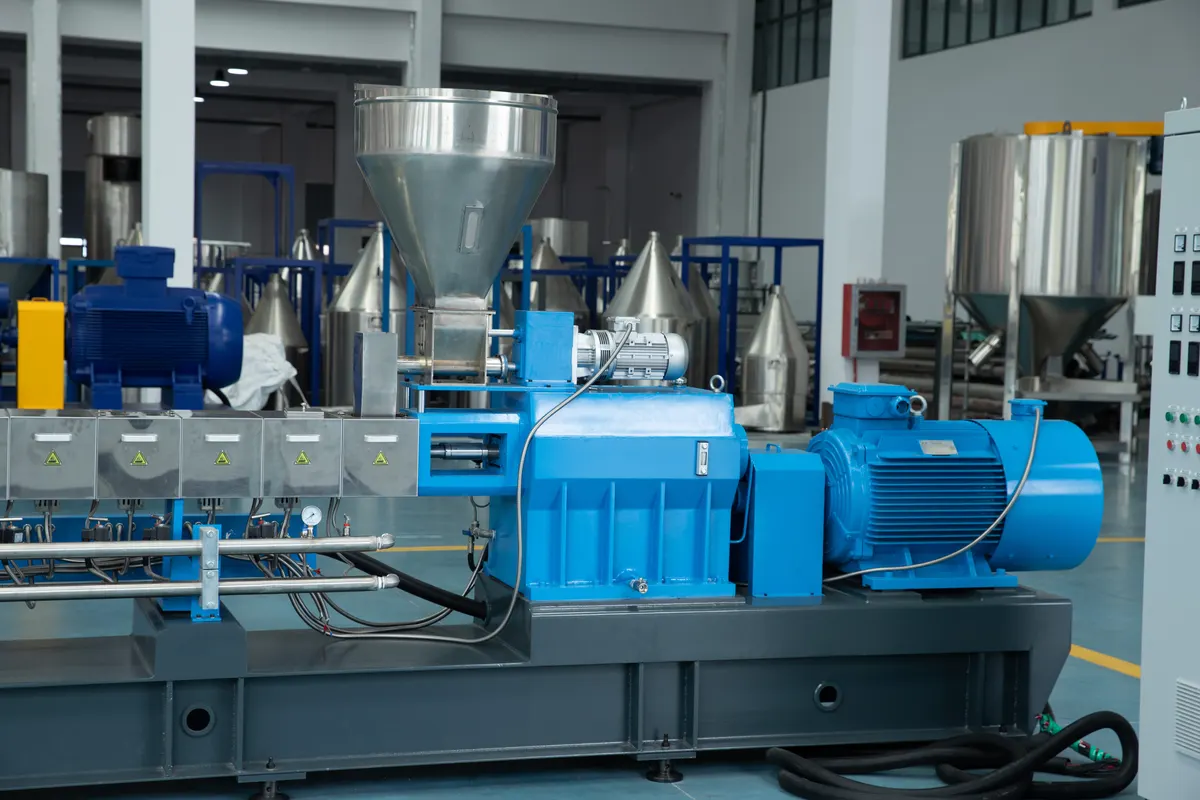
The skeleton
| Component | Typical share | Job | What breaks without it |
|---|---|---|---|
| Mineral filler | 70–85% | Cost, stiffness, opacity | — (this is the product) |
| Carrier resin | 12–25% | Wets and transports filler into the end resin | Masterbatch won't feed or disperse downstream |
| Coupling agent | 0.8–1.5% | Bonds mineral surface to resin | Filler behaves as inert sand; mechanical properties halve |
| Dispersant / lubricant (PE wax + stearates) | 3–5% | Prevents agglomeration, eases pelletizing | Strings break, pellets dusty, die pressure high |
| Antioxidant | 0.1–0.3% | Protects carrier through thermal history | Yellowing on second processing |
Choosing each part
Filler: heavy CaCO₃ 800–1250 mesh (10 μm target) for cost grades; talc 1250+ mesh when stiffness matters (talc platelets are natural nucleating agents — PP/talc flexural modulus ≈ 4,500 MPa vs PP/CaCO₃ ≈ 3,200). Moisture below 0.3% is a hard gate.
Carrier: same or compatible resin as the customer's end polymer, MFR slightly higher than the end resin. PP powder or LLDPE for polyolefin lines; the recycled-carrier route (recycled PP + LDPE + PP-g-MAH) is a documented cost lever.
Coupling: aluminates for CaCO₃ (cost-effective), titanates/silanes for talc. Activation happens before extrusion: high-intensity mixer at 110–120°C, agent dosed in 1–2 additions over 10–15 min.
Dispersant: PE wax 3–5% plus calcium stearate 0.5–1% is the workhorse pair; EBS for talc systems.
Which lever moves which customer complaint
| Complaint | Lever |
|---|---|
| "Pellets dusty / feed inconsistent" | More PE wax, check carrier MFR |
| "End product brittle at high dosage" | Coupling quality first, then filler mesh |
| "Strings breaking at pelletizer" | Wax level, die temp, filler % too high for strand cutting |
| "Cost too high" | Carrier → recycled route; filler mesh down one grade (test impact) |
The dosage ceiling is a line decision, not a recipe decision: above 50% filling, strand pelletizing strings break; 30–82% wants water-ring; 82–90% wants air-cool hot-face; above 85% the machine should be two-stage.
Typical published practice — run trials on your own material before production.
Line setup that delivers this skeleton
| Component | Share | Function | Process lever |
|---|---|---|---|
| Filler (CaCO₃/talc) | 70–85% | Cost and stiffness | Side feed position, loading ceiling |
| Carrier (PE/PP) | 12–25% | Continuous phase | MFR matching the end polymer |
| Coupling agent | ~1% | Bonding | Mixer activation at 110–120°C |
| Dispersant / lubricant | 3–5% | Wetting, flow | PE wax or stearate, dosed with filler |
| Antioxidant | 0.1–0.2% | Thermal protection | Main feed, never side feed |
The levers are not equal. Loading sets cost; coupling sets strength; dispersant sets surface and output. If a customer asks for "cheaper masterbatch", the honest answer is to trade loading against coupling — not to cut the dispersant, which is what usually happens.
What this line costs
The 65 mm filler line at USD 70,850 (2024) covers 70–85% loading at 300–450 kg/h, and the 50 mm version at USD 56,500 covers 80–200 kg/h. Per kg/h: USD 157–236. The formulation's economics are dominated by filler price (USD 80–200/t) against carrier (USD 900–1,300/t), so every percentage point of loading saves 0.7–1.2% of material cost — which is why lines are pushed to the wall.
Trials before production
- Fix the carrier MFR first; changing it later invalidates every dispersion result.
- Test two dispersant levels at the target loading and compare output and surface — the cheaper one often wins.
- Measure tensile at three loadings to find where the curve turns; that is your commercial ceiling.
- Run a 2-hour continuous run and check vent carry-over and die pressure drift.
- Compare pellet dust before and after adding 0.3% wax; dust is the hidden cost in filler masterbatch.
The failure this recipe is known for
The four-part skeleton fails when one part is used to fix another's problem. Cutting coupling agent to afford more dispersant buys output and loses tensile; adding wax to fix dust lowers impact. Each component has one job. When a batch is off-spec, identify which property moved and change only the component responsible for it — otherwise the next batch drifts further.
FAQ
Can I skip the antioxidant?
At 200–230°C with 10-minute residence, no. Without it you lose 5–8% of elongation after storage, and the customer blames the filler.
What is the cheapest way to raise loading?
Better filler size distribution (D97 under 10 µm) rather than more dispersant. Dispersant is a lubricant, and excess lubricant costs strength.
Does carrier choice affect output?
Yes, by 10–15% through melt viscosity. A higher-MFR carrier runs faster but lowers impact strength.
Why does my masterbatch feel greasy?
Over-lubrication. Cut wax by 0.5% and check whether dispersion still passes the grind gauge.
How do I know which component to adjust?
Match the symptom: white specks → dispersant; low tensile → coupling; greasy feel → wax; yellowing → antioxidant. Change one at a time and re-test. ## What these numbers do not settle
The skeleton fixes the roles, not the values. Carrier MFR, filler size distribution and the customer's processing temperature each move the numbers by several points, and they interact. Two plants using the same skeleton and the same filler can end up 6 points apart on achievable loading because of carrier choice alone.
Where these numbers come from
Figures in this page are drawn from patent-set process statistics, commissioning records, cross-checked against delivered-line commissioning records. They are typical published practice — run trials on your own material before fixing production settings.
Filler Masterbatch Formulation Structure — the short version
Related on this site: CaCO₃ two-stage line · Coupling agent activation · Talc formulation
Bottom line. Every filler masterbatch is the same four-part skeleton with different numbers: filler 70–85%, carrier 12–25%, coupling agent ~1%, dispersant/lubricant ~4%, plus a trace of antioxidant. Start from the reference ranges, then verify on your own line material before locking the recipe — our lab returns pellets, video and a parameter report in 3–7 days.