
Process guide · 5 min read
MAH Grafting on PP/PE: Liquid Injection, Twin Vacuum & the 0.8–1.2% Target
Maleic-anhydride grafting turns polyolefins into compatibilizers (PP-g-MAH, PE-g-MAH) by reacting MAH onto the chain in the melt — with peroxide initiation, liquid metered injection, and a dual-vacuum venting scheme to strip unreacted monomer below 0.3% residue. The temperature ceiling surprises people: PP runs 190–210°C, and above 230°C the graft rate falls because PP degradation outpaces grafting.
Short answer: Maleic-anhydride grafting turns polyolefins into compatibilizers (PP-g-MAH, PE-g-MAH) by reacting MAH onto the chain in the melt — with peroxide initiation, liquid metered injection, and a dual-vacuum venting scheme to strip unreacted monomer below 0.3% residue. The temperature ceiling surprises people: PP runs 190–210°C, and above 230°C the graft rate falls because PP degradation outpaces grafting.
Reference formulations
| System | Composition | Notes |
|---|---|---|
| MAH-g-PP | PP 95–97% + MAH 1–2% + DCP 0.1–0.3% + styrene co-monomer 0.5–1% + AO 0.2% | Styrene co-monomer raises graft rate and suppresses PP chain scission |
| MAH-g-PE | PE 96–98% + MAH 1–1.5% + DCP 0.05–0.15% + AO 0.2% | PE grafts less readily; mostly used as compatibilizer |
The process sequence
| Step | Zone | Detail |
|---|---|---|
| 1. Melt | Feeding + melting zones | Resin only |
| 2. Liquid injection | Post-melting | MAH (mp 52°C — heated lines to prevent freezing) + DCP, gravimetric/liquid metering |
| 3. Graft reaction | Mixing sections | PP 190–210°C, PE 160–180°C; L/D 44–48; strong distributive mixing |
| 4. First vent | Atmospheric | Bulk volatiles out |
| 5. High vacuum | Deep vent | Residual MAH <0.3% — monomer is corrosive and odorous |
| 6. Pelletize | Underwater or water-ring | MAH hydrolyzes slowly on wet pellets — dry pellets after cutting |
Why twin vacuum is mandatory
Unreacted MAH is a severe irritant and produces odor in the customer's downstream processing. The atmospheric vent alone leaves monomer; the high-vacuum stage pulls it below the 0.3% residual threshold. This is a machine configuration argument — quote both vent stages as a package with the line.
Machine matching
Reaction sections want controllable residence time and fill factor: KTE-50D/65D (high torque, dual vacuum) is the standard recommendation. Grafting customers typically use their product in their own modification work — the line's promise is reproducible reaction conditions, while graft rate itself is formulation (MAH/DCP ratio) territory. Do not quote graft-rate numbers; quote window reproducibility.
Failure modes
- MAH feed line cold → monomer solidifies, dosing stops, recipe drifts
- Vacuum too aggressive at the wrong stage → strips MAH before reaction
- Over-temperature → PP scission, graft rate drops, pellets yellow
- Wet pellets stored sealed → MAH hydrolyzes to maleic acid, corrosion + odor
Typical published practice — run trials on your own material before production.
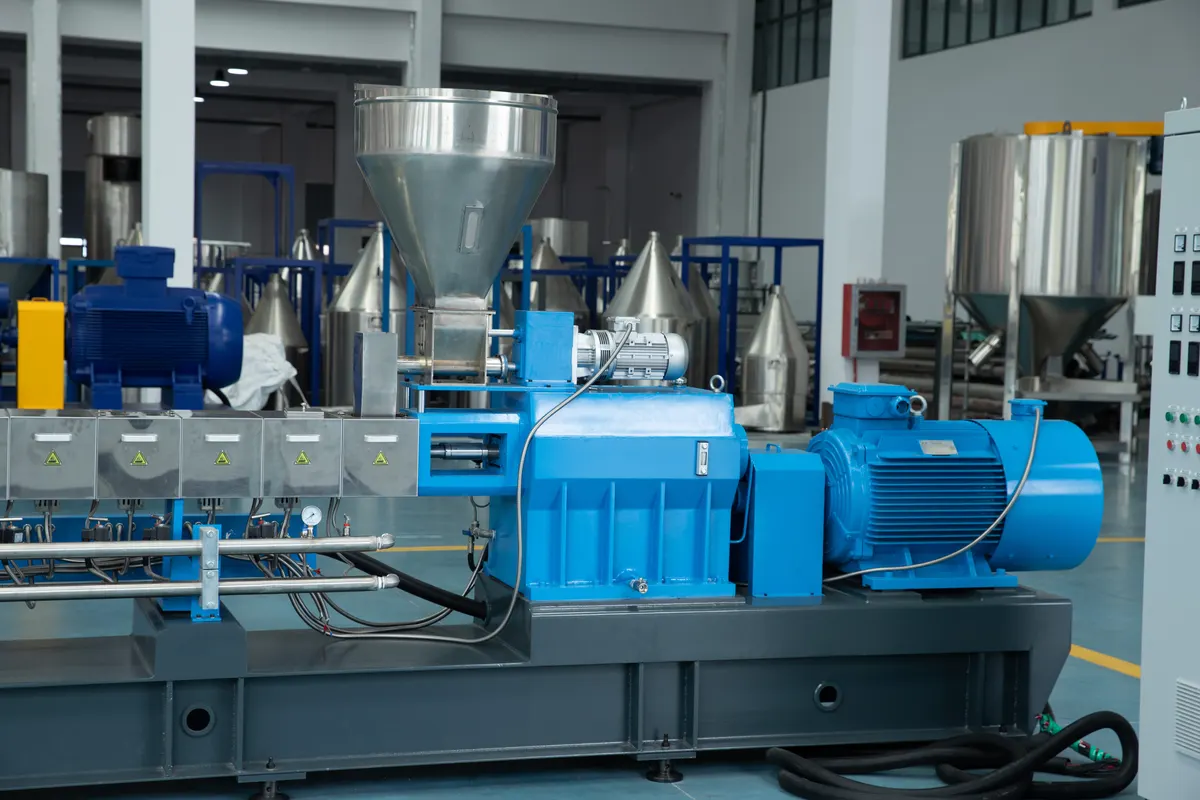
Line setup that delivers this graft
| Element | Specification | Setting |
|---|---|---|
| Frame | KTE-65B, 40:1 | 300–600 kg/h at 250–400 rpm |
| Injection | MAH liquid at 4–6 D, peroxide at 8 D | Separate metering pumps |
| Reaction zone | 2 kneading groups, 180–200°C | Residence 60–120 s |
| Venting | Two vacuum ports, −0.08 MPa | Strip unreacted monomer below 0.3% |
| Pelletizing | Water-ring | Standard |
Two vacuum ports are not optional. One port strips the bulk of the monomer; the second takes the residue down to the 0.3% level that customers test for. Lines with a single vent typically sit at 0.5–0.8% residue and fail the spec.
What this line costs
A grafting line at 65 mm with dual vacuum, liquid injection and water-ring pelletizing runs USD 85,000–100,000 in 2024 terms. Per kg/h at 400 kg/h that is USD 210–250 — high, because the vacuum system and the metering pumps are a large share of it. The MAH and peroxide together are USD 60–120/t of product at typical dosages.
Trials before production
- Titrate the grafted product (acid-base back-titration) at 1, 2 and 4 hours of run to confirm steady state.
- Measure residual monomer at both vents separately; if the first vent does nothing, the melt seal is missing.
- Run a torque sweep: grafting needs residence time, and too much speed cuts conversion.
- Check for MAH fuming at the die; visible fume means the vacuum is undersized.
- Age a sample at 60°C for 7 days and re-titrate — post-reaction drift indicates unreacted peroxide.
The failure this recipe is known for
Grafting fails by gel. Unreacted MAH crosslinks slowly in storage, and a product that titrates correctly on day one develops gels by week four. The cause is residual peroxide; the fix is either a longer vent residence or a 0.02–0.05% antioxidant added after the reaction zone. Test gel count after 30 days at 40°C, not on the day of production.
FAQ
Why is my graft level lower than the recipe predicts?
Insufficient residence time or monomer flashing at the vent. Check melt seal first, then screw speed.
Can I graft without a vacuum system?
No. Residual monomer above 1% makes the product unusable and creates a smell the customer will reject.
Is a twin screw necessary?
For PP-g-MAH and PE-g-MAH at commercial quality, yes. Single-screw grafting exists but conversion is lower and consistency worse.
What peroxide should I use?
A dialkyl peroxide with a 1-minute half-life near 190°C, dosed at 0.05–0.15%. The exact grade matters less than the metering accuracy.
Can I raise graft level by adding more MAH?
Only with more peroxide, and that brings gels. Above about 1.2% graft level on PP, the side reactions dominate and the product degrades. ## What these numbers do not settle
Graft level is a function of residence time, peroxide half-life and vent efficiency together. The 0.8–1.2% target is achievable across a wide range of those three, which is why two lines can both hit it with different speeds. What the tables cannot tell you is the gel content after storage — that is a function of residual peroxide, and only a 30-day ageing test reveals it.
Where these numbers come from
Figures in this page are drawn from patent-set process statistics, commissioning records, cross-checked against delivered-line commissioning records. They are typical published practice — run trials on your own material before fixing production settings.
MAH Grafting on PP/PE — the short version
Related on this site: TPU reactive extrusion · Vacuum level · XLPE grafting