
Process guide · 5 min read
HFFR Cable Compound: Why Two-Stage Beats Single Screw
Halogen-free flame-retardant (HFFR) cable compounds carry 50–60% ATH/MH filler, and aluminum trihydrate starts releasing water above ~200°C.
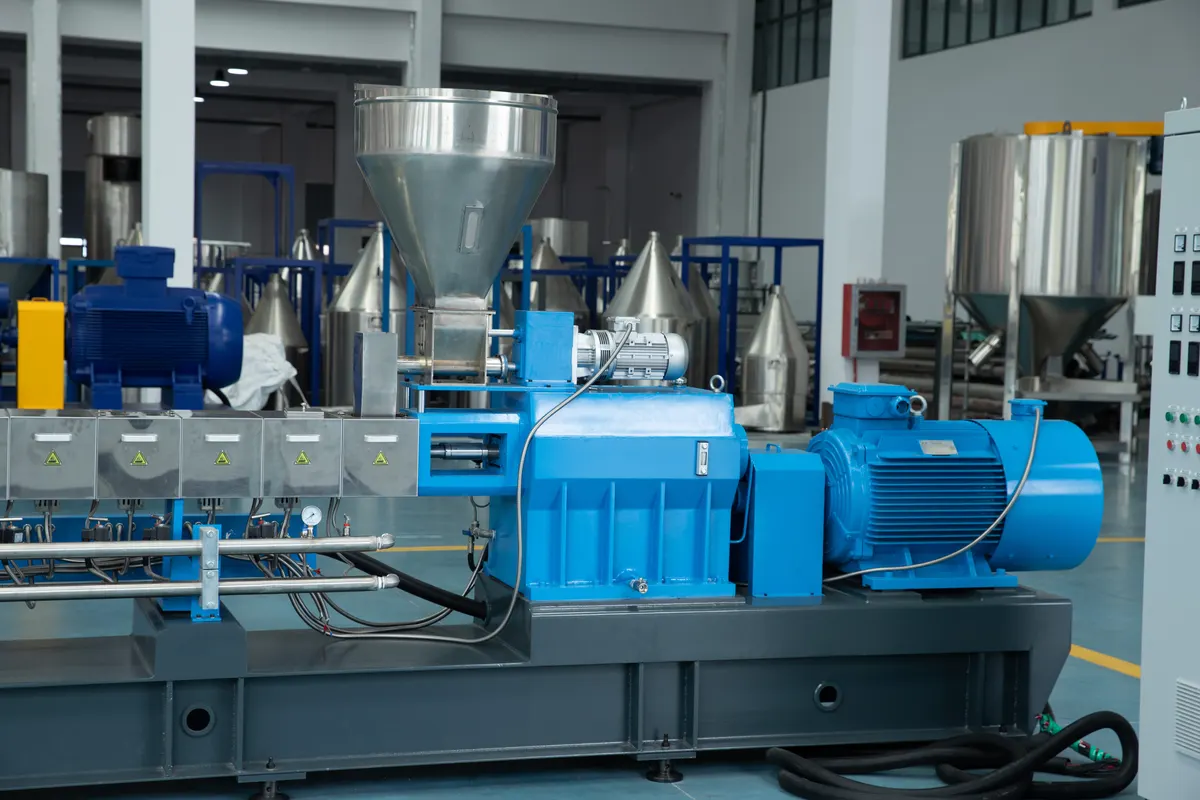
Short answer: Halogen-free flame-retardant (HFFR) cable compounds carry 50–60% ATH/MH filler, and aluminum trihydrate starts releasing water above ~200°C. A single twin screw dispersing that load while also building die pressure generates exactly the shear heat that kills the filler — which is why the standard answer is a two-stage KTE/SE line: twin screw disperses cold, single screw pressurizes gently, air-cooling hot-face pelletizing keeps the compound dry.
The formulation
| Component | Share | Role |
|---|---|---|
| EVA / POE / PE base | 35–45% | Flexibility matrix |
| ATH (activated) or MH | 50–60% | Flame retardant + smoke suppression |
| Silane coupling agent | 1–2% | Filler bonding (pre-activated powder) |
| Zinc borate | 3–5% | Synergist |
| Lubricant + antioxidant | 1–2.5% | Processability |
Above ~60% ATH the melt strength collapses — pelletizing and extrusion both become unreliable. That ceiling is real; quotes for "more filler" need reformulation, not just a bigger machine.
Process discipline
| Parameter | Setting | Red line |
|---|---|---|
| Barrel temperature | 140–170°C | ATH dehydration >200°C releases steam |
| Two-stage split | Twin: disperse; SE: build pressure | Single-screw stage at 0–120 rpm |
| Pelletizing | Air-cooling hot-face | Water contact pre-activates ATH surface |
| Vacuum | Standard, remove free moisture | Wet feed causes voids |
The two-stage split also protects the cable plant: compound produced on a KTE/SE line runs at steady pressure into the customer's extruder, where surge shows up as insulation thickness variation — a rejection-level defect.
PVC comparison (same machine family)
PVC cable compound runs the same two-stage logic for a different reason: heat sensitivity (HCl release), not filler decomposition. L/D 36, barrel 140–170°C, air-cooling hot-face cutting because cold PVC is hard and wet cutting carries water. Kerke capacity rows: PVC/HFFR on KTE/SE-50/100 through 95/200 spanning 150–1,500 kg/h.
What buyers get wrong
- Quoting a single twin screw because the filler is "only" 55% — shear-heating failures at the ATH ceiling are then blamed on the machine
- Water-ring pelletizing "because output is higher" — moisture reactivates ATH and hydrolyzes the silane bond
- Skipping powder activation — dispersion failure shows up as dielectric weakness, not as machine trouble
Typical published practice — run trials on your own material before production.
Line setup that delivers this formulation
| Stage | Specification | Duty |
|---|---|---|
| Twin screw | KTE-65B, 44:1 | Disperse 50–60% ATH/MH below 200°C |
| Side feed | 16–20 D, forced feeding | ATH powder, low bulk density |
| Transfer | Vacuum, melt seal | Isolate from the pressure stage |
| Single screw | SE-150, 60–100 rpm | Gentle pressurization |
| Pelletizing | Air-cooled hot-face | Avoids water pick-up |
Air-cooling is not a preference here. Water-ring or underwater systems put the compound in contact with water at a moment when the filler is hygroscopic and the polymer is hot — moisture pick-up shows up later as surface defects on the cable.
What this line costs
The 65 mm two-stage reference at USD 66,600 (2024) covers black masterbatch; an HFFR cable compound line adds air-cooled hot-face pelletizing and heavier venting, landing at USD 85,000–105,000. Per kg/h at 400–600 kg/h that is USD 170–210. The compounding extruder is not the cost driver — the pelletizing and the material handling are.
Trials before production
- Check ATH moisture before feeding: above 0.3% it flashes in the barrel and voids the melt.
- Run the melt at 190°C and 200°C and compare tensile and elongation after 7 days of ageing.
- Verify vacuum at the transfer under full load; HFFR compounds generate water vapour continuously.
- Inspect the hot-face cutter for build-up every 30 minutes in the first run.
- Test the finished compound for surface resistivity and dielectric strength before shipping.
The failure this recipe is known for
HFFR fails on ageing, not on the line. A compound that passes tensile at day one can lose 30% of elongation after 7 days at 90°C because the ATH was surface-treated with a coupling agent that hydrolyses. Buy treated filler with a documented coupling system, and run a 7-day oven test on every new filler lot before it enters production.
FAQ
Why two-stage rather than one twin screw?
At 50–60% ATH the twin screw cannot disperse and pressurize at the same time without exceeding 200°C. The second stage builds pressure slowly and cool.
Can I run HFFR on a single-stage line?
Up to about 45% filler with a D-class box, a short die and reduced output. Above that the temperature ceiling is the binding constraint.
What causes surface roughness on HFFR pellets?
Moisture at the die. Either the filler was wet or the vacuum at the transfer is insufficient.
Is air-cooling slower than water-ring?
Yes, by 10–20% in line speed, and that is the price of avoiding water contact. Most HFFR lines accept it.
Why does the pellet feel damp out of the bag?
Moisture pick-up from the filler or from air-cooling in humid conditions. Dry at 80°C for 2 hours before the customer's extrusion, and specify foil-lined bags. ## What these numbers do not settle
The 200°C ATH ceiling is a rule for untreated filler. Surface-treated ATH with a proper coupling system tolerates 10–15°C more, which is often the difference between a viable output rate and a marginal one. Verify the treatment, then re-measure the ceiling on your own filler lot.
Bottom line: the two-stage answer exists because ATH releases water at 200°C and the twin screw cannot disperse 55% filler and build die pressure without crossing that line. Air-cooling is part of the same argument.
Where these numbers come from
Figures in this page are drawn from patent-set process statistics, commissioning records, cross-checked against delivered-line commissioning records. They are typical published practice — run trials on your own material before fixing production settings.
HFFR Cable Compound — the short version
Related on this site: Two-stage extruder · PVC compound formulation · Underwater pelletizing
Bottom line. Halogen-free flame-retardant (HFFR) cable compounds carry 50–60% ATH/MH filler, and aluminum trihydrate starts releasing water above ~200°C. Ranges here come from our floor notes and typical published practice — they set the design direction, not your setpoints. Send 25–50 kg and we return pellets, a running video and a capacity report to confirm against your targets.