
Process guide · 5 min read
80% CaCO₃ Masterbatch Line: The Two-Stage Setup
A filler masterbatch above 80% CaCO₃ is the classic two-stage application: one co-rotating twin screw to melt, activate-load and disperse the mineral, one slow single screw to build die pressure — because above ~85% filling, dispersion and pressurization fight for the same shaft on a single machine. Kerke KTE/SE-65B/150 delivers 200–500 kg/h on 85–90% CaCO₃.
Short answer: A filler masterbatch above 80% CaCO₃ is the classic two-stage application: one co-rotating twin screw to melt, activate-load and disperse the mineral, one slow single screw to build die pressure — because above ~85% filling, dispersion and pressurization fight for the same shaft on a single machine. Kerke KTE/SE-65B/150 delivers 200–500 kg/h on 85–90% CaCO₃.
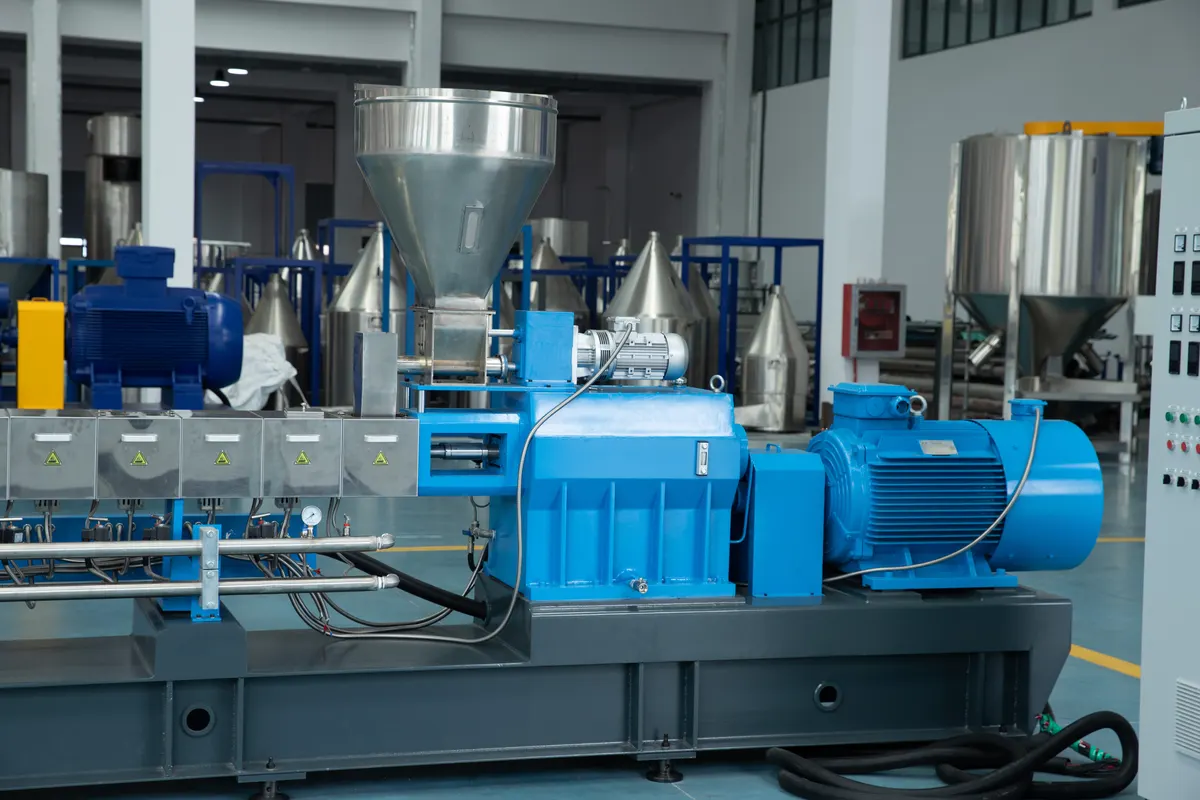
The line, stage by stage
| Stage | Equipment | Job | Settings |
|---|---|---|---|
| 0 | High-speed mixer 300–500 L | Pre-activate powder | 110–120°C, aluminum coupling agent 0.8–1.5%, 10–15 min |
| 1 | KTE-65 twin screw (L/D 40–44) | Melt carrier, disperse filler | Zone 1 at 80–120°C (anti-bridging), melting zones 190–230°C, speed ~325 rpm |
| 2 | SE-150 single screw (0–120 rpm) | Pressurize die, low shear | L/D 7–20, gentle build-up |
| 3 | Pelletizing | Cut | Filling 82–90% → air-cooling hot-face; 30–82% → water-ring |
Output by stage-1 machine: KTE/SE-50B/120 100–350 kg/h · 65B/150 200–500 · 75B/180 400–800 · 95B/200 700–1,500 kg/h.
Why not one bigger twin screw?
At 85–90% mineral content the melt is abrasive slurry with the viscosity of putty. A single twin screw must compress this through a screen pack and die — the back pressure pushes melt back into the mixing zones, fill factor collapses, output drops. The single-screw stage builds pressure slowly at 0–120 rpm with almost no shear, so the abrasive melt never sees high shear twice.
Non-negotiable hardware
- Bimetallic barrel liners (α101 C-type) — CaCO₃ is an abrasive; liners convert a barrel replacement into a liner replacement
- Loss-in-weight feeding — filler recipes live and die by dosage accuracy (±0.5%)
- W6Mo5Cr4V2 screw elements; D-class gearbox for this torque load
Formulation skeleton (typical published practice)
| Component | Range | Role |
|---|---|---|
| CaCO₃ (800–1250 mesh, moisture <0.3%) | 70–85% | Cost & stiffness |
| Carrier (PP powder / LLDPE, MFR slightly above end resin) | 12–25% | Binding |
| Aluminum/titanate coupling agent | 0.8–1.5% | Interface |
| PE wax + stearates | 3–5% | Dispersion & lubrication |
Customer economics: compare finished-product cost, not masterbatch unit price — a higher-priced nano-CaCO₃ masterbatch dosed at 20% beats a cheap masterbatch dosed at 8% on final cost per ton of bags.
Line setup that delivers this formulation
| Stage | Specification | Duty |
|---|---|---|
| Twin screw | KTE-65B, 44:1 | Melt, activate, disperse at 300–450 rpm |
| Transfer | Vacuum or gravity, 20–30 mm melt seal | Isolate the stages |
| Single screw | SE-150, 90–120 rpm | Build 60–120 bar die pressure slowly |
| Pelletizing | Air-cooled strand + gantry | 3×3 mm, low dust |
| Mixer | SHR-300A high-speed | Coupling activation at 110–120°C |
What this line costs
The 65 mm two-stage black masterbatch line at USD 66,600 (2024) is the closest commercial reference; a CaCO₃ two-stage with a high-speed mixer and air-cooled strand lands 5–10% above that, around USD 70,000–75,000. Per kg/h at 300–500 kg/h that is USD 140–250. The mixer is USD 8,000–12,000 of that and is where the quality actually comes from — a two-stage line with a bad mixer produces bad masterbatch faster.
Trials before production
- Verify the transfer holds vacuum for 10 minutes with the machine stopped; leaks appear only under load.
- Run the twin at three speeds and confirm the SE follows without pressure swings above 10 bar.
- Check the strand for internal voids at 85% loading — voids mean air is entering at the transfer.
- Measure output at the pelletizer, not at the twin; the two differ by 3–8% on a well-set line.
- Inspect the SE screw after 200 hours for wear at the compression zone; filler is abrasive there.
The failure this recipe is known for
Two-stage lines fail at the transfer, and they fail intermittently — which is worse. A marginal melt seal holds at 300 kg/h and breaks at 450 kg/h, so the line runs clean all week and then produces a batch full of voids on the day the customer audits. Size the seal at 1.5× your maximum rate, and test it at maximum rate, not at the rate you like to run.
FAQ
Can I run 85% CaCO₃ on a single twin screw?
Only with a D-class box and a short die, and output drops sharply. The two-stage exists because dispersion and pressurization compete for the same shaft.
Does the single screw need a vent?
Usually not — the twin has already devolatilized. Adding one costs money and creates a leak path.
What die pressure should I target?
60–120 bar at the SE discharge for strand pelletizing. Higher pressure raises melt temperature and voids the strand.
Why does the two-stage line consume more power per tonne?
It runs two drives. On 85% filler the extra kWh is offset by higher output; below 70% loading it is pure loss.
Can I run the SE faster to keep up?
Only to a point. Above about 120 rpm the single screw shears the melt and the strand loses strength; increase the twin output, not the SE speed. ## What these numbers do not settle
The crossover at 85% is an average across fillers and frames. On a 50 mm frame it arrives nearer 80%; on a 95 mm D-class frame it can sit at 88%. The number also assumes a coated filler with a sane size distribution. Treat 85% as the planning figure and confirm it on your frame.
Bottom line: below 85% loading, a single D-class frame with a 44:1 barrel is cheaper to buy, cheaper to run and easier to keep clean. The second shaft earns its place only when dispersion and pressure genuinely cannot share one screw — and that is a number you can measure before you buy.
Where these numbers come from
Figures in this page are drawn from patent-set process statistics, commissioning records, cross-checked against delivered-line commissioning records. They are typical published practice — run trials on your own material before fixing production settings.
80% CaCO₃ Masterbatch Line — the short version
Related on this site: Filler formulation structure · Two-stage extruder · First zone temperature
Bottom line. A filler masterbatch above 80% CaCO₃ is the classic two-stage application: one co-rotating twin screw to melt, activate-load and disperse the mineral, one slow single screw to build die pressure — because above ~85% filling, dispersion and pressurization fight for the same shaft on a single machine. Start from the reference ranges, then verify on your own line material before locking the recipe — our lab returns pellets, video and a parameter report in 3–7 days.