
Selection guide · 5 min read
Lab Twin Screw Extruder: What to Check Before You Buy
A lab twin screw earns its keep only if its data transfers to your production machine.
This page collects our floor notes on Lab Twin Screw Extruder: how the line is laid out, the numbers we reference most, and the checks that prevent the usual startup problems.
Short answer: A lab twin screw earns its keep only if its data transfers to your production machine. The checklist below is what separates a useful R&D tool from an expensive toy. Kerke lab frames: KTE-16 (Φ15.6 mm, 500 rpm, 1–5 kg/h), KTE-20B (Φ21.7 mm, 2–15 kg/h), KTE-25D (Φ26 mm, 5–20 kg/h).
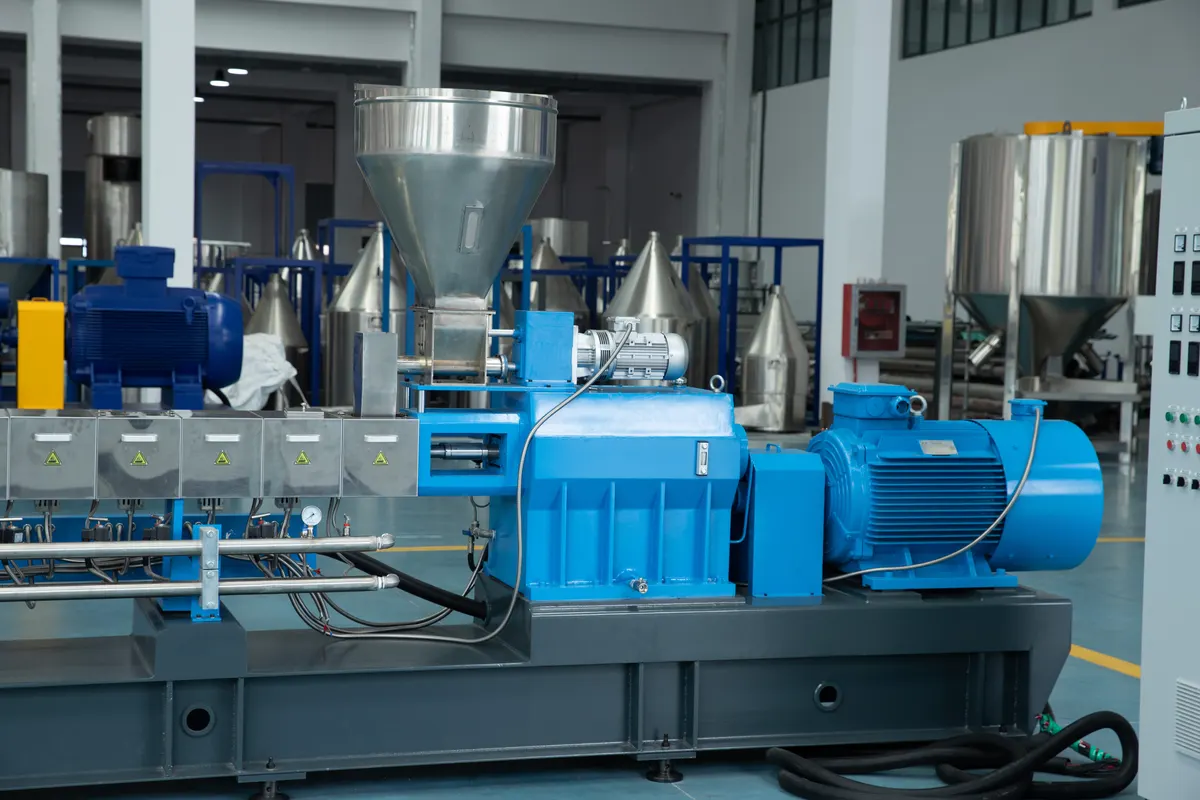
The six checks
| # | Check | Why it matters | What good looks like |
|---|---|---|---|
| 1 | Same element system as production | Screws are modular building blocks; lab results transfer only if elements match | Same naming scheme (e.g. 60°/4/32 kneading blocks), interchangeable geometry ratios |
| 2 | Real torque, not toy torque | KTE-20B: 2×30 N·m; KTE-25D: 2×85 N·m — enough to run 60%+ filler trials truthfully | Rated torque quoted, gearbox class stated |
| 3 | Loss-in-weight feeding | Volumetric feeding at 2–15 kg/h destroys recipe accuracy | Gravimetric feeder, ±0.5% |
| 4 | Multiple feed ports + side feeder option | You must replicate side-feeding of fiber/filler | Side feeder port on barrel section 4+ |
| 5 | Vacuum venting | Devolatilization behavior is process-critical | Water-ring vacuum pump, vent port with melt seal |
| 6 | Interchangeable die + pelletizer | Strand, water-ring and die-face trials need different heads | Quick-change die head |
The transfer problem (the one that kills credibility)
A lab machine at 500 rpm with L/D 40 produces a melt history that a production KTE-65D at 800 rpm will not repeat unless you scale by specific energy input (kW·h/kg) and residence time, not by rpm. When you run a trial, record: screw speed, feed rate, melt temperature per zone, motor load %, vacuum level. Those five numbers are what you take to the production line — not "it looked good."
Typical lab workload
- Formulation screening: 5–15 kg/h for 2–3 h per recipe, 10–30 kg total material
- Color matching: 1–5 kg batches on KTE-16
- Filler activation studies: KTE-25D with side feeder, 2×85 N·m torque runs 80% CaCO₃ realistically
What buyers regret
- Buying the cheapest lab unit without side feeding, then discovering fiber/filler work is impossible
- No gravimetric feeder — every "successful" trial rerun gives different numbers
- L/D too short (fixed 32) — no room for vent + side feed + mixing zones simultaneously
Frame selection by what you need to prove
| Purpose | Frame | Output | Drive | Minimum accessory |
|---|---|---|---|---|
| Formulation screening | KTE-16 (Φ15.6) | 1–5 kg/h | 2.2 kW | Loss-in-weight feeder, strand pelletizer |
| Color and additive trials | KTE-20B (Φ21.7) | 2–15 kg/h | 4 kW | Gravimetric feeder, vacuum vent |
| Pilot / small production | KTE-25D (Φ26) | 5–20 kg/h | 7.5–11 kW | Side feeder, water bath, pelletizer |
The most common buying error is a lab frame too small to reproduce production shear. Below 20 mm diameter, channel depth and screw speed produce a shear history that a 65 mm production machine cannot repeat. If the goal is scale-up data, 25–36 mm is the honest minimum.
What a lab line costs
A 20–25 mm lab line with feeder, water bath, strand pelletizer and controls runs in the USD 25,000–45,000 band in 2024 terms; the machine itself is roughly half of that. The accessories decide whether the data is usable, so budget them first and pick the frame with what remains. A 16 mm machine with a good gravimetric feeder beats a 25 mm machine with a volumetric one.
What to verify before you buy
- L/D range, not just L/D. You need 28–48 interchangeable to model different production machines.
- Torque density. A lab frame with a weak gearbox cannot reproduce high-filler conditions.
- Barrel opening count. At least two, so you can move the vent and add a side feed later.
- Data logging. Torque, melt pressure and melt temperature at 1 Hz minimum — without these, scale-up is guesswork.
- Sample size per trial. Ask how many kilos a design-of-experiment run consumes; below 2 kg per point, screening gets expensive in labour.
What to send with your enquiry
- What the trials must prove: formulation ranking, scale-up data, or customer samples.
- The smallest batch you can afford to consume per trial point.
- Which production frame the data must transfer to; the lab frame should be within two sizes of it.
- Whether you need water-strand, underwater or a strand die only.
- Available lab space, power and ventilation, including fume extraction for degraded polymers.
Bottom line
A lab extruder is a data instrument, not a small production machine. Buy the smallest frame that reproduces production shear, spend the remaining budget on gravimetric feeding and logging, and treat 25–36 mm as the honest minimum for scale-up work. Anything smaller is a formulation blender.
One field case worth knowing
A university bought a 16 mm lab line and could not reproduce a customer's 65 mm production defect. Shear rate at the same screw speed was 2.4× higher, so the formulation degraded in the lab and looked fine in production. Adding a 25 mm frame solved it, at 40% of the original budget. If the question is "will this work on my production machine", the lab frame must be geometrically close enough to answer it.
FAQ
Can a 16 mm machine predict production behaviour?
For formulation ranking, yes. For shear-sensitive or fiber-containing systems, no — the geometry is too different. Use 25 mm and above for anything you intend to scale.
Do I need a water bath or underwater pelletizing on a lab line?
Strand and water bath is standard and cheaper. Underwater only if pellet shape is the subject of the trial.
How much floor space does a lab line need?
Roughly 4 × 2 m including the water bath and pelletizer, plus 1 m clear at the die end for sample collection.
Is a used lab extruder a good idea?
Only with a barrel inspection. Lab machines often run aggressive formulations at high temperature, and screw/barrel clearance is the first thing to go.
Should the lab machine have the same L/D as production?
Same or longer. A shorter lab barrel cannot model a production venting section, which is where most scale-up surprises come from.
Where these numbers come from
Figures in this page are drawn from KTE parameter tables, shaft design notes, cross-checked against delivered-line commissioning records. They are typical published practice — run trials on your own material before fixing production settings.
Lab Twin Screw Extruder — the short version
Related on this site: Specific torque · Loss-in-weight calibration · Screw elements
Bottom line. A lab twin screw earns its keep only if its data transfers to your production machine. Ranges here come from our floor notes and typical published practice — they set the design direction, not your setpoints. Send 25–50 kg and we return pellets, a running video and a capacity report to confirm against your targets.