
Application · 8 min read
80–90% CaCO₃ Masterbatch: The Line Layout That Actually Runs It
High-filling masterbatch is won or lost at three stations: powder activation, the mixing architecture, and pelletising. This page gives the layout we quote for 85–90% loading, the 350–600 kg/h reference band, and the three failure points that separate a line that runs from one that disappoints.
Short answer: at 85–90% filling the standard answer is a two-stage line (twin screw for mixing, slow single screw for pressure build) — reference band 350–600 kg/h on KTE/SE-65/150 — fed by activated powder from a 110–120°C high-shear premix and pelletised by air-cooling hot-face or water-ring cutting. A single twin screw can run it, but pays 30–40% of its output for the privilege, and the gap widens as loading rises.
Why the architecture changes at 85%
Below roughly 60% filler, a single twin screw mixes and pumps without strain. Between 60–80% it still works, with tighter screw configuration and watchful melt temperature. Beyond 85%, the melt is so loaded that mixing (which wants low speed, deep flights) and die pressure (which wants pumping authority) fight for the same shaft — output collapses and melt temperature climbs. The two-stage splits the jobs: the twin screw mixes at its own speed with no die, and the slow single screw (0–120 rpm) builds pressure with minimal shear. Same total length, two shafts, no compromise.
The line layout, station by station
| Station | Specification | Why |
|---|---|---|
| 1. Premix / activation | High-shear mixer (300–500 L), 110–120°C, coupling agent in 1–2 portions | Unactivated powder never reaches loading targets |
| 2. Main feed | Loss-in-weight feeder, ±0.5% | Recipe honesty at high loading; bridging control |
| 3. Twin screw stage | KTE-65 class, L/D 40–44, 45° kneading bias, bimetallic liners | Melt and disperse without die pressure |
| 4. Vent | −0.06 MPa tier between stages | Activated powder carries air; strands must not foam |
| 5. Single screw stage | SE-150 class, 0–120 rpm | Pressure build at minimum shear |
| 6. Pelletising | Air-cooling hot-face or water-ring | Hot-face for the highest loadings; water-ring for throughput |
Reference outputs on this layout: KTE/SE-50/120 → 100–350 kg/h; KTE/SE-65/150 → 350–600 kg/h; KTE/SE-75/180 → 400–800 kg/h. Powder fineness is typically 800–1250 mesh; moisture below 0.3%.
Activation: the step people skip
Coupling-agent activation is where 85% lines succeed or fail. Unactivated CaCO₃ is sand: it will not wet into the carrier, dispersion shows as specks, and the masterbatch dilutes brittle in the customer's film. The working procedure: heat the powder in the high-shear mixer to 110–120°C, add the coupling agent (aluminate class, 0.8–1.5% of masterbatch weight) in one or two portions, hold 10–15 minutes, discharge hot. Activation quality is visible immediately — activated powder flows and wets; the difference shows in the first trial dilution.
Wear budgeting: plan for it, do not fear it
CaCO₃ is abrasive, full stop. The honest plan: bimetallic barrel liners from day one (replaceable liners, not whole barrels), M2-class elements with a spare set for the two high-wear sections (melting and first mixing), and wear inspection at every planned stop. Liner life on an 85% loading line runs in years, not months, when the elements are the sacrificial part — that is the design intent. The expensive failure mode is running hardened-carbide-cheap elements to destruction and scoring the shafts.
FAQ
Can a single twin screw really not run 85% CaCO₃?
It can run it; the question is at what output. Expect 30–40% below the two-stage's band at the same melt temperature, worsening as loading rises past 85%. For dedicated high-filling production, the two-stage is the standard answer.
What output does a 65-class two-stage achieve at 85–90% loading?
350–600 kg/h on the KTE/SE-65/150 reference layout, with activated powder, one vent and air-cooling hot-face or water-ring pelletising.
Which pelletising method suits 85% masterbatch?
Air-cooling hot-face for the highest loadings and the most regular pellet shape; water-ring when throughput matters more. Water strand cutting works below ~50% loading but shows strand breakage at high filling — the melt is too stiff.
How often do wear parts need replacement at 85% loading?
Elements in the melting and first mixing sections are the sacrificial parts — inspect at planned stops and keep one spare set. Bimetallic liners run for years when the elements do their job. The design intent is that elements wear, liners survive.
What powder spec should I buy?
Heavy CaCO₃ at 800–1250 mesh, purity ≥95%, moisture <0.3%. Finer powder disperses better but costs more and carries more air — the vent tier handles it. Moisture over spec shows up first as strand porosity.
Where these numbers come from
The layout and output bands come from delivered 85–90% CaCO₃ lines across the KTE/SE range; activation procedure follows published practice and our commissioning records. We run trials on your powder before quoting — send 25–50 kg of filler and the carrier, and the trial returns the loading ceiling and the output band for your material, not a catalogue estimate.
85% CaCO₃ — the short version
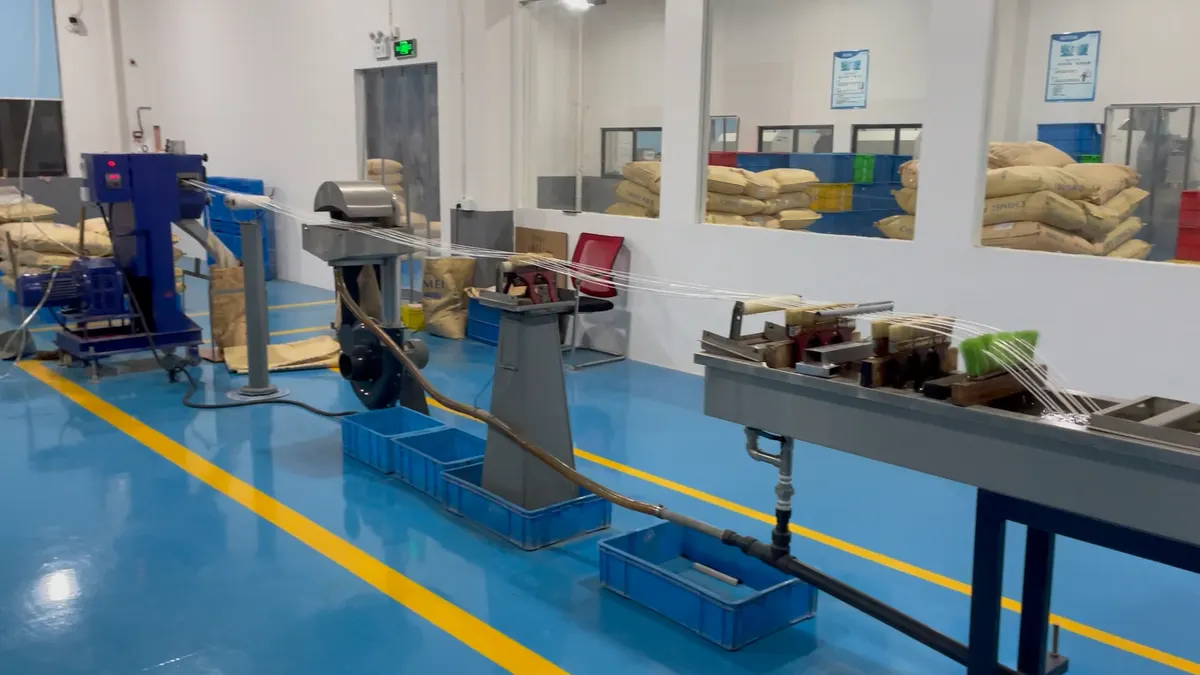
Three stations decide the line: activation (never skip), the two-stage architecture (the physics answer), and hot-face/water-ring pelletising. Wear parts are a budget, not a surprise.
Related on this site: when the two-stage is required · activation procedure · formulation skeleton · send your powder for a trial